

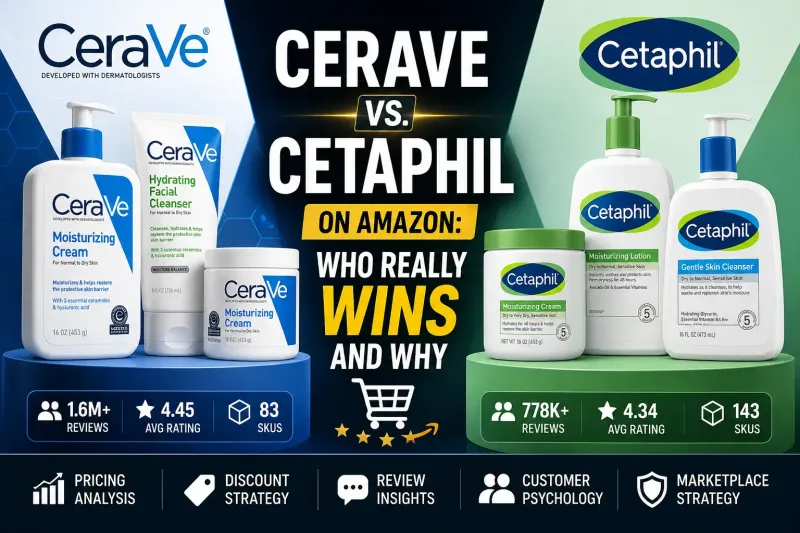
Why CeraVe and Cetaphil Dominate Amazon Skincare
The skincare aisle on Amazon is not a level playing field. Two brands - CeraVe and Cetaphil - have carved out a permanent duopoly in the dermatologist-recommended segment, and their dominance is built on data-driven marketplace strategies that go far deeper than good formulations.
This analysis breaks down how both brands position, price, discount, and emotionally connect with customers - using 226 active products and over 2.3 million real customer reviews as the raw material.
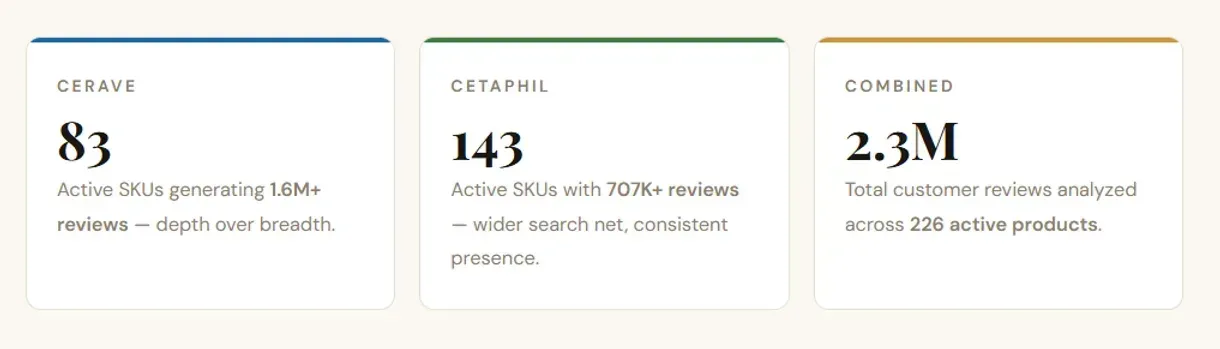
This analysis draws on our deep dives into each brand individually: Cetaphil on Amazon 2026 (143 products, 707K reviews) and CeraVe on Amazon 2026 (83 products, 1.6M reviews).
Market Overview: Two Giants, Two Marketplace Strategies
Both brands serve the same core demographic - people with sensitive skin, parents, and those seeking clinically reliable skincare. Yet their Amazon architectures are built on fundamentally different philosophies.
SKU Strategy: Depth vs. Breadth
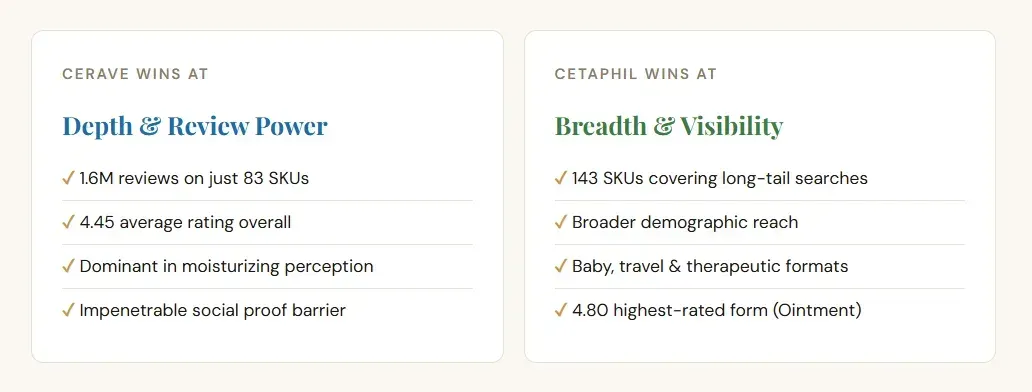
On Amazon, SKU count correlates directly with search visibility. More products means more impressions, more search query coverage, more opportunities to capture a sale. But CeraVe's performance proves that raw SKU count isn't the only path to dominance.
Lotion and Cream categories dominate both catalogs: 53% of CeraVe's catalog and 49.7% of Cetaphil's are in these two moisturizer formats. Both brands agree that moisturization is the primary purchase driver — they just pursue dominance differently.
- Liquid formats (CeraVe: 11 SKUs, Cetaphil: 17 SKUs) form a meaningful secondary tier — pump-format cleansers and targeted treatments bridging skincare and body care.
- Gel formats (CeraVe: 10 SKUs, Cetaphil: 11 SKUs) serve oily and combination skin customers who demand lightweight, non-greasy solutions.
- Specialty formats diverge sharply: CeraVe stays experimental (Serum, Oil, Patch, Paste) while Cetaphil extends into Wipes, Foam, Bar, and Drop formats for full lifecycle coverage including baby and travel.
Pricing Tier Analysis: How CeraVe and Cetaphil Position Products
How each brand distributes products across price tiers reveals their thinking about customer segments, from sensitive skin newcomers buying their first cleanser, to loyal customers investing in specialised treatments.
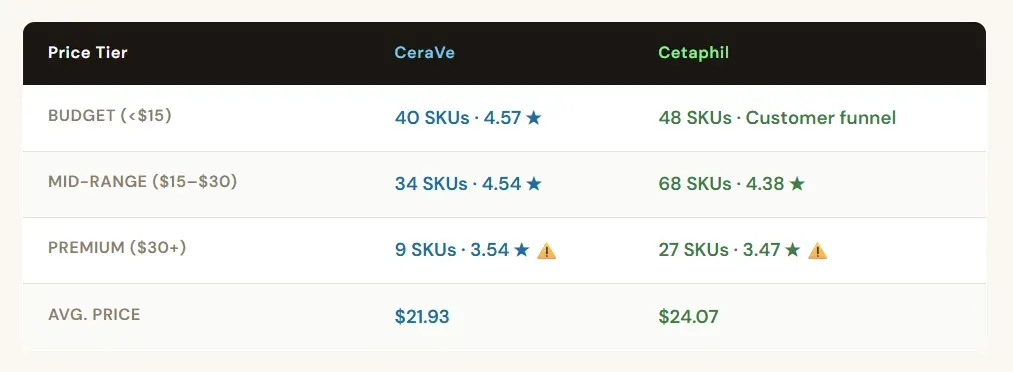
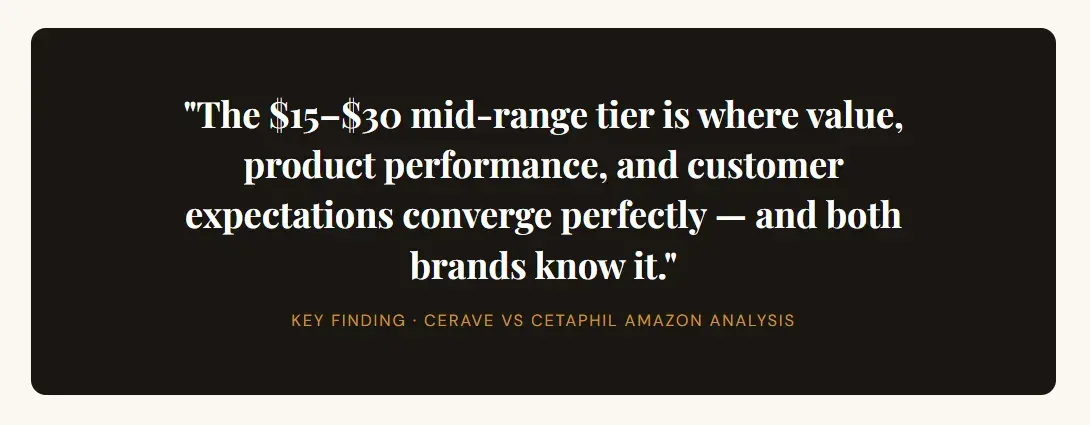
The premium tier ($30+) is a shared vulnerability. CeraVe products above $30 average a 3.54 rating; Cetaphil's average 3.47. Consumers view these clinical brands as accessible daily necessities, not luxury items — and the review data says so explicitly. Cetaphil's exposure is larger, with 27 premium SKUs averaging $53.34.
Discount Strategy: Who Discounts What and Why
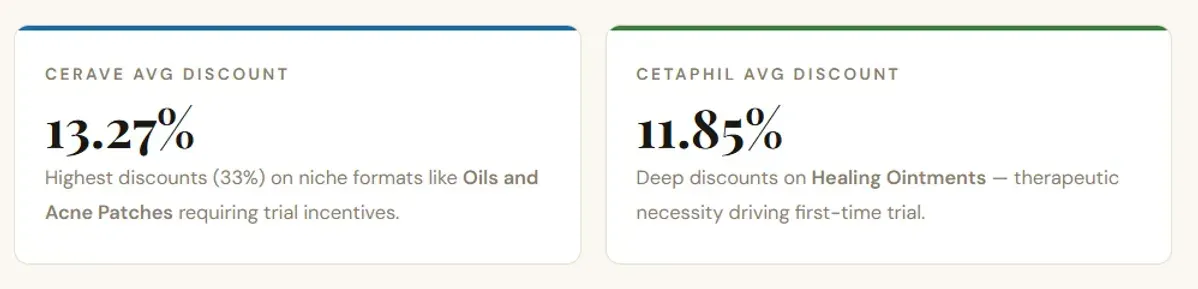
Discount behavior is one of the most honest strategic signals in e-commerce. It reveals which products a brand is actively pushing, where customer acquisition costs are high, and where established trust makes promotional spend unnecessary.
The Lotion Signal: Confidence in Full View
The most telling number in the entire discount analysis: CeraVe's Lotion carries only a 9.87% average discount; Cetaphil's Lotion only 9.54%. Their bestselling formats don't need promotional support. Brand reputation and repeat purchase habits drive volume without discounting.
Review Concentration & Customer Loyalty
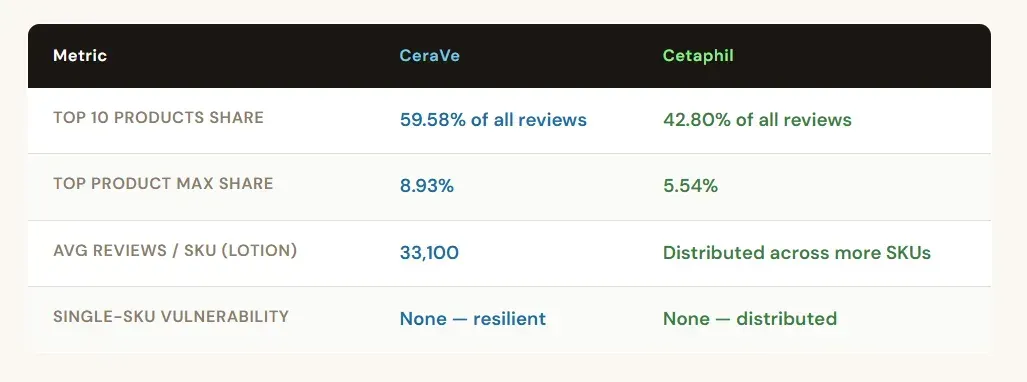
Understanding how each brand's total reviews are distributed across its catalog reveals whether success depends on a few hero products or a broader foundation of consistent performers. This distinction matters enormously for long-term marketplace resilience.
Customer Psychology: Why People Buy CeraVe vs Cetaphil
Star ratings tell us how satisfied customers are. Reviewing attribute data tells us why. The emotional triggers that convert browsers into buyers differ fundamentally between these two brands - and that gap is where smart strategy lives.
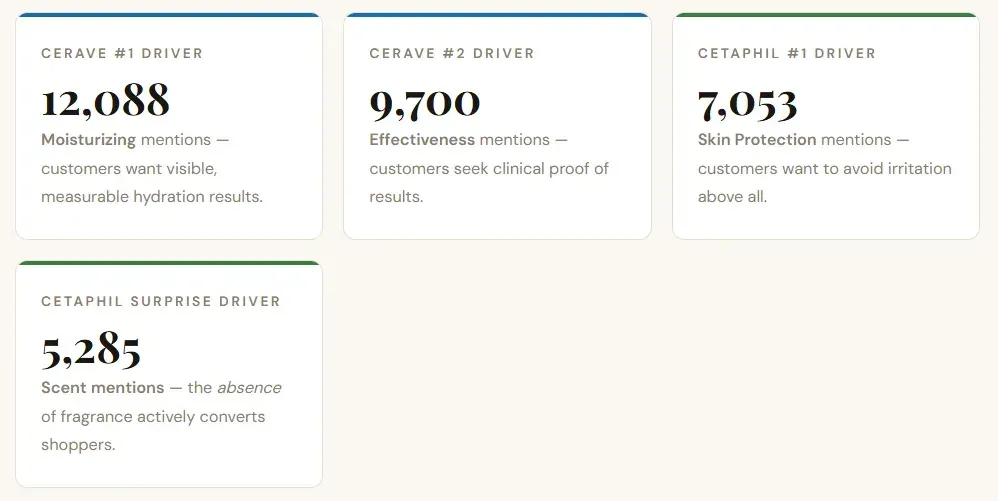
The customer journeys mapped by this data are distinct and telling:
- CeraVe's journey: Moisturizing attracts trial → Effectiveness drives loyalty → Value enables repeat purchase → Compatibility builds long-term trust.
- Cetaphil's journey: Protection attracts trial → Gentleness keeps customers → Softness delivers sensory confirmation → Value for money seals the repeat purchase.
For the full data behind each brand's strategy, explore the individual analyses: CeraVe on Amazon and Cetaphil on Amazon.
Final Verdict: Two Different Moats
CeraVe wins through clinical depth and concentrated power. By investing heavily in a smaller portfolio of Creams and Lotions, it has built an impenetrable wall of 1.6 million reviews. Its 4.45 average rating across 83 SKUs reflects a brand that consistently delivers on the promise of visible hydration.
Cetaphil wins through algorithmic breadth and safety positioning. Its 143 SKUs capture diverse long-tail searches that CeraVe's concentrated catalog can't reach. Its customers are deliberate, protective buyers managing sensitive skin - and fragrance-free formulation is a conversion trigger, not just a product feature.
Both brands share one clear vulnerability: the premium price tier. Consumers see these as accessible daily necessities. Any product pushing above $30 faces an uphill battle against that perception - and the review ratings prove it.
Connect with Datahut for top-notch web scraping services that bring you the information you need, hassle-free.

FAQ SECTION
1. Which is better on Amazon: CeraVe or Cetaphil?
- CeraVe performs better in engagement, with over 1.6M reviews and higher average ratings
- Cetaphil offers a wider product range, covering more niche and sensitive-skin needs
- CeraVe wins on effectiveness and customer trust signals
- Cetaphil wins on gentleness and safety-focused positioning
- The better choice depends on skin type and specific needs
2. Why is CeraVe more popular on Amazon than Cetaphil?
- Strong review concentration on top products
- Higher average ratings across fewer SKUs
- Focus on moisturization and visible results
- Better product-level dominance instead of catalog expansion
- Builds trust through consistent performance and social proof
3. Why do customers choose Cetaphil over CeraVe?
- Known for gentle, non-irritating formulations
- Preferred for sensitive and reactive skin types
- Strong association with fragrance-free skincare
- Wider product formats (wipes, bars, baby care)
- Focus on skin protection and comfort
4. Do discounts affect sales of CeraVe and Cetaphil on Amazon?
- Bestselling products from both brands have low discount dependency (~9–10%)
- Indicates strong brand trust and repeat purchase behavior
- Discounts are mainly used for:New product launchesLess popular SKUsCompetitive categories
- Core products sell well without heavy promotions
5. What is the biggest weakness of both CeraVe and Cetaphil?
- Both struggle in the premium price segment ($30+)
- Customers view them as daily essentials, not luxury skincare
- Higher-priced products receive:Lower ratingsReduced perceived value
- Indicates a clear pricing ceiling in consumer mindset


