
Olay vs. L'Oréal Paris on Amazon: Which Beauty Brand Really Wins?
- Aarathi J
- 11 hours ago
- 6 min read


In short, neither brand clearly comes out on top since they succeed in different ways. Olay does better in terms of price and in building customer loyalty based on the sensory experience of skincare, with an average price of $25.82 and reviews that focus on the scent and the softness of the skin. L'Oréal Paris, on the other hand, excels in terms of scale and consistency, with 4.3 times as many reviews (2.8 million compared to 651 thousand), a much broader range of 27 products, and a more tightly grouped set of ratings. Although both have the same average rating of 4.44, they achieve this result by following completely different strategies: Olay by concentrating on premium-mid-range skincare, and L'Oréal by offering a wide range of products across skincare, haircare, and makeup.
Olay vs. L'Oréal Paris on Amazon analysis is based completely on structured Amazon catalog and review data obtained by Datahut - the same underlying datasets that are used in our individual breakdowns of the Olay and L'Oréal Paris brands. The questions that a marketer, a category manager, or a member of a competitor-research team would actually ask when comparing the two are set out below.
Olay vs. L'Oréal Paris on Amazon: What Is This Comparison Based On?
The comparison is based on data from the Amazon US catalog for both brands, including information on active product listings, prices, discount percentages, star ratings, the number of reviews, and analysis of review text to identify factors that led to purchases. The dataset for Olay includes 266 active products in 14 different product forms, while that for L'Oréal Paris includes 300 active products in 27 product forms. The same methodology was applied in carrying out both analyses, and this common methodology enables the comparison to be direct rather than comparing apples to oranges.
How Do Olay and L'Oréal Paris Compare in Catalog Size?
L'Oréal Paris runs a broader, more fragmented catalog. Olay runs a narrower, more concentrated one.
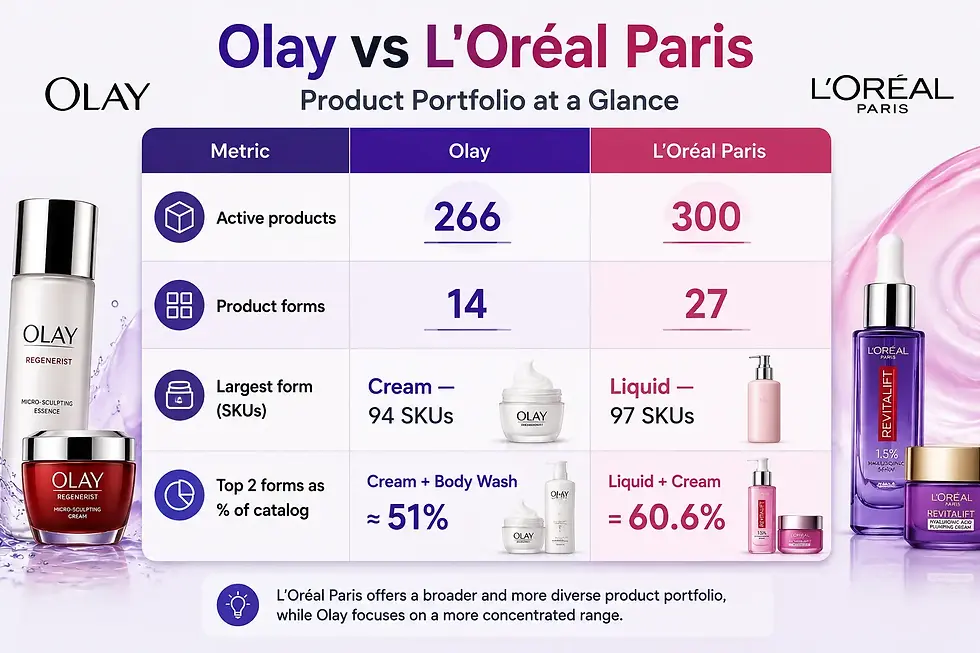
L'Oréal's 27 product lines include those for the skin, hair, and color cosmetics - the reason for the brand's existence is so that it will have a product available for almost every beauty-related search on Amazon. Olay remains focused within the field of skincare and personal care, with nearly half of its range devoted just to Cream and Body Wash. When the question is which brand covers more search intent, L'Oréal comes out on top in terms of range. But when the question is which brand goes the deepest into one category, Olay is the winner in terms of depth.
Which Brand Has More Reviews, and Why Does That Matter?
L'Oréal has around 4.3 times as many reviews as Olay -2,824,778 as compared to 651,038, even though its catalog is only about 13% bigger when measured by the number of SKUs.
Review volume serves as a rough estimate of purchase volume and market reach. The review base for L'Oréal is due to its extensive distribution of colour cosmetics and haircare products, categories in which Olay does not compete - along with high-frequency categories such as Liquid (with 851,000 or more reviews across 97 SKUs) and Cream (with 728,000 or more reviews across 85 SKUs). Nearly all of Olay's review base is concentrated in a single format: Cream alone makes up 363,514 reviews, which is 55% of all the reviews the brand has gathered.
A category analyst can conclude from this that Olay's growth is limited by the breadth of the category since it has already reached the limits of its influence in the "Cream" segment, and that L'Oréal's growth is hindered by its performance across a large number of smaller formats, each of which has its own set of competitive dynamics.
How Do Their Pricing Strategies Differ?
Olay sits in premium-mid skincare pricing at $25.82 average. L'Oréal Paris sits in mass-market pricing at $15.41 average - roughly 40% cheaper.

It is interesting that the same $15 to $30 mid-range segment is the one in which shoppers in the beauty sector report the highest level of satisfaction in relation to the price they pay for both brands. However, the two brands differ at the top end: in Olay's premium range (products priced at $30 and above) the ratings fall to 4.29, indicating that consumers compare more expensive Olay products with those of luxury brands. In contrast, L'Oréal's premium range maintains a score of 4.42, which is close to the average across its range - this is what Datahut's analysis describes as a "masstige" positioning that does not break down at higher price levels.
Which Brand Discounts More Aggressively and Why?
L'Oréal discounts significantly harder - 15.23% average versus Olay's 9.44% - but both brands use discounting surgically, not as a blanket strategy.

The two brands adopt the same basic approach: they maintain their profits on the SKUs that are already successful and use discounts to gain trial in those categories where they are still building up their market share. Olay applies the largest discounts to its Serums since it is putting money into this higher-margin but more competitive area. With respect to L'Oréal, it is giving the biggest discounts on Masks (55%) and Kits (36%) because these products are low-commitment entry points intended for attracting new customers into the wider range of products - a strategy that Datahut's analysis refers to as the "gateway product" formula. The extent of L'Oréal's discounting (with some items being as high as 55%) is in line with the overall range of its product offerings, since it has more "gateway" categories to introduce customers to than Olay does.
Which Brand Is More Resilient to Losing a Bestseller?
Both brands are unusually well-distributed - no single product dominates either portfolio but L'Oréal is marginally more resilient.

Compared with the review concentration observed in many consumer-product portfolios, both Olay and L'Oréal show unusually distributed review volume, indicating that the disappearance of one or two of its key products would indeed represent a real business risk. This is not the case with either Olay or L'Oréal; both of them spread about three-quarters of their review volume over 250 or more other products and are therefore not vulnerable to any single product failing. It is a genuinely rare feature at this level of product range, and it is probably the most significant similarity between the two brands.
What Actually Drives Purchase Decisions for Each Brand?
In short, customers who shop at Olay base their purchases on sensory and functional trust; this includes scent, quality, and skin softness, while those who shop at L'Oréal buy primarily for visible results at first, supported by the product's effectiveness.

The most distinct difference in strategy between the two brands is this: Olay is offering a promise that is both sensory and functional, focusing on how the product feels and performs on the skin, and doing so at a price point that matches that of top-end alternatives. In contrast, L'Oréal starts by promoting a visible change (such as hair color or cosmetics), with product effectiveness and quality serving as the supporting evidence. The two types of strategic approach are not transferable between the brands' main product areas, which is why they can both exist in the same market without one eating into the other.
Which Brand Should You Benchmark Against?
This depends on what you're trying to learn:
Benchmarking a premium-adjacent skincare brand? Use Olay. Its pricing discipline, mid-tier sweet spot, and sensory-driven review language are the more relevant comparison set.
Benchmarking a mass-market, multi-category beauty brand? Use L'Oréal Paris. Its catalog breadth, tiered discount strategy, and consistency-at-scale (a 0.16-point ratings spread across 27 product forms) are the harder benchmark to hit and the more instructive one if your brand also spans skincare, haircare, and cosmetics.
Studying portfolio resilience? Either brand is a strong reference both keep top-10 concentration under 26% of total reviews, a genuinely uncommon result worth modeling regardless of category.
Turn Comparisons Like This Into a Repeatable Process
This analysis took two structured Amazon datasets and a shared methodology to produce. If you're tracking competitors across a category - not just one brand at a time ; the real value comes from doing this continuously: fresh pricing, fresh discount data, fresh review-driver mining, refreshed on a schedule instead of a one-time pull.
Datahut builds exactly this kind of structured, automatically refreshed marketplace data for teams doing competitive and category benchmarking. If you want a similar side-by-side built for your own category, request a free data audit or talk to a Datahut strategist about ongoing category monitoring.
Frequently Asked Questions
Is Olay or L'Oréal Paris rated higher on Amazon?
They're effectively tied - both average 4.44 out of 5.0. Olay's rating varies more by product form (a 0.46-point spread), while L'Oréal's is more consistent (a 0.16-point spread across 27 forms).
Which brand is cheaper on average?
L'Oréal Paris, at $15.41 average versus Olay's $25.82 , roughly 40% less expensive per product.
Which brand has more Amazon reviews?
L'Oréal Paris, with 2,824,778 reviews compared to Olay's 651,038 - about 4.3x more, driven by its wider catalog spanning color cosmetics and haircare in addition to skincare.
Does either brand rely too heavily on one hero product?
No. Olay's top 10 products account for 25.32% of all reviews; L'Oréal's top 10 account for 24.09%. Both are unusually well-distributed compared to typical consumer brands, where a handful of SKUs often drive the majority of engagement.
What price tier performs best for both brands?
The $15–$30 mid-range tier is the strongest for both - Olay rates 4.51 there and L'Oréal rates 4.48. It's the one place both brands' data agrees almost exactly.
Which brand discounts more?
L'Oréal Paris, at a 15.23% average discount versus Olay's 9.44%. L'Oréal also uses much deeper discounts on specific categories (up to 55% on Masks) to drive trial in niche formats.


