

Introduction : GDPR Fines of 2025
Yes, it’s over — the era of unchecked data collection, silent tracking, and unaccountable digital practices. The General Data Protection Regulation (GDPR) ended it for good, redefining how organizations collect, process, and protect the personal data of European Union citizens.
A decade ago, user information was traded, tracked, and monetized with little scrutiny; privacy was an afterthought, not a business priority. That changed in 2018 with the enforcement of GDPR — now recognized as the world’s most comprehensive and consequential data privacy framework.
There’s a saying in tech — “what you don’t track, you can’t improve.” But what happens when you track too much? A company eager to “understand its users” collects every click and scroll — the intent was insight, the outcome was investigation. GDPR reframed that idea, shifting focus from what data can do to what it should do.
And if you’re still wondering what exactly the General Data Protection Regulation (GDPR) is — it’s the European Union’s landmark privacy law giving individuals control over their personal data while holding organizations accountable for how it’s collected, used, and shared.For a deeper understanding, explore DataHut’s in-depth guide on GDPR compliance and how to prepare for it.
Since GDPR enforcement began, one truth stands firm — data protection isn’t optional. Record fines show that compliance drives trust and resilience. To support ethical data collection, DataHut’s guide to transparent web scraping offers a clear path to compliance.
This article reviews the top10 GDPR fines (2021–2024) and the lessons shaping data protection in 2025.
- Why Was Meta (Facebook) Fined €1.2 Billion Under GDPR in 2023?
In 2023, Meta was issued a €1.2 billion fine by the Irish Data Protection Commission (DPC). The DPC found that users’ personal data from Facebook was transferred to external servers without adequate safeguards, violating GDPR requirements on international data transfers. The record-breaking penalty followed a binding decision by the European Data Protection Board (EDPB). ➡️ GDPR Articles: 44–49 — Rules governing cross-border data transfers.
Key Takeaway:
Cross-border data transfers remain one of the most complex compliance challenges under GDPR. Organizations must implement enforceable safeguards and conduct continuous risk assessments when moving personal data outside the EU.
- What Led to Amazon’s €746 Million GDPR Fine in 2021?
Following Meta’s penalty ,In 2021, Amazon was issued a €746 million fine by Luxembourg’s Commission Nationale pour la Protection des Données (CNPD). The CNPD found that customer data was processed for targeted advertising without valid consent, violating GDPR principles of lawfulness and transparency. ➡️ GDPR Articles: 5(1)(a) and 6 — Fairness, transparency, and lawful processing.
Key Takeaway:
Clear and informed consent is essential for lawful data use. Even slight ambiguity in advertising practices can invite regulatory penalties.
- How Did Instagram’s Public Data Settings Result in a €405 Million Fine?
Soon, regulators turned their attention to social platforms. In 2022, Instagram was issued a €405 million fine by the Irish Data Protection Commission (DPC). The DPC found that minors’ contact details were exposed through public business profiles and default visibility settings, violating GDPR requirements for the protection of children’s personal data. ➡️ GDPR Article: 6(1) — Lawfulness of processing (children’s data).
Key Takeaway: Child data protection demands proactive design controls. Platforms targeting or accessible to minors must enforce strict default privacy settings and minimize public exposure.
- Why Did Meta Face a €390 Million Penalty for Ad Consent Violations?
In 2023, Meta was issued a €390 million fine by the Irish Data Protection Commission (DPC). The DPC found that users were required to accept personalized advertisements to access Facebook and Instagram, violating GDPR principles regarding the lawful processing of personal data. The decision followed a binding determination by the European Data Protection Board (EDPB). ➡️ GDPR Article: 6(1) — Lawfulness of processing (invalid consent).
Key Takeaway:
Under GDPR, access cannot depend on ad consent. Users must have real freedom to opt out without losing service functionality.
- How Did TikTok Breach GDPR Rules on Teen Privacy?
The same year, TikTok was issued a €345 million fine by the Irish Data Protection Commission (DPC). The DPC found that TikTok set teen user accounts to public by default, allowing anyone to view or comment on their content, violating GDPR principles of data protection by design, by default, and data minimization. ➡️ GDPR Articles: 8 and 25 — Child consent and privacy by design and default.
Key Takeaway:
Integrating privacy early in design prevents bigger risks later. Regulators expect protection by design, not post-launch corrections.
- Why Was LinkedIn Fined €310 Million by the Irish DPC in 2024?
As regulators deepened their focus on ad targeting, LinkedIn was issued a €310 million fine by the Irish Data Protection Commission (DPC). The DPC found that LinkedIn processed user data for targeted advertising without valid consent, violating GDPR requirements for lawful processing of personal data. ➡️ GDPR Article: 6(1)(a) — Lawfulness of processing based on cookie consent. 🔗 Irish DPC Press Release – LinkedIn Ireland Fine
Key Takeaway:
Personalized advertising must be built on clear user consent. Without a legitimate basis, behavioral targeting erodes trust and invites regulatory risk.
- What GDPR Violations Led Uber to a €290 Million Fine?
As scrutiny expanded to cross-border platforms in 2024, Uber was issued a €290 million fine by the Dutch Data Protection Authority (DPA). The DPA found that Uber transferred EU users’ personal data to U.S. servers without adequate safeguards, violating GDPR Data Sharing provisions governing international data transfers. ➡️ GDPR Articles: 44–49 — International data transfer provisions.
Key Takeaway:
The enforcement underscored that contractual assurances are insufficient on their own. Robust technical and procedural measures are essential to meet GDPR adequacy requirements for data transfers.
- How Did Meta’s Data Scraping Incident Lead to a €265 Million Fine?
In 2022, Meta was issued a €265 million fine by the Irish Data Protection Commission (DPC). The DPC found that personal data of over 500 million Facebook users was scraped and published online due to insufficient security and privacy safeguards, violating GDPR privacy policy principles of integrity and confidentiality. ➡️ GDPR Articles: 25 and 5(1)(f) — Privacy by design and integrity/confidentiality of processing.
Key Takeaway: This decision underscored that weak technical controls leading to mass data exposure are considered governance failures under GDPR’s security and integrity obligations.
- Why Was Meta Penalized €251 Million for Data Protection Failures?
In 2024, Meta was among the notable cases in GDPR enforcement fines, receiving a €251 million penalty from the Irish Data Protection Commission (DPC).The DPC found that Meta failed to implement adequate data protection measures at a system level, violating GDPR requirements for data protection by design and by default. ➡️ GDPR Article: 25 — Data protection by design and default.
Key Takeaway:
Compliance must operate at the architectural level rather than through isolated procedures. Embedding privacy by design within systems and workflows ensures resilience and consistent adherence to GDPR standards.
- What GDPR Transparency Failures Cost WhatsApp €225 Million?
Transparency became the next frontier of GDPR enforcement,In 2021, WhatsApp was issued a €225 million fine by the Irish Data Protection Commission (DPC). The DPC found that WhatsApp failed to clearly inform users and non-users about how their data was collected and shared with Facebook, violating GDPR Privacy Controls principles of transparency and fair processing of personal data. ➡️ GDPR Articles: 5(1)(a), 12, 13, and 14 — Transparency and information obligations.
Key Takeaway:
Transparency remains the foundation of effective data governance. Clear, layered, and accessible privacy disclosures strengthen accountability and help maintain user confidence.
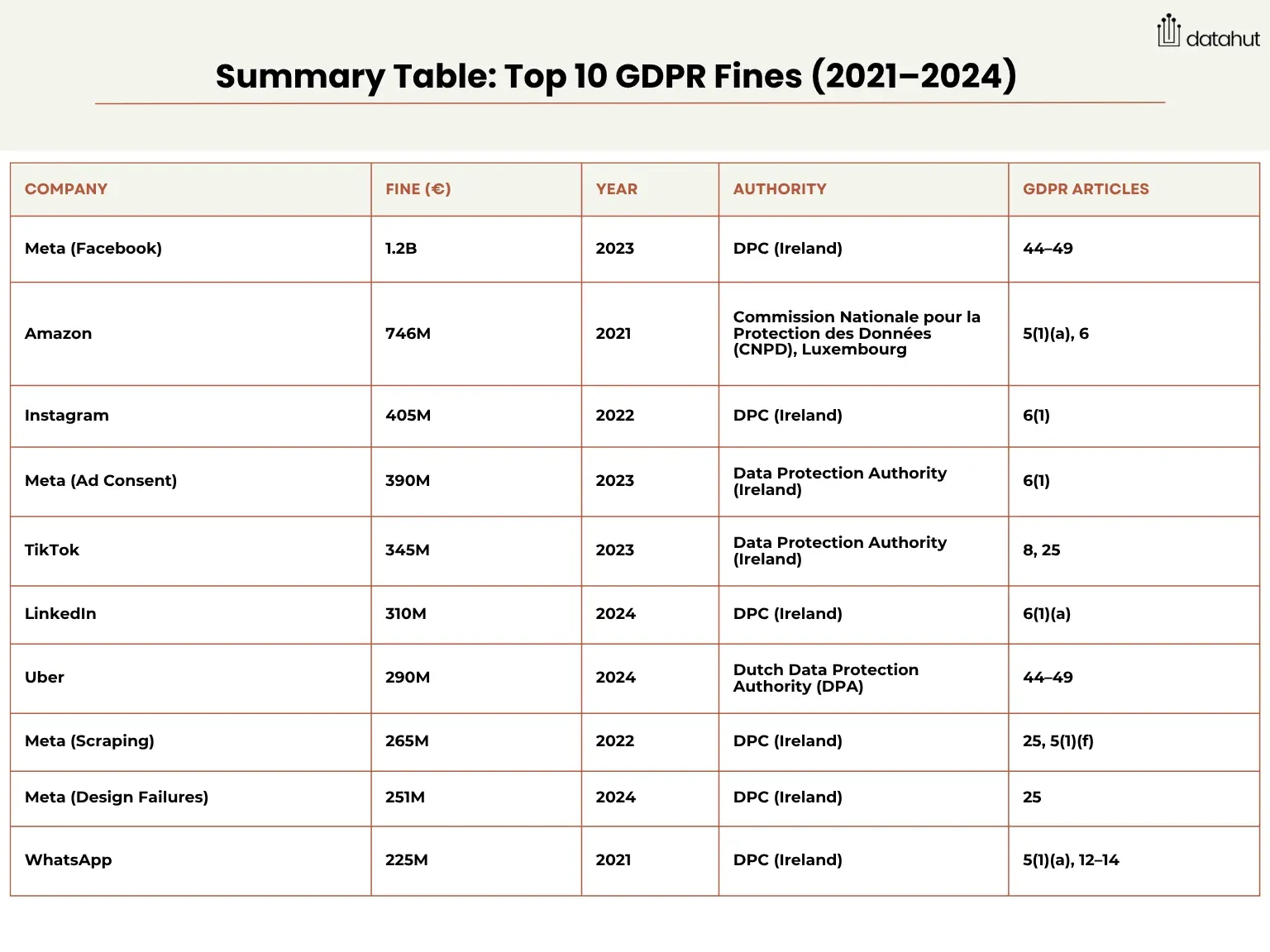
Over 80% of these record fines were issued by the Irish Data Protection Commission (DPC), highlighting Ireland’s pivotal role in EU data enforcement.
What These Fines Teach Businesses
- Transparency and Consent Are Non-Negotiable: Most GDPR violations stem from unclear consent practices or data usage.
- Privacy by Design Is Critical for privacy law: Weak system-level protections can lead to multimillion-euro penalties.
- Cross-Border Data Transfers Need Safeguards: International processing requires documented compliance.
- Children’s Data Is Highly Protected: Default public exposure of minors’ information is a red flag.
- Continuous Compliance Is Essential: Regular audits and documentation prevent long-term exposure.
Datahut Expertise
At DataHut, we help businesses turn compliance into a competitive advantage — enabling responsible, GDPR-aligned data collection through transparent web scraping solutions. Partner with our experts at DataHut to keep your operations ethical, efficient, and future-ready.
Conclusion
The enforcement of GDPR demonstrates that no organization is beyond regulatory accountability. Each case highlights a distinct compliance failure — from transparency and consent to cross-border data handling.
As seen across these landmark decisions, regulators continue to reinforce that user trust and ethical data practices are the foundations of sustainable digital business.
Organizations can prepare better by understanding real-world enforcement trends and applying compliant methods for data collection. For instance, DataHut’s post on using web scraping to track GDPR fines and enforcement cases explores how businesses can leverage data responsibly while staying fully compliant.
As global data protection authorities strengthen coordination, organizations must view GDPR enforcement and data protection laws not as punishment, but as an evolving framework for safeguarding data breach and data subjects’ rights and digital accountability.
To Ensure your web scraping and data collection practices stay GDPR-compliant — talk to our data experts today at DataHut.
Frequently Asked Questions (FAQ)
Q1. What is the largest GDPR fine to date?
The largest fine to date is €1.2 billion, imposed on Meta (Facebook) in 2023 by the Irish Data Protection Commission (DPC) for unlawful data transfers to the United States.
Q2. Who enforces GDPR fines?
GDPR fines are enforced by national Data Protection Authorities (DPAs) such as Ireland’s DPC, Luxembourg’s CNPD, and the Dutch DPA, under the coordination of the European Data Protection Board (EDPB).
Q3. How are GDPR fines calculated?
The amount of a GDPR fine depends on the severity and duration of the violation, the company’s global turnover, and the degree of cooperation with regulators. Serious violations can result in penalties of up to 4% of annual global revenue.
Q4. Are small businesses also subject to GDPR?
Yes — GDPR applies to any organization processing the personal data of EU citizens, regardless of business size or geographic location. Learn more in DataHut’s post on GDPR compliance for small businesses.
Q5. How can companies prepare for GDPR compliance?
Organizations should conduct data audits, document processing activities, and obtain explicit consent from users before collecting or sharing data. For practical guidance, read DataHut’s GDPR compliance preparation guide.


