

Web data is now essential for analytics, AI, pricing, and business decisions. Still, data professionals spend almost 80% of their time on tasks like finding, cleaning, validating, and combining data from different systems instead of actual analysis.
In a 40-hour workweek, that means each person spends 32 hours on tasks that don’t involve actual analysis every week.
For a whole data team, this inefficiency adds up and leads to:
- Slower analytics and AI workflows
- Higher engineering and cloud costs
- Reduced agility for pricing, assortment, and competitor intelligence teams
- Increased compliance risk
- Lower reliability across downstream models
By 2026, the gap between what companies need from data and how ready that data is will continue to grow. Websites are getting more complex and better protected, so picking the right web scraping company is more important than ever.
Today’s web platforms use dynamic rendering, React interfaces, virtualization, ongoing UI changes, and strong anti-bot systems like Cloudflare, PerimeterX, Kasada, and DataDome. Meanwhile, companies must also meet higher standards for GDPR, CCPA, DMA, and internal governance.
In this environment, the right web scraping service becomes a strategic partner instead of just another tool.
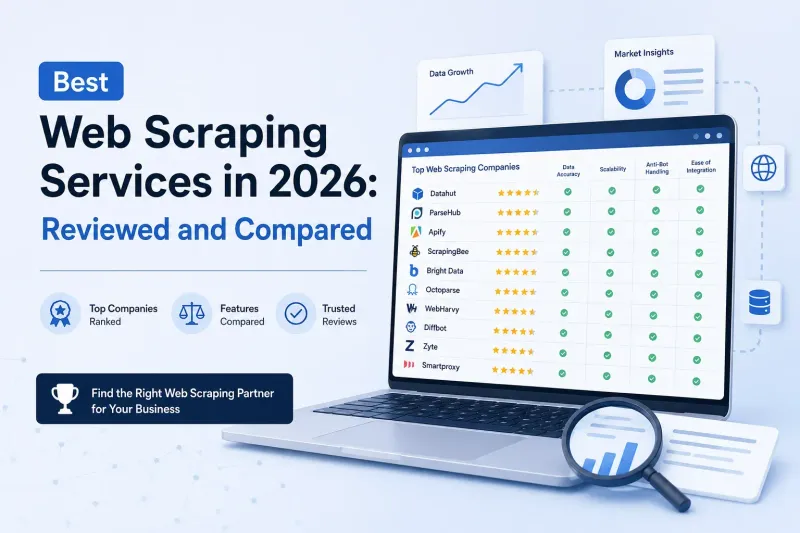
This guide reviews the Top 10 Web Scraping Companies in 2026, looking at reliability, compliance, delivery quality, scalability, and value for enterprise teams. The analysis is neutral, but we point out where Datahut excels, especially in enterprise web scraping, compliance, and long-term data operations.
1. Why Choosing the Right Web Scraping Company Matters in 2026
Web scraping in 2026 is very different from just three years ago.
Websites now use:
- JavaScript-heavy front-ends (React, Next.js, Vue, Angular)
- Server-side rendering combined with hydration
- Infinite scrolling, dynamic pagination, and lazy loading
- Automated experimentation platforms shipping layout changes daily.
- Anti-bot systems that fingerprint browser behavior, TLS signatures, and request metadata
- Login walls, paywalls, and personalization
At the same time:
- AI and LLM teams need massive amounts of structured, accurate training data.
- Retailers need real-time competitor insights across thousands of SKUs
- Marketplaces need continuous monitoring of supply, pricing, and seller behavior.
- Compliance and data governance teams demand higher transparency.
- Internal scraping teams are expensive to hire, retain, and maintain
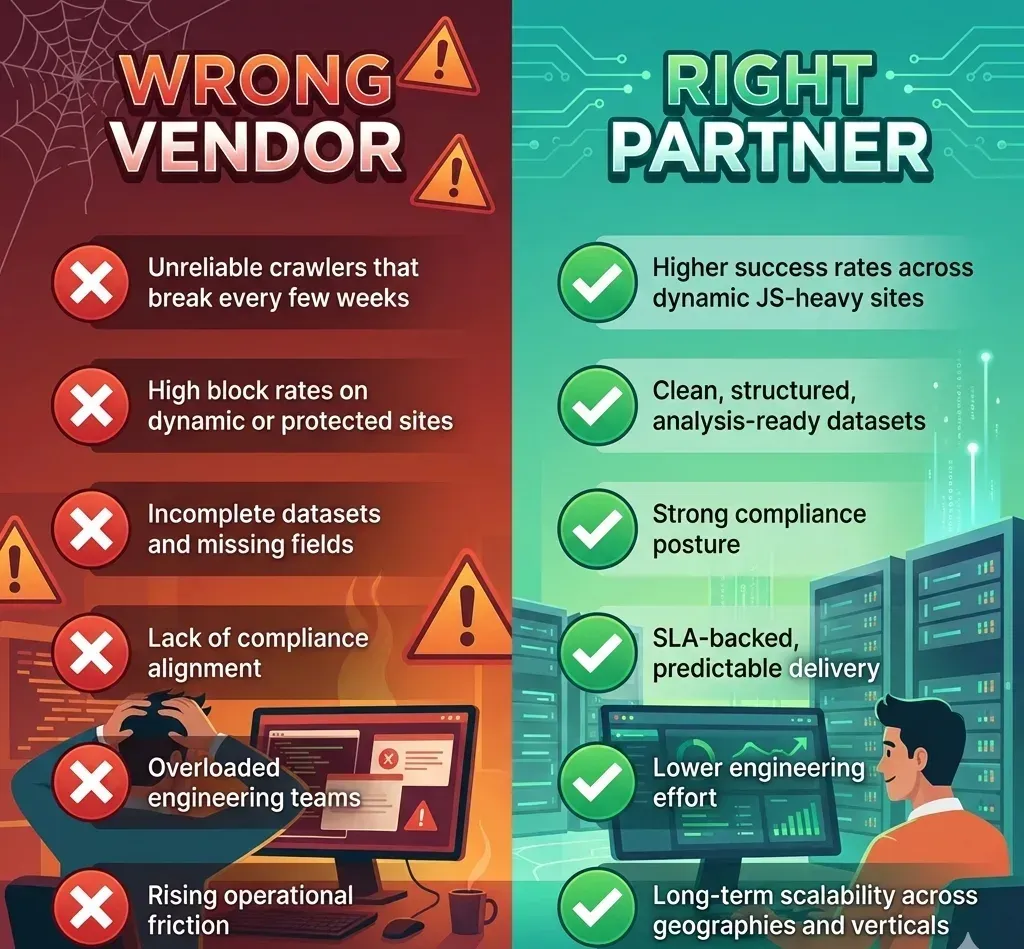
Choosing the right partner for enterprise web scraping leads to:
This guide is based on public information, customer feedback, and industry trends. Each company listed has its own approach to web data extraction, ranging from fully managed services to API tools and large proxy networks.
The goal is not to rank these companies, but to help businesses find the model that best fits their needs.
4. Best Web Scraping Services in 2026
Below is the updated list of the best web scraping companies and web scraping services for 2026.
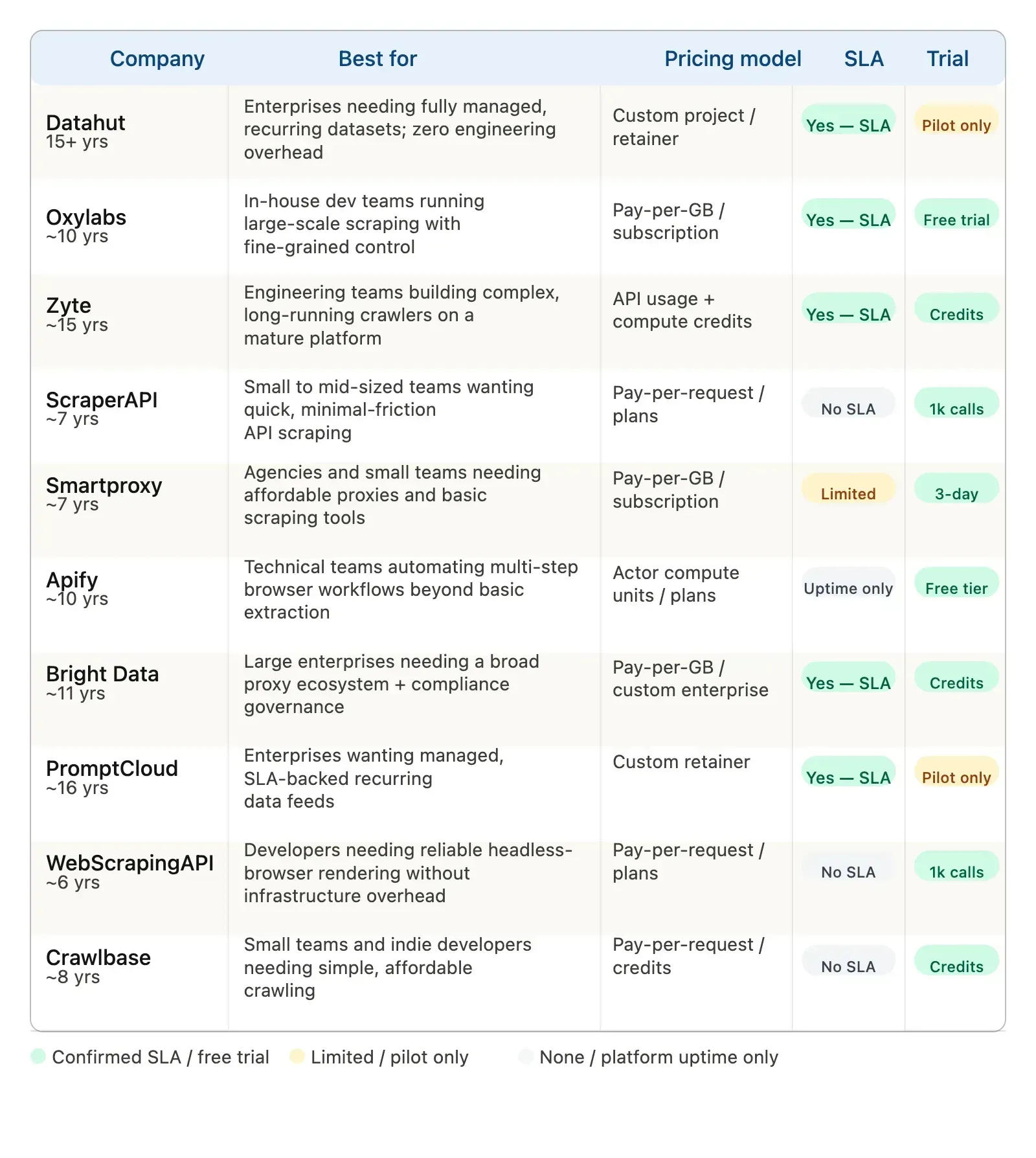
4.1 Datahut
Years in Business: 15+ years
Datahut is a fully managed, enterprise-level web scraping service for teams that want clean, compliant, ready-to-use datasets without running their own scraping infrastructure.
Unlike API-first vendors, Datahut creates custom extraction pipelines for each client. This approach brings higher accuracy, better success rates, and stronger compliance, especially on complex, dynamic, or well-protected websites.
Since Datahut doesn’t sell scraping APIs, anti-bot systems can’t reverse-engineer the scraping logic or test public endpoints. Clients get only the data, not the scraping layer, which makes the pipelines harder to detect and block.
- Enterprises needing reliable recurring datasets
- Retail & ecommerce operations
- Marketplaces with large SKU catalogs
- Real estate, travel, finance, and alt-data workflows
- AI teams need clean, structured training datasets
- Companies with strict compliance/governance requirements
Strengths
- Zero engineering overhead for clients
- Custom pipelines designed for complex, changing websites
- High accuracy through multi-layer quality checks
- Strong GDPR/CCPA compliance posture
- High reliability with predictable delivery
- Excellent for long-term recurring pipelines
- Expertise in web scraping for ecommerce
- Proven track record with Fortune 500 and large global enterprises
Weaknesses
- Not suitable for hobbyists
- No instant API access
- Requires project scoping before onboardingg
4.2 Oxylabs
Years in Business: ~10 years
Oxylabs is one of the most established infrastructure-focused web scraping companies, offering a powerful suite of scrapers and a large proxy network. It is built for organizations that need to run web data collection at a serious scale and want fine-grained control over how scraping is executed.
Oxylabs is best for teams with in-house developers who want strong building blocks like residential and mobile proxies, SERP APIs, and web scrapers, rather than a fully managed, hands-off service.
Best Use Cases
- Large-scale price and product monitoring
- Search engine data collection (SERP)
- Market intelligence and competitive benchmarking
- High-volume, always-on scraping workloads
Strengths
- Massive scalability for very large workloads
- AI-powered block avoidance and advanced anti-bot tooling
- Global residential, mobile, and datacenter proxy coverage
- Multiple products (proxies, SERP APIs, scrapers) under one roof
Weaknesses
- Can be expensive for smaller teams or experiments
- An API-first model means your developers still own selectors and data modeling.
- Not a fully managed, end-to-end data delivery service by default
4.3 Zyte (Scrapinghub)
Years in Business: ~15 years (Scrapinghub)
Zyte (formerly Scrapinghub) is a developer-focused web scraping platform known for its Smart Proxy Manager, Zyte API, and Smart Crawler. It focuses on reliability and data quality, especially for teams that want to centralize crawling logic and let the platform handle rendering and blocking.
Zyte is a strong choice for engineering teams that want powerful scraping capabilities but are comfortable defining spiders, extraction rules, and handling data flow themselves.
Best Use Cases
- Complex JS-heavy websites where reliability matters
- Long-running crawlers that need stability over time
- Teams that value a strong ecosystem (libraries, spiders, support)
Strengths
- Smart automated crawling through Zyte API and Smart Crawler
- Built-in JavaScript rendering to handle modern front-ends.
- Strong focus on structured, clean, well-formatted data
- Mature ecosystem, documentation, and community tools
Weaknesses
- Requires solid technical skills to get the most out of the platform
- Managed service tiers exist, but are more expensive and not the default.
- Still largely a DIY model where your team designs and maintains spidersders
4.4 ScraperAPI
Years in Business: ~7 years
ScraperAPI is a plug-and-play web scraping API designed for developers who want to focus on parsing content rather than managing proxies, blocks, or CAPTCHA. You send a URL; ScraperAPI returns the HTML, handling most of the underlying complexity for you.
It’s best for small to mid-sized teams that want a quick, minimal-friction way to add scraping into their applications without running a full scraping stack.
Best Use Cases
- Rapid prototypes and MVPs
- Internal tools needing occasional scraping
- Low-to-mid complexity sites with moderate protection
Strengths
- Very easy to integrate with a simple URL-based API
- Automatic proxy rotation, retries, and CAPTCHA handling
- Good pricing entry point for mid-level usage
- Helpful for teams that don’t want to run their own proxy infrastructure
Weaknesses
- A general-purpose approach can struggle with very complex, highly protected, or heavily dynamic sites.
- An API-only model means no managed data delivery or ownership of custom pipelines.
- Costs can scale up quickly on high-volume or very frequent workloads.
4.5 Smartproxy (DecoDo)
Years in Business: ~7 years (DecoDo)
Smartproxy became known as an affordable, reliable proxy provider and has expanded into scraping solutions. It’s aimed at users who want cost-effective proxies and simple scraping tools without investing in heavy infrastructure.
It’s well-suited for agencies, small businesses, or data teams that have modest scraping needs but still require legitimate proxy networks and basic tools.
Best Use Cases
- Light-to-moderate price tracking or content monitoring
- Small-scale SEO data collection
- Experiments and proof-of-concept scraping
Strengths
- Budget-friendly pricing, especially for smaller workloads
- Easy onboarding and simple dashboards
- Good balance between quality proxies and cost
Weaknesses
- Entry-level plans can be limited in terms of bandwidth and features.
- Scraping tools are less advanced than dedicated, enterprise scrapers.
- No true managed, professional-services layer for end-to-end data delivery
4.6 Apify
Years in Business: ~10 years
Apify is an automation-focused platform that combines web scraping, browser automation, and workflows using its "Actors" model. Each Actor is a reusable bot that can log in, navigate, extract, transform, and export data in one process.
Apify is a great fit for technically inclined teams that want more than just raw HTML—they want to automate entire business processes involving the web.
Best Use Cases
- Multi-step workflows (login → search → paginate → scrape → export)
- Complex browser interactions (forms, filters, dashboards)
- Building reusable scraping automations for multiple stakeholders
Strengths
- Powerful combination of scripting + automation + scraping
- Browser rendering support for complex and interactive sites
- A large marketplace of ready-made Actors for common tasks
- Flexible for both one-off jobs and recurring workflows
Weaknesses
- Non-technical users may find the Actor model and JS/Node environment challenging.
- Monitoring, scaling, and maintaining Actors is still your team’s responsibility.
- Managed/consulting help is available, but not the default starting point.
4.7 Bright Data
Years in Business: ~11 years
Bright Data is a well-known enterprise web data platform that combines a large proxy network with advanced unblocking technology and specialized data collection products. It’s built for organizations that see web data as a key part of analytics, AI, and decision-making.
With a strong emphasis on compliance, governance, and control, Bright Data is ideal for teams looking to build large-scale scraping and data-gathering infrastructure on top of a mature platform.
Best Use Cases
- Large-scale market and competitive intelligence
- Global price and assortment tracking across many sites
- AI training datasets requiring broad, diverse web data
Strengths
- Huge proxy ecosystem across residential, mobile, and datacenter IPs
- Web Unblocker and other tools for difficult, highly protected websites
- Strong compliance, KYC, and governance framework for enterprise buyers
- Wide range of specialized products (SERP, datasets, proxies, collectors)
Weaknesses
- Pricing is higher than many alternatives, especially for smaller users.
- Product- and infra-first model; managed end-to-end data delivery is not the default
- Best value is realized only when you have a capable internal engineering team.
4.8 PromptCloud
Years in Business: ~16 years
PromptCloud is an established managed web scraping company that delivers structured datasets at scale for enterprises. Instead of just providing tools and APIs, PromptCloud acts as a data partner: you tell them what you need, and they deliver it regularly.
This makes it attractive for organizations that know their requirements and prefer predictable, SLA-backed deliveries over building internal scraping capabilities.
Best Use Cases
- Recurring catalog, pricing, or listings data across many sites
- Enterprises that want stable feeds instead of tools
- Long-term, fixed-structure data projects
Strengths
- Strong orientation toward managed, customized data pipelines
- Reliable long-term delivery with clear formats and schedules
- Good fit for enterprises that want a “set it and run” relationship
Weaknesses
- Limited self-serve or low-commitment options for quick testing
- Less flexibility for highly experimental or fast-changing use cases
- Engineering teams that want to tinker or iterate rapidly may feel constrained.
4.9 WebScrapingAPI
Years in Business: ~6 years
WebScrapingAPI is a fast-growing web scraping API platform for developers who want reliable rendering, proxy rotation, and anti-bot handling without building their own scraping setup. It aims to make complex scraping tasks easier and offers higher success rates on modern, JavaScript-heavy websites.
Compared to older scraping APIs, WebScrapingAPI focuses on speed, scalability, and ease of integration, making it a strong alternative to ScrapingBee.
Best Use Cases
- Small to mid-scale scraping operations
- JavaScript-rendered pages using headless browsers
- SEO monitoring, SERP tracking, and content extraction
- Internal dashboards and automation tools
Strengths
- Built-in headless browser support
- Automatic proxy rotation and CAPTCHA handling
- Simple API interface with quick onboarding
- Good success rates on dynamic pages
- Scales well for developers who need reliability without complexity
Weaknesses
- Not ideal for very large enterprise scraping programs
- No fully managed or custom pipeline service tier
- Teams must still write selectors, logic, and validation flows.
4.10 Crawlbase (ProxyCrawl)
Years in Business: ~8 years (ProxyCrawl)
Crawlbase, formerly known as ProxyCrawl, offers a straightforward scraping and crawling API for developers who want to fetch web content with minimal friction. It focuses on reliability and simplicity at an accessible price point.
It’s a good match for smaller teams, indie developers, and internal tools that need basic but dependable scraping capabilities.
Best Use Cases
- Basic HTML extraction from content or listing pages
- Small to mid-scale internal automation and monitoring scripts
- Projects where budget and simplicity are more important than deep customization
Strengths
- Affordable and easy to start using
- Simple API surface for common scraping tasks
- Handles many standard blocking and retry scenarios for you
Weaknesses
- Not designed for highly dynamic, heavily protected websites at large scale
- No managed or custom pipeline services — you own the full data flow.
- Less feature-rich than some larger enterprise scraping platforms
5. Before You Choose a Web Scraping Partner, Ask Yourself These Questions
Choosing the wrong vendor is more than just an inconvenience. It can create data blind spots, revenue loss, and growing operational risks that often go unnoticed. Here are the questions every enterprise should ask before selecting a web scraping company:
1. What happens if a critical crawler breaks during peak business hours?
Do you have a vendor who takes responsibility, or does your engineering team suddenly have to handle the emergency?
2. If a website ships a layout change tonight, will your data pipeline survive tomorrow morning?
Or will you wake up to empty dashboards, stale feeds, and missing data?
3. How confident are you that your vendor can stay undetected on complex, JS-heavy, anti-bot-protected sites?
If your data stops because your vendor is blocked, what is the real cost to your business?
4. Who is liable if your current scraping setup violates GDPR, CCPA, or DMA guidelines?
Do you have a partner focused on compliance, or just a tool that leaves you with the risk?
5. How much engineering time will your team lose every month maintaining scripts, proxies, selectors, and retries?
And what could your teams achieve if that time were freed?
6. If you’re monitoring thousands of SKUs across marketplaces, what happens when product pages become more dynamic or personalized?
Can your vendor consistently keep up — or will your data slowly degrade without you noticing?
7. Are you paying for a tool… or for predictable outcomes?
If you are still responsible for selectors, logic, QA, and monitoring, is it really a “service”?
8. If your competitor invests in better, fresher, cleaner data, how long until that advantage shows up in pricing, assortment, or SEO rankings?
Are you comfortable being the one with the slower, noisier data?
9. Does your vendor give you clean, structured, analysis-ready datasets — or just raw HTML?
If you’re still doing the heavy lifting, you’re not getting the value you should.
10. What is the cost of being wrong?
Broken pipelines, incorrect pricing data, stale competitor feeds, or unreliable training datasets can cost far more than the price of the vendor.
Final Thoughts: The Cost of Bad Data Is Always Higher Than the Cost of Good Data
The web is now the world’s largest, fastest-changing data source — and the companies that master it win.
But companies that underestimate how complex it is often pay the price without realizing it:
- The wrong prices were pushed live.
- The wrong assortment decisions were made.
- The wrong competitors are monitored.
- The wrong training data feeds AI models.
- The wrong signals are driving multi-million-dollar outcomes.
These are not hypothetical risks.
These problems happen when data is incomplete, outdated, unreliable, or blocked. By the time the impact appears in dashboards or revenue, it’s often too late.
That’s why choosing the right web scraping partner is no longer just a technical decision.
It’s a strategic moat.
Each top web scraping company in this guide offers something valuable, such as proxies, APIs, automation, or managed services.
In 2026, the companies that succeed will be those who build on better data, faster, not those still fixing crawlers or guessing what the market is doing.
Ready to Stop Fighting Scrapers and Start Scaling With Clean, Reliable Data?
If you want to avoid expensive crawler failures, compliance risks, and inaccurate datasets—and instead get fresh, structured data delivered the way your business needs it—let’s talk.
Get a Free Data Strategy Call With a Datahut Expert
We will review your use case, look at your current data flow, and show you how a fully managed pipeline can remove engineering overhead and help you make better decisions.
Frequently Asked Questions (FAQs)
1. How do I choose the right web scraping company?
Choosing the right web scraping company depends on your requirements, such as data volume, website complexity, compliance needs, and whether you prefer a fully managed service or developer-focused APIs. Enterprises often prioritize reliability, structured data delivery, and compliance support.
2. What is the difference between a managed web scraping service and a scraping API?
A managed web scraping service handles the entire process, including extraction, cleaning, validation, and delivery of structured datasets. A scraping API typically provides raw HTML or partially processed data, and your team is responsible for parsing, monitoring, and maintaining the pipeline.
3. Are web scraping services legal to use?
Web scraping is legal in many jurisdictions when done responsibly and in compliance with website terms, data privacy laws such as GDPR or CCPA, and ethical data collection practices. Businesses should work with vendors who prioritize compliance and governance.
4. Why is web scraping more difficult in 2026 than before?
Modern websites use dynamic JavaScript frameworks, continuous UI changes, login walls, and advanced anti-bot systems. These technologies make scraping more complex and require sophisticated infrastructure, browser automation, and monitoring.
5. What industries benefit most from web scraping services?
Industries that rely heavily on web data include e-commerce, travel, real estate, financial services, market research, and AI development. These sectors use web scraping for pricing intelligence, competitor monitoring, trend analysis, and training datasets.
6. What is the best web scraping service for ecommerce?
The best web scraping service for ecommerce depends on your business goals, scale, and data requirements. Companies that need reliable product, pricing, inventory, review, and marketplace data often prefer managed web scraping providers that deliver clean, structured datasets rather than raw scraped data. Key factors to consider include data accuracy, scalability, anti-bot handling, compliance practices, delivery formats, and ongoing support. For enterprises, a fully managed solution can significantly reduce the operational burden of maintaining scraping infrastructure and adapting to website changes.


