

Why I’m Writing This
As a founder, I engage in conversations with product teams, data leaders, and day-to-day business managers. Almost every time I have one of these conversations, I hear the same question asked:
“Should we build our own scraping stack, or should we buy?”
This build vs buy web scraping debate is often framed as a tooling choice. In reality, it’s a strategic decision about where your most expensive and scarce resource—engineering time—should be spent.
I have observed numerous teams spend a lot of time developing scraping tools that they later did not want to continue developing. Additionally, I have witnessed teams outsourcing their work without any knowledge, thereby losing control over portions that could have been leveraged. What I will do is demonstrate how I would assess that trade-off in very general and simple terms.
If there’s one idea to keep in mind as you read:
Web scraping infrastructure is no longer a differentiator. What you do with the data is.
I recently spoke with a startup founder who spent nearly 9 months building an internal scraping stack. They had to use additional resources on the scraping stack and by the time their web scrapers were stable, their original product roadmap had slipped by a 5 months and could not raise the additional funds they needed from the investors.
The Real Shift People Miss: Scraping Is No Longer “Just Code”
Ten years ago, scraping was relatively straightforward:
Back then, libraries like Beautiful Soup were often enough to get the job done. You could fetch a page, parse the HTML, and move on without worrying too much about how the site behaved.
Scraping data often involves sending an HTTP request, checking the response for relevant data, and then moving on. You could reliably retrieve the data you wanted with a simple HTTP GET Request, avoiding issues with how pages were rendered, found, or behaved, since you didn't have to render the page in a browser to get your data.
- Write a script
- Parse some HTML
- Schedule a cron job
Today, modern web scraping looks very different.
What used to be simple scripts has evolved into long-running web scrapers that behave more like infrastructure than code.
- Evolving and sophisticated anti‑bot systems
- Client-rendered, JavaScript-heavy websites
- Cookies and fingerprinting are seen as methods of detection.
- Breakages that are experienced continuously create an ongoing need for adaptation
At this point, scraping has turned into full‑time anti‑bot warfare. What teams are really dealing with now is continuous anti-bot evasion, not one-time scraper development.
Modern web scrapers now require continuous adaptation just to maintain baseline data coverage. Without that adaptation, teams quickly run into IP bans that silently degrade coverage and data freshness. Self healing scrapers is the new normal - you building a similar tool does not make any difference. Building a distributed scraping infra is should not be your priority - building the product should be.
Tools like Beautiful Soup (for scraping data from static webpages) are breaking down before our eyes as more and more sites rely on dynamic (rather than static) client-side rendering and behavioral detection. This problem has moved beyond a simple maintenance issue; it has become an infrastructure problem that requires sustained effort to continue operating.
This is why many teams increasingly rely on specialized web scraping services instead of maintaining fragile internal scrapers.
The Question I Ask Founders and PMs
When considering whether to buy or build web scraping capabilities, the question becomes even more relevant: "Is this where you want to win?"
This is often when the project manager will pause before responding with: "Honestly? No. We thought we had to own it." At this point, that response will generally shift this PM's thought process from habitual to strategic.
Your engineering resources are your most treasured and limited resource. But if 20-30% of the time spent by your engineers is working on broken web scraping tools, continuously rotating proxies, and/or reacting to changes on your target sites, then they are not:
- Improving product insights
- Building better models
- Creating smarter analytics
- Shipping features customers will pay for
This is where the build vs buy decision stops being technical and becomes strategic. Most teams don’t set out to become experts at maintaining web scrapers—it happens accidentally.
Instead of fixing scrapers, teams could use that time to analyze pricing data, assortment gaps, or competitive positioning.
A Simple Mental Model: Commodity vs Differentiator
This is the simplest way to explain the decision to non‑technical stakeholders.
Commodity Layer (Not Where You Win)
These are capabilities you need, but don’t get credit for:
- Proxy rotation and IP management
- Headless browsers and JavaScript rendering
Running headless browser farms inside a company is expensive and hard to manage. This is especially true when you need to scale beyond a few sites.
- CAPTCHA handling
Tasks like solving CAPTCHAs are necessary in modern scraping. They add extra work but do not make the product different.
- General anti‑bot adaptation
Everyone needs these. No one wins because of them. Keeping anti-bot evasion working well over time is operational work. It does not make the product different.
Managing residential proxies at scale is costly and rarely worth the internal overhead. This layer is typically handled by external web scraping services, not internal product teams.
Differentiator Layer (Where You Actually Win)
Data creation of actual value consists of:
- The types of data collected (so there's no duplication),
- How you clean, enrich, and validate it
- Type of ETL processes used to transfer data for storage and analysis
- Types of analytics, models, and business rules used to analyze, interpret, and create data, and
- How tightly is this data integrated into your product?
This is the layer your customers actually experience.
Much of this work involves turning messy, unstructured data into formats your systems and decision-makers can actually use.
Well-designed ETL pipelines change raw data into something reliable, comparable, and ready for decisions.
Long ago, some teams discussed whether to develop their own logging or monitoring systems. Today, the discussion is not seen as a strategy. The same thing has happened with scraping: many teams have not yet updated their thinking about it.
How do you evaluate your options?
This is the code idea we use internally and recommend to most teams evaluating build vs buy web scraping.
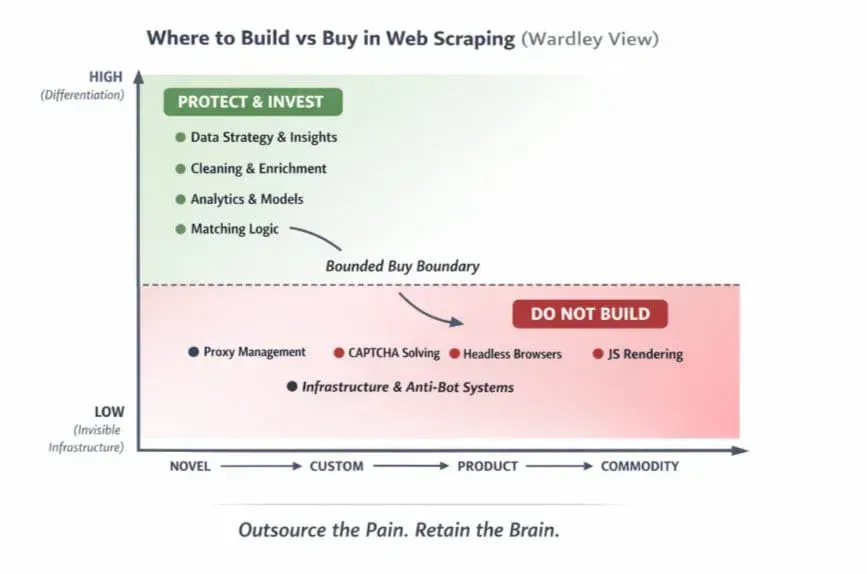
The idea is simple:
- You buy reliability, scale, and resilience at the infrastructure layer
- You retain intelligence, logic, and competitive advantage at the value layer
The boundary matters.
You outsource the pain. You keep the brain.
That’s what we call Bounded Buy.
A Simple Way to Think About How Capabilities Mature
You don’t need formal frameworks or jargon to understand this part. The idea is straightforward:
Most capabilities develop in a predictable way over time.
What starts as something rare and strategic eventually becomes something expected and operational.
Here’s how that typically plays out:
1. NovelAt this stage, very few teams can do the thing at all. It needs testing, deep knowledge, and creativity. Early on, building this in‑house can make sense because there are no reliable external options.
2. Custom (Built In‑House)As more teams face the same problem, they start building their own internal versions. Each implementation looks slightly different, and a lot of engineering time goes into making it work for specific use cases.
3. ProductizedOver time, vendors emerge. They standardize the problem, package it into tools or services, and make it easier to adopt. At this stage, buying often becomes cheaper and faster than building.
4. CommodityEventually, the capability becomes expected. Everyone needs it. Best practices exist. Scale, reliability, and good operations matter more than clever design.
Web scraping infrastructure has clearly reached this final stage. The web scraping industry has matured significantly over the last decade, with established vendors, best practices, and strong economies of scale. What matters now is uptime, resilience, and consistency—not bespoke engineering.
This is where many build vs buy web scraping decisions go wrong. Teams continue to treat mature, commodity infrastructure as if it were still a source of competitive advantage.
Your analytics, models, data interpretation, and decision logic are not common or standard yet. They are shaped by your business context and customer needs—and that’s exactly where internal creativity and ownership belong.
Option 1: Build Everything In-House (If You MUST Have Control Over Everything)
If you cannot compromise at all on the build-out end of the web scraping build vs.-buy spectrum, then a completely in-house web scraping system is owned by teams.
In reality, a legitimate in-house scraping system consists of:
Behind the scenes, this often means operating headless browser farms just to render pages reliably at scale.
- Multiple senior engineers
- Dedicated DevOps support
- Continuous proxy and infrastructure spending
- Continuous maintenance for evolving sites
Most teams are not budgeting enough for expenses. In reality, you should expect:
- Between $150k and $400k for initial development
- Several hundred thousand dollars each year for salary costs
- Between 20-30% of engineering time will go toward maintenance activities.
These numbers still understate the real issue: maintenance costs compound over time as sites change, detection evolves, and internal tooling ages.
Much of this effort goes into keeping web scrapers functional rather than improving downstream insights. A large part of the spending often goes to buying and rotating residential proxies. It does not improve data quality or insights.
Downsides of Pure In‑House Build
- CAPTCHA resolution does not grow exponentially: Increasing the number of sites that use CAPTCHA results in high costs.
- Anti-bot avoidance measures will never be complete: New techniques for detecting automated traffic are continually evolving, keeping the internal team in a cycle of reacting.
- High opportunity costs: The time spent developing scrapers takes time away from developing product, models, and features that are customer-facing.
- Compounding impact: Over time, the costs of maintaining scrapers, infrastructure sprawl, and the operational risks associated with poorly built scrapers continue to compound.
This approach only makes sense when:
- You operate in heavily regulated environments.
- You need end‑to‑end auditability
- You scrape highly proprietary or internal systems.
For most teams, this is an expensive way to solve a non‑differentiating problem.
Option 2: Bounded Buy (Hybrid Model)
If you are looking for a way to maintain control of your data without reinventing the wheel, the Bounded Buy Model may be your best option.
In the Bounded Buy Model, you will:
- Utilize either commercial unblockers or scraping platforms as a reliable means of extracting data.
- Maintain complete control over how you process, validate, and use your data.
The Hybrid Model takes advantage of the best of both worlds by giving teams ownership of their internal data while also providing access to external web scraping services to increase their scale and resilience.
Advantages
- Reduced time to market from months to a matter of weeks.
- Fixed costs become variable or usage-based
- Engineering can focus on developing value for the customer.
Disadvantages of the Hybrid Model
- Anti-bot evasion techniques can still be detected: although many vendors provide reliable solutions for the commodity (unblocker/scraper), vendors operating upstream of the commodity will still run into operational issues when their techniques change.
- Complex Integrations: Engineering teams will continue to have effort(s) integrating, monitoring, and adjusting to the vendor-provided information.
- Partial Dependency: Your reliance on external vendors for the commodity layer results in the reliability of your use of that vendor’s service.
- Zero-maintenance is a misnomer: Although operational oversight is considerably less, it is still necessary. Even in a hybrid environment, the teams are still responsible for monitoring any failure of the upstream web scraper.
Most importantly, your competitive advantage stays in your codebase - not your vendor’s.
Option 3: Fully Managed Service
A fully managed web scraping service works best when speed and simplicity matter more than deep customization.
This solution is a good fit in the following cases:
- There is an immediate need for data
- Requirements are well defined
- Minimal custom logic is used
There are also downsides to a Fully Managed Service:
- Less flexible - you must operate within the vendor’s data model and delivery structure
- Less control - the ability to modify scraping behavior is typically abstracted away
- Vendor dependency - if you want to switch providers later, it may require remapping the workflow
You are trading some flexibility for a focus on the analytics aspect of your solution. This trade-off makes a lot of sense and is often optimal for many analytics-driven and early-payment use cases.
In this model, teams no longer need to think about how individual web scrapers are built or maintained.
TCO Comparison: Three Web Scraping Sourcing Models
This view shows how teams should evaluate build vs buy web scraping decisions over a realistic three‑year horizon. People often miss how maintenance costs add up over time. These costs include engineering time, extra infrastructure, and operational risks. Costs here are driven largely by proxy acquisition, especially residential proxies, and the effort required to keep them usable over time.
Build vs Buy: A Practical Guide for Web Scraping
Legal and Compliance: The Part You Can’t Ignore
Scraping isn’t just a technical problem—it’s a legal and operational one.
If you handle:
- Personal data
- Regulated markets
- Strict retention or deletion requirements
Then compliance workflows matter as much as cost. This often becomes the hidden deciding factor in build vs buy web scraping decisions.
Hybrid and managed models work well here because infrastructure risk is outsourced while compliance logic can remain tightly controlled.
My Founder Takeaway (Where We Actually Land)
We have seen hundreds of build vs buy web scraping decisions across companies. We have watched how the web scraping industry has changed. Our recommendation today is clear.
For most teams, Fully Managed Service is the right default choice.
Scraping infrastructure has crossed the point where owning it creates meaningful leverage. Continuous anti-bot evasion is now table stakes, not a competitive edge. Proxy management, browser orchestration, bot evasion, and scaling are now areas where teams quietly lose time and momentum.
A fully managed approach allows teams to:
- Eliminate months of setup
- Avoid permanent headcount for non‑core problems
- Transfer uptime and breakage risk to specialists
- Pay only for the data they actually use
Most importantly, it removes an entire class of operational distraction from the roadmap.
Final Thoughts
If you strip away pride, tooling bias, and sunk‑cost thinking, the decision becomes simple:
If scraping does not directly differentiate your product, you should not be running scraping infrastructure.
The best build-vs-buy decisions protect focus, accelerate learning, and keep teams working on what customers actually pay for—better insights, faster iteration, and cleaner data.
That’s why, in practice, this is the model we see scale with the least friction over time.
Frequently Asked Questions (FAQs)
1. When does it actually make sense to build web scraping in-house?
Only when the web scraping component of your site is fundamentally related to your main product or any required compliance issues is it worth doing your web scraping in-house. This generally occurs in regulated environments with private internal systems or if the way you gather data will provide a competitive advantage over others in the industry. For most analytics or research applications, building something in-house will likely create more headaches and disadvantages than building with a third party.
2. Are web scraping services reliable for long-term use?
Most mature, established web scraping services are designed to provide a dependable service over a long period of time. They continue to invest in proxy management, browser control systems, and effective anti-bot measures. In-house, these tasks tend to take a great deal of time and money. It is most beneficial to work with a vendor that can demonstrate a track record of scale, transparency in SLAs, and clarity about the quality of their data.
3. How do I evaluate build vs buy web scraping from a cost perspective?
Cost needs to be looked at as the total cost of ownership, not just the purchase price of tools. When you build an in-house solution, there are additional hidden costs (engineering time, maintenance time, infrastructure sprawl, and therefore opportunity cost) that are not included in the comparison of the initial cost vs. buying or using a fully managed service.
4. Does using a fully managed web scraping service mean losing data control?
Not necessarily true, when you use fully-managed services, you will not have any visibility to how the actual scraping is being done (e.g., are you using a scraper tool, and if so, what type), but you still have control over how your team stores the data, transforms it, validates it, and uses it internally. In many cases, control over the use of the data will be more important than control over the mechanics of data collection.
5. What is the biggest mistake teams make in build vs buy web scraping decisions?
The most common mistake is treating scraping infrastructure as a source of differentiation. Teams often think owning common infrastructure is more valuable than it is. They also forget about the long-term costs to run it. Teams mix up owning web scrapers with having a competitive edge.


