

Most companies ask us for competitor pricing data. Usually, they begin with a shortlist and say, “Track these five competitors.” We usually push back. Why those five? Why not the entire category? That question gets the same response every time: Why would we do that?
Because tracking competitors only shows what a few companies did today. Tracking the whole category shows what the market is doing and helps you see if a change is just a one-time event or a real shift. This blog explains the difference.
The Problem With Pricing in E-commerce
This is a familiar scene. You log in on a Tuesday, check a key competitor, and see they’ve cut prices across their electronics aisle. Instantly, you’re forced into a decision:
- Do you match them and protect conversion?
- Do you hold and protect margin?
- Do you undercut and try to take a share?
But the real question is the one nobody can answer from a single price check:
Is this a one-off move or the market shifting under your feet?
Most teams default to gut feel, a few screenshots, and a Slack thread. The problem is that pricing is noisy. A seller clears inventory. A marketplace runs a flash sale. A brand tests a promo. If you react to every alert, you end up reacting to randomness. Most retailers underestimate the discipline dynamic pricing requires.
A category price index solves this problem. It combines scattered competitor changes into a single, clear market signal, giving you context rather than just notifications.
What Is a Category Price Index?
A category price index is a simple way to answer a hard question: what’s happening to pricing in my market, overall?
Instead of watching individual SKUs, which can be noisy and easy to misread, you track a group of similar products and combine them into a single index number over time. This works like the Consumer Price Index (CPI): one product can be misleading, but a group shows the real trend.
In practical terms, a category price index tells you:
- Is this category getting more expensive or cheaper over time?
- Are my prices moving with the market — or drifting out of position?
You can define the category broadly, like “running shoes,” or more narrowly, such as “men’s trail running shoes, size 9 to 12.” Narrower definitions usually give a clearer signal, as long as your group is large enough to be representative.
You can also create useful variants:
- Competitor index: only your top competitors
- Channel index: marketplaces vs D2C
- Price-tier index: entry / mid / premium baskets
No matter how you slice it, the idea is the same: stop treating pricing as a set of isolated SKUs and start measuring it as a market trend you can manage.
How Category Price Indexes Are Built
A category price index isn’t complicated. It’s just a disciplined way to turn messy SKU-level pricing into a clean signal you can track.
Here’s the basic process:
- Define the category (and the rules). Decide what belongs in the category and what doesn’t. Be explicit about filters like brand, specs, size range, condition (new vs refurbished), seller type (1P vs 3P), and whether you include out-of-stock items.
- Build a representative basket. Choose enough products to cover the full range of the category, including entry-level, mid-tier, and premium, so that no single brand or price point dominates the results.
- Collect prices consistently over time. Pull the same set of fields at a regular cadence (daily / weekly). This can come from web scraping, retailer feeds, or a third-party provider like Datahut.
- Normalize to a baseline. Pick a reference period (e.g., January 2026 = 100), so changes are easy to interpret. If the index moves from 100 to 92, the category is ~8% cheaper than the baseline.
- Weight where it matters. Not every SKU should count the same. You can use sales volume, review count, bestseller rank, or other signals to make sure the index reflects what customers actually buy, not just what is listed in the catalog.
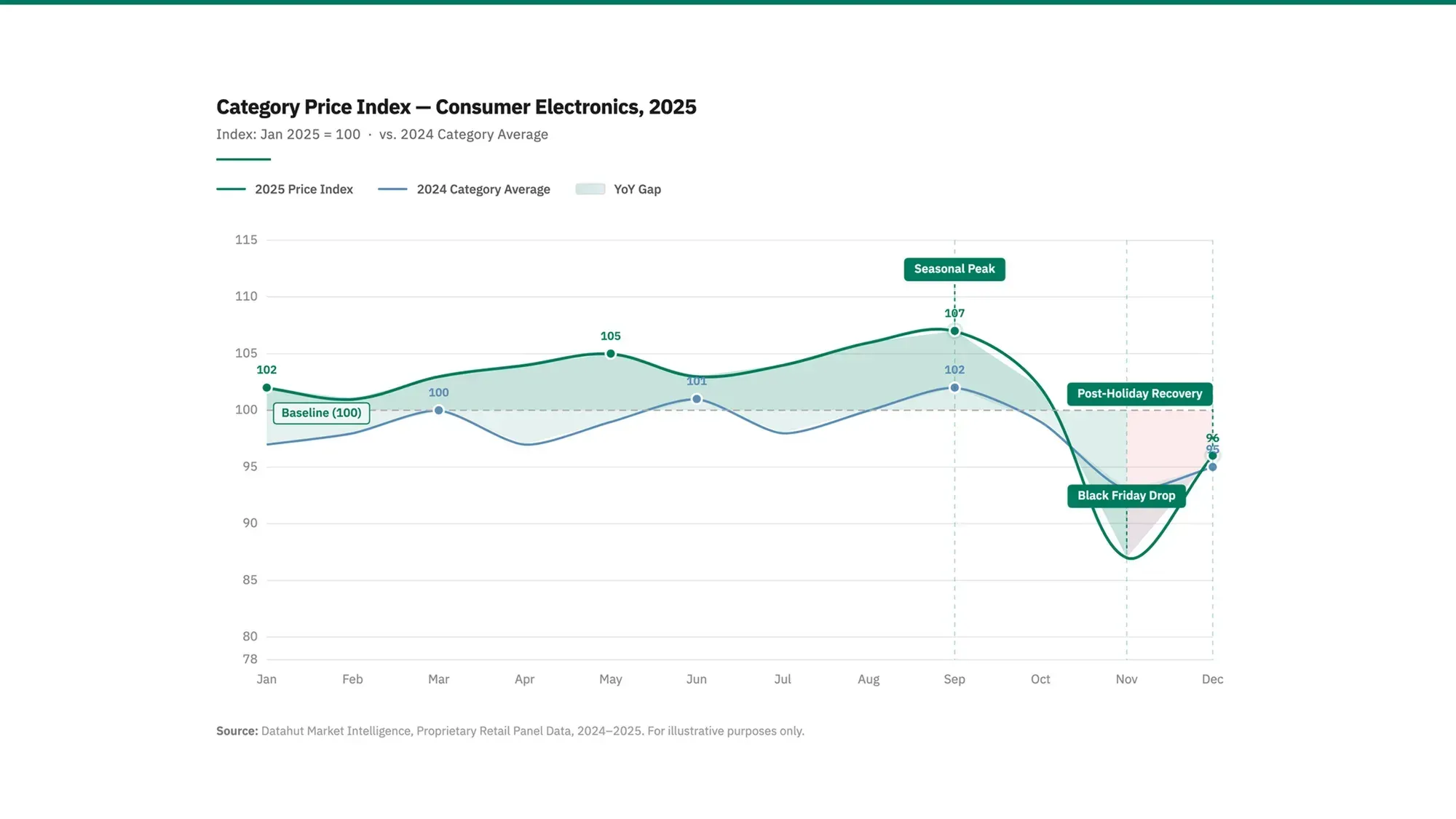
The result is simple: a single number and trend line that shows where the category is heading, without getting lost in the noise of individual SKU changes.
Why It Matters for E-commerce Sellers
A category price index might sound like just another analytics tool. In reality, it changes how you make pricing decisions because it replaces isolated reactions with a broader market context.
1. It Separates Signal From Noise
SKU prices are naturally volatile. One seller clears inventory, a marketplace runs a 48-hour promo, or a brand tests a discount, and suddenly your dashboards light up.
A category price index dampens one-off events and shows the market's underlying direction. If the category index drops 8% over six weeks while your prices stay flat, you’re not looking at “a competitor having a bad week.” You’re looking at a category-level shift you can’t ignore.
2. It Reveals Seasonal and Structural Pricing Cycles
Most categories move in cycles, but the pattern of these cycles changes every year. The index helps you see these changes.
You can compare this year vs last year and answer questions like:
- Are discounts starting earlier this season?
- Is the Q4 dip deeper than normal?
- Are prices recovering more slowly post-holiday?
These patterns are easy to miss when you focus on individual SKUs. At the index level, they become clear.
3. It Benchmarks Your Positioning Against the Market
Instead of asking, “Am I cheaper than Competitor X on Product Y?” you can ask the more strategic question:
Is my overall price positioning moving toward or away from the market?
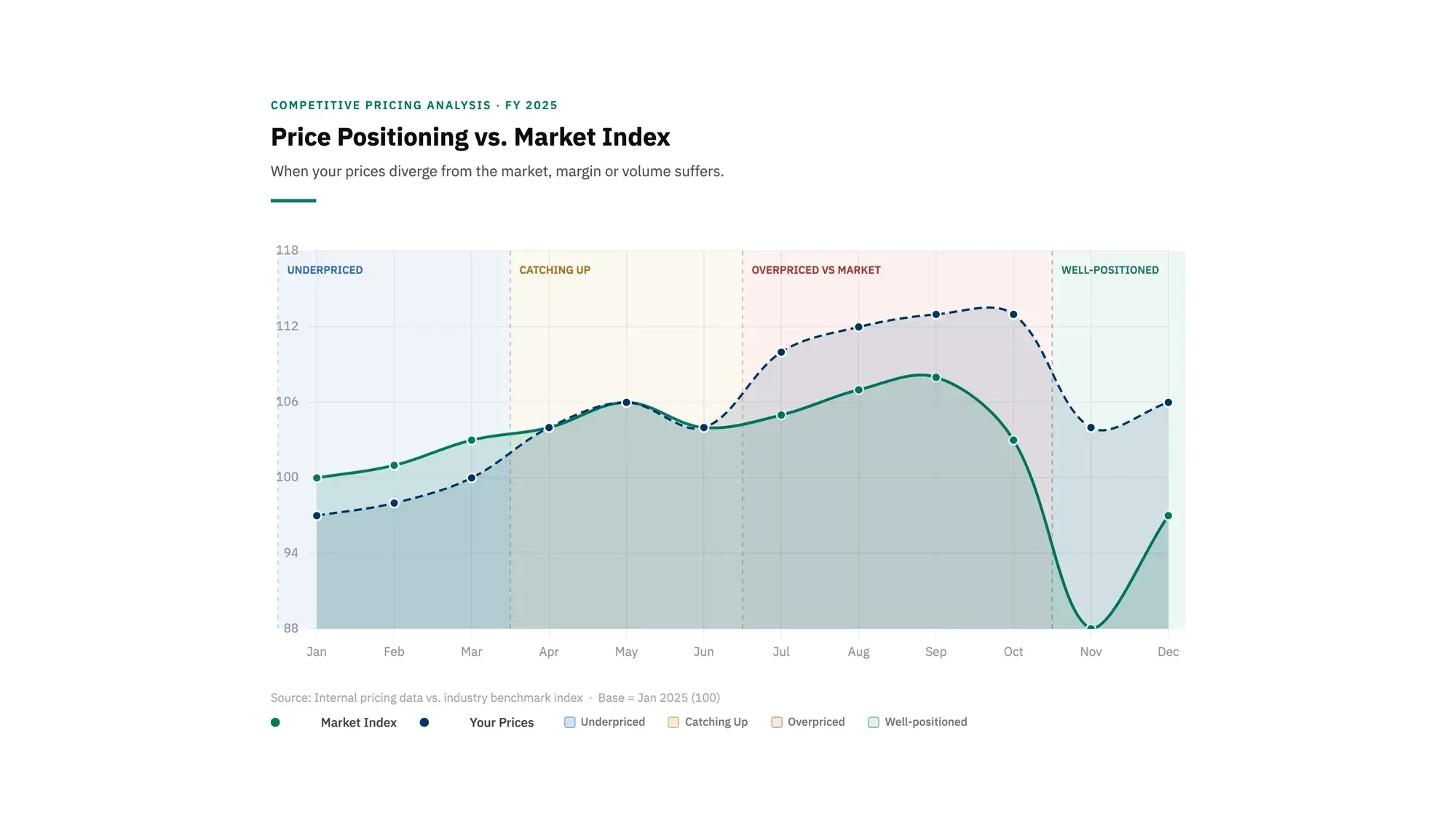
This is especially important when your catalog is large. You can’t manually monitor thousands of SKUs, but you can track your index against the market index and spot changes early, whether you’re becoming too expensive or losing margin without noticing.
4. It Lets You Go Granular With Price-Tier and Basket Trends
One index gives you the direction of the category. But real decisions often live in the details.
So you split the category into baskets and track each one:
- Entry / mid/premium price tiers
- Top brands vs long-tail brands
- Key spec buckets (e.g., storage sizes, screen sizes, active ingredients)
- Hero SKUs vs the rest
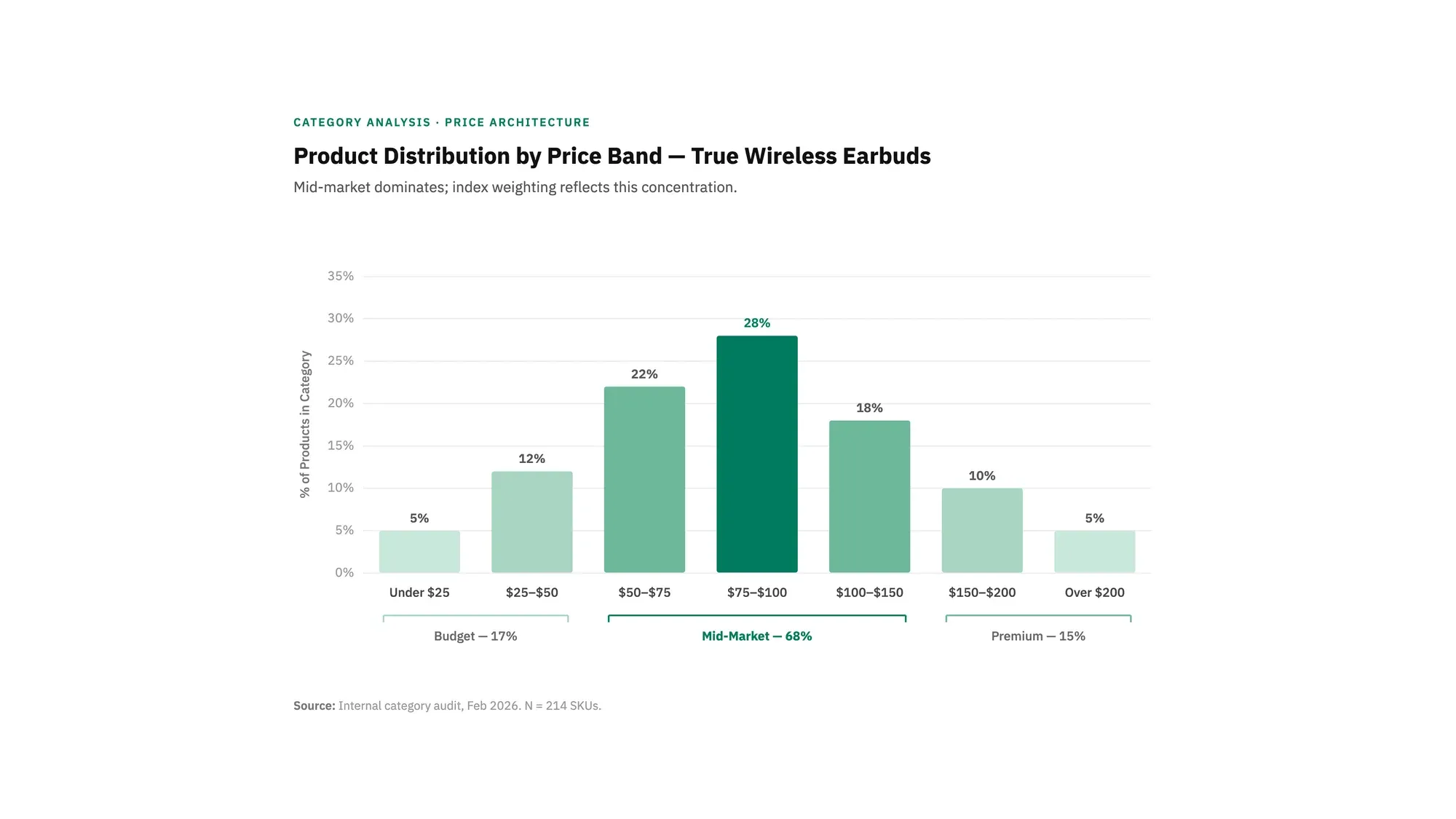
This approach helps you spot things the overall index might hide, such as “premium is holding price while entry is collapsing,” or “one spec bucket is being aggressively discounted.”
5. It Powers Smarter Repricing Rules
Most repricers are SKU-first: match the lowest price, stay within X% of Buy Box, follow competitor A.
Indexes enable more advanced strategies. You can adjust your rules based on where the category is in its pricing cycle:
- When the category index is falling, price more defensively to protect volume.
- When it’s rising, pull back discounts and protect margin.
You stop repricing in response to chaos and start repricing based on the overall market situation.
6. It Informs Procurement and Inventory Decisions
Pricing intelligence shouldn’t stay trapped inside a pricing dashboard.
When the category index trends up, it can signal that it's time to lock inventory earlier, before costs move. When it trends down, it can signal the need to negotiate harder, reduce buys, or shift mix.
The index becomes a shared language for pricing, buying, and inventory planning, not just another report for the pricing team.
Getting Started With Category Price Indexes
You don’t need a data science team to start. You need a clean external data feed and a simple operating rhythm.
- Start with 3–4 revenue-driving categories. Pick categories where pricing volatility directly impacts margins and conversion rates.
- Define a basket of 20–30 representative SKUs per category. Don’t aim for “complete.” Aim for “representative.” Cover entry, mid, and premium tiers.
- Get the data layer right. Use a provider like Datahut to collect prices consistently across your chosen sources and deliver a standardized dataset you can trust (not a fragile scraper you babysit).
- Start by tracking weekly. Consistency is more important than perfection. A simple weekly index is better than a complex system that no one uses.
- Share it cross‑functionally. The index is most valuable when pricing, merchandising, and buying teams reference the same signal.
Why Now (and Why Datahut)
Category price indexes only became practical — and urgent — in the last few years.
Why now
- Margin compression is structural. When costs, promos, and competitor behavior swing faster, you can’t manage pricing with occasional checks. You need a market-level signal that updates predictably.
- Pricing is no longer “a few competitors.” It’s a category-wide algorithmic game. Marketplaces, repricers, and promo engines move prices across hundreds of SKUs at once. If you only watch a shortlist, you miss the real trend. Also, keep in mind that regulators are paying attention.
- Information asymmetry compounds. Teams with a reliable category index know when the market is rising, falling, or stabilizing — and they tune discounts, promo depth, and price positioning accordingly. Everyone else reacts late (or overreacts) to noise.
Why Datahut
Building a category index is straightforward. Maintaining the data pipeline behind it is not. Retailers rarely struggle because they can’t calculate an index. They struggle because they don’t have consistent, structured, decision-ready price data across the sources that matter — with stable identifiers, clean normalization, and enough coverage to keep the basket representative.
Datahut makes category indexing usable by delivering:
- Standardized price feeds across retailers/marketplaces (with timestamps, seller type, availability, discount flags)
- Clean, stable SKU mapping so your basket doesn’t break every week
- Category and tier coverage that keeps the index representative (entry / mid / premium)
- BI-ready datasets so you can compute and track indexes inside the tools you already use
You don’t have to rebuild your entire data stack overnight. Add the category-index layer first and start making pricing decisions with market context rather than isolated competitor alerts.
The Bigger Picture
Category price indexes represent a shift in how ecommerce teams think about pricing — from a product-by-product activity to a market-level capability. In a world where algorithms can reprice thousands of products per day, advantage doesn’t come from faster reactions. It comes from better interpretation.
Indexes give you the context to act with intent instead of reflex. That’s not just better pricing. That’s a durable business advantage.
About the author
I’m Tony Paul, founder of Datahut. I’ve spent 15+ years in the web scraping industry helping retailers and enterprises build reliable external data pipelines.
My belief is simple: most teams waste time reinventing the commodity layer (scrapers, proxies, maintenance) when they should focus on the value layer (insights, decisions, execution).
If you’re exploring web scraping, pricing intelligence, retail data, or AI-ready external datasets, reach out — you can connect with me on LinkedIn: Tony Paul.
FAQ’s
1) What is a category price index in e-commerce?
A category price index tracks the overall price movement of a product category over time using a representative basket of SKUs. It turns thousands of price changes into a single trend line so you can see whether the market is rising, falling, or stabilizing.
2) How is a category price index different from competitor price tracking?
Competitor tracking shows what a few sellers did. A category price index shows what the market is doing. That difference matters because a single competitor drop can be noise, while an index reveals whether pricing pressure is broad-based and persistent.
3) Can I build a category price index using web scraping?
Yes. Web scraping is one of the most common ways to collect consistent category pricing across retailers and marketplaces — as long as you maintain a reliable pipeline (stable identifiers, clean normalization, consistent cadence, and monitoring). This is exactly where teams often prefer a managed provider like Datahut instead of maintaining fragile scrapers internally.
4) What does Datahut deliver for category price indexing?
Datahut typically delivers a standardized, BI-ready dataset that includes prices over time across your chosen sources, plus the fields you need to keep an index stable: timestamps, seller type (1P/3P), availability, discount flags, and clean SKU mapping so your basket doesn’t break every week.


