

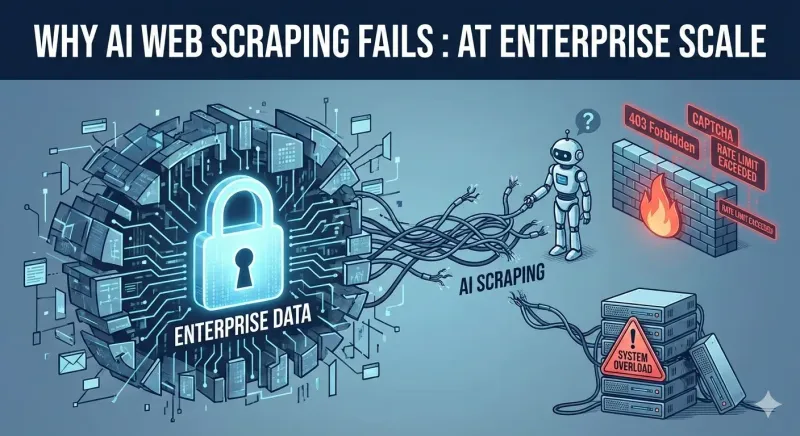
People often see AI web scraping as fast and simple. But when it comes to large-scale enterprise use cases, relying just on large language models (LLMs) introduces new risks that you may not notice.
When large language models (LLMs) became common, many believed that web scraping problem had finally been solved.
The idea was logical at first sight. If AI could read and understand language, it should also handle web pages, extract data, and adapt as sites change, which are some of the hardest web scraping problems. For teams frustrated with fragile scripts and constant maintenance, LLMs looked like a new beginning. Even the market projections were through the roof. In reality, things have become more complicated.
This gap between early expectations and real-world performance is exactly why AI web scraping fails when organizations try to use it at enterprise scale.
As my friend Arjun said, you can hack together an AI tool to work at 70% accuracy in a weekend; from there onwards, each percentage gain is extremely difficult.
The Illusion of Effortless Scale in AI Web Scraping
In industries such as retail, real estate, travel, and finance, data engineers find that LLM-based web scraping works well in early tests but struggles in large-scale production environments. This leads to a gap between what works in demos and what succeeds in real, high-volume use.
LLMs are really good at finding patterns. They can work around messy HTML, summarise text, and make different terms consistent. For small projects or early tests, this is a real improvement.
At the enterprise level, large-scale web scraping is more than just reading HTML. It is an operational system that must deliver reliable, accurate data from websites, often in places designed to block automated tools.
This is where depending mostly on LLMs begins to fail.
Three Structural Limitations of LLM-Only Web Scraping
1. Cost grows nonlinearly with volume
LLMs charge based on computing power, so AI-powered web scraping gets expensive as volume increases. But web pages are not made for machines. They have a lot of repeated code, scripts, and extra content that must be processed repeatedly.
What looks affordable for thousands of pages quickly becomes too costly at millions. Retrying failed pages, updating content, or keeping records only adds to the expense. For organizations needing regular data updates, like price checks or catalog monitoring, this pricing model creates long-term uncertainty.
2. Reliability is probabilistic, not deterministic
Enterprise web scraping systems must be predictable to ensure accurate and reliable data extraction. A field is either present or missing; a price is either right or wrong. LLMs, however, give results based on probability.
This creates subtle risks:
- silent hallucinations
- website layout drift over time
- inconsistent schema
- difficulty tracing root causes when errors occur.
On their own, these errors might seem minor. But at scale, they multiply and reduce trust in analytics, AI models, and decision-making systems.
3. Access remains the unsolved bottleneck
One of the biggest overlooked limits in LLM web scraping is that LLMs do not fix the problem of access.
Anti-bot systems check network behaviour, browser details, session patterns, and traffic consistency. No matter how advanced your extraction model is, it cannot collect data it cannot reach.
In real-world production, most failures happen before parsing even starts:
- blocked requests
- degraded coverage
- partial crawls
- region-specific denials
LLMs operate above this layer. They do not replace it. The access problem is extremly hard and needs continues adaptation often requireming a dedicated R&D team.
Enterprise Web Scraping Is an Infrastructure Problem
The main mistake is to see web scraping as just a single technical skill.
In reality, enterprise web scraping and scalable data extraction are more like other core infrastructure:
- It must be resilient to change
- observable and auditable
- cost-predictable
- compliant by design
- adaptable without constant rework
This means you need a system with multiple layers, not just one model.
Where AI Actually Creates Durable Value in Scalable Web Scraping
This does not make AI less important. In fact, AI is essential when used wisely. Effective enterprise web scraping systems separate concerns across access, extraction, and validation:
- Access and crawl control are handled through engineered, deterministic mechanisms.
- Stable data fields rely on rule-based or ML-assisted extraction.
- Unstructured or ambiguous content is selectively routed through LLMs.
- Quality and drift detection are continuously monitored, not inferred.
- Human feedback loops correct edge cases and retrain models where it matters.
In this setup, LLMs enhance the system’s abilities instead of being a single point of failure.
A Strategic Question for Leaders
For executives considering AI-driven data projects, the real question is not:
“Can AI extract this data?”
It is:
“Can this system deliver trustworthy data, every day, at scale, under real-world constraints?”
Organizations that miss this point often have to rebuild their data pipelines after early wins, but now with more urgency and higher costs.
Conclusion: Scale Is a Discipline, Not a Feature in Enterprise Web Scraping
LLMs have changed how we experiment, but they have not replaced the basics of good system design.
Teams that treat web scraping as a strategic skill, not just a quick fix, are building systems that combine strong engineering with focused AI support.
The result is not just faster and more scalable data extraction, but also a lasting advantage for enterprise data. In today’s economy, where external data is more important than ever, that difference truly matters.
Build infrastructure or buy data from us
You could spend engineering time battling proxies, fingerprints and more web scraping headaches Or you could plug into Datahut's battle-tested extraction layer—get structured, data feeds delivered daily—and reserve your AI budget for actual value-add tasks like enrichment and analysis.
Frequently Asked Questions About AI Web Scraping
- Why do AI web scrapers fail at web scraping at scale?AI web scrapers struggle because they are probabilistic systems and they can't crack the access problem at scale. While they work well for small experiments, they introduce reliability, cost, and consistency issues in production-grade web scraping environments, especially when combined with anti-bot protection and frequent website changes.
- Is AI web scraping scalable for enterprise use?AI web scraping can be scalable when used selectively within a broader enterprise web scraping architecture. Deterministic crawling, access management, and validation layers must be in place alongside LLMs to ensure reliability, cost control, and long-term scalability.
- How should enterprises think about LLMs vs traditional web scraping?LLMs vs traditional web scraping is not an either-or decision. Traditional scraping provides deterministic control and cost predictability, while LLMs add value in unstructured data extraction and enrichment. The most effective systems combine both approaches.


