
E-commerce Category Management: Challenges, Opportunities, and Best Practices in 2026
- Aarathi J
- Mar 11, 2020
- 10 min read

Updated: Jun 3
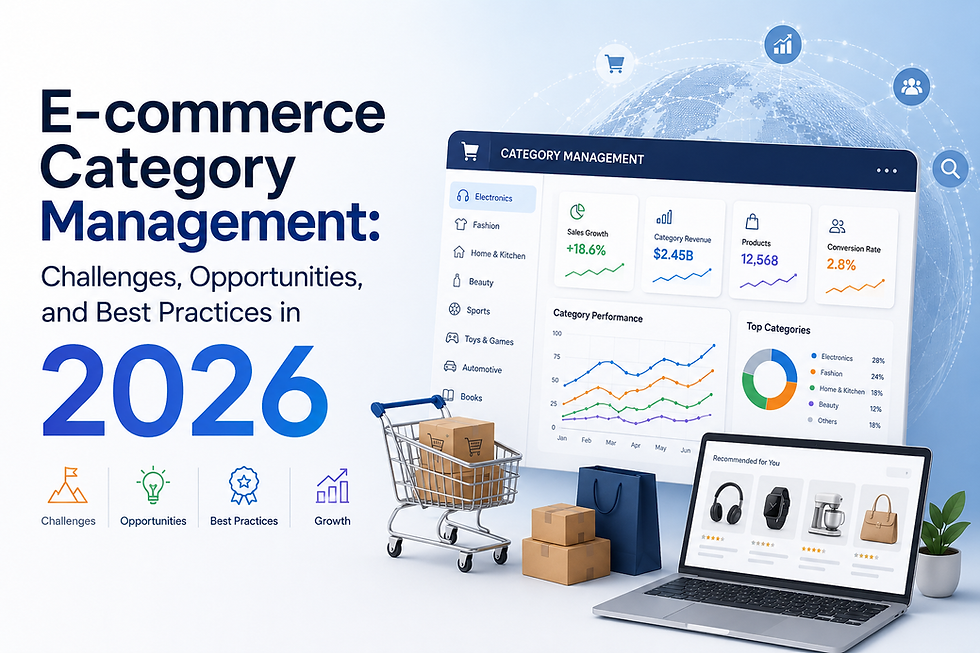
The e-commerce industry is enormous yet functions so smoothly. The secret recipe is e-commerce category management. A particular class of experts - e-commerce category managers - is the caretaker of your business. Right from pricing to space allocation, they manage it all.
Let us take an example of a product in a supermarket or on an e-commerce website. We need to present our product in a way that appeals to customers. Many factors come into play - pricing, visual appeal, inventory, and positioning. The person responsible for tying all of these together is your e-commerce category manager.
What is E-commerce Category Management?
Category management is the process of grouping substitutable or related products into distinct business units called categories. Each category has its own profitability target, and the category manager is accountable for hitting it.
You can categorize either products bought by a manufacturer or those sold by a retailer - the approach depends entirely on your business structure. What remains constant is that each category is treated as a standalone business, requiring its own strategy, budget, and performance tracking.
Who Are Category Managers?
In a typical supermarket, there are hundreds of product categories. In an e-commerce marketplace, there can be millions. Each of those categories has variables tied to it - pricing, inventory, space allocation, and presentation. Managing all of this is a humongous task, and the person responsible is the category manager.
An e-commerce category manager is responsible for increasing the ROI of products within a specific category. To do this effectively, they need to be skilled in sales, visual merchandising, pricing, data analytics, and stakeholder management.
Roles and Responsibilities of a Category Manager
As a category manager, your core task is to maximize sales and meet each category's financial targets. Here is what the role typically covers:
Assortment - Finalizing the product range for a store or cluster. Deciding which products to add or remove.
Floor planning - Determining store layout, aisle spacing, and creation of high-traffic hot spots.
Space allocation and management - Carefully positioning top-performing products to raise visibility and sales.
Visual Merchandising - Using planograms, brand blocking, and color blocking to display products appealingly.
Price planning - Determining prices that suit your target customers whilst maintaining margin targets.
Inventory handling - Guaranteeing adequate stock levels while eschewing overstock of slow-moving products.
Promotions - Planning and executing marketing campaigns for a product or an entire category.
How to Classify Job Roles into E-commerce Categories
One of the most common questions in e-commerce org design is: which category does a given manager or job title belong to? Here is a practical classification system:
Job Title | Ecommerce Function Category |
Marketing Manager | Brand & Category Marketing |
Head of Ecommerce | Category Strategy & Operations |
Brand Marketing Director | Brand Category / Category Development |
Sales Manager | Sales & Revenue Category |
Business Development Manager | Growth & Partnership Category |
Merchandising Manager | Visual Merchandising & Space Planning |
IT Manager | Technology & Operations Category |
Pricing Analyst | Pricing & Competitive Intelligence |
Inventory / Supply Chain Manager | Inventory & Fulfillment Category |
How to classify a marketing manager in an e-commerce organization’s category
A marketing manager in an ecommerce organization falls under the Brand & Category Marketing function. Their primary responsibility is driving awareness and demand for products within specific categories, working closely with the category manager on promotions, content, and campaigns.
How to classify a head of ecommerce by category
The Head of Ecommerce typically sits at the intersection of Category Strategy and Operations. They own the overall ecommerce P&L, define category priorities, and align cross-departmental teams, including marketing, merchandising, supply chain, and tech.
How to classify a business development manager in e-commerce
A business development manager maps to the Growth & Partnership Category - responsible for identifying new supplier partnerships, broadening product category coverage, and driving revenue through strategic alliances.
Which category fits sales management roles in e-commerce?
Sales management roles fall under the Sales & Revenue Category, focusing on driving conversion, managing sales teams, hitting GMV targets, and improving sales funnels across categories.
Understanding this mapping helps organizations build cleaner category hierarchies, assign accountability correctly, and avoid operational overlap between functions.
The Development of E-commerce Category Management
If you think e-commerce category management is a new concept, it isn’t. It has been evolving for over a decade. Here is how it has transformed:
1. Tools Used
Back in 2015, category management was mostly manual - Microsoft Excel was the primary interface. Today, e-commerce category managers use advanced BI tools like Power BI and ThoughtSpot. These tools are automated, customizable, and powered by machine learning algorithms, enabling analytics-based decisions at scale.
2. Variety of Data Used
Around 2015, business decisions relied solely on internal data. Brainstorming with top executives was the norm. Today, competitive external data has entered the picture -allowing category managers to examine market trends, monitor competitors, and make more informed global decisions.
3. Pricing Trends
Pricing used to be based on guesswork and slow-moving. Today, it has evolved into highly dynamic pricing - where category managers analyze competitive data in real time and continuously modify prices to maximize sales velocity.
4. Promotional Strategies
The industry has moved from simple discounts to sophisticated promotional tactics: product bundling, tiered discounts, alternative product recommendations, and loyalty incentives - all driven by category-level data.
Challenges in E-commerce Category Management
As shopper expectations evolve and competition increases, category management faces distinct group challenges.
1. Giving Shoppers a Reason to Choose You
Reasonable pricing and product quality are no longer enough. Differentiation is now central to every category plan. Category managers must narrow down target shoppers and their needs, and improve the appeal of the store or listing experience to stand out from competitors.
2. Customer Curation
Retailers face constant pressure to cut costs while maintaining productivity against discounters with limited product ranges. The category manager must identify each product's unique value and communicate it effectively - driving customer understanding and ultimately increasing sales.
3. Making Yourself Indispensable
A great category manager studies large volumes of sales data and shopping behavior data, then translates them into category-level insights. This encourages valuable collaborations with retailers and makes the category manager an irreplaceable part of the business.
4. Looking at the Bigger Picture
A retailer’s goal is to optimize the entire store - not just one category. Category managers must identify and act on cross-category opportunities, using their understanding of shopper missions to make proposals that benefit the wider business.
5. Consistency and Transparency
Today’s shoppers are digitally savvy and expect consistent, transparent messaging. Before executing any category plan, ensure your communications on pricing, promotions, and product information are clear and consistent across channels.
6. Easy Implementation
Most category manager proposals are strategically valid but hard to execute. With retailers focused on supply chain cost-cutting, implementation capacity is limited. The best category managers design proposals that are simple, practical, and easy to roll out.
Six Skills to Be an Effective Category Manager
Category management demands a varied and evolving skillset. Here are the six core competencies that separate good category managers from great ones.
1. Supplier Management
You must ensure the unhindered flow of products or services. Stay in regular contact with suppliers, monitor their industry certifications and financial sustainability, and hold them to performance standards. Only when supplier performance is in check can you deliver the end product efficiently.
2. Commercial Expertise
With knowledge of the commercial landscape, a category manager can negotiate effectively and manage risk. This includes understanding:
Pricing models
Investment outcomes
Procurement-related risks
Spending patterns and budget allocation
Your job is to ensure all commercial factors are duly addressed - from finalizing deals to managing legal and compliance requirements.
3. Product and Project Management
Category managers operate across multiple workstreams with stakeholders who have varying expectations. You need to manage multi-departmental teams, navigate diverse working styles, and keep both budget and timelines in check. Delivering on these product management fundamentals creates credibility with leadership and suppliers alike.
4. Domain Acumen
A category manager with deep domain knowledge is exponentially more effective. Beyond sourcing and procurement basics, you need a deeper understanding of your category -the products, customers, seasonality, and competitive factors. This knowledge enables you to deliver real-time value that stakeholders can trust.
5. Zero-Based Budgeting
Zero-based budgeting requires you to justify every expense for each new budget period, rather than simply rolling forward last year’s numbers. In category management, this means having structured conversations with stakeholders about what is actually needed and why - ensuring the budget goes where it has the greatest impact.
6. Digital Nativity
Technology and digitalization is one of the most powerful levers available to a category manager. From category analytics platforms to pricing intelligence tools, digital fluency makes procurement more efficient and strengthens your brand's competitive position. Category managers who embrace data and automation regularly outperform those who don’t.
Best Practices in E-commerce Category Management
1. Analyze Industry and Consumer Trends Through Data
Customer behavior data is the engine of category growth. By gaining insights into customers’ behavior, you can quickly spark innovation. Understanding purchase decision-making and the drivers of customer loyalty allows you to make the right calls on product design, pricing, segmentation, branding, and value proposition. Data-driven decision making guarantees dependable solutions too.
2. Devise Long-Term Category Strategies
Effective category planning looks beyond a single category. A change in one product range often has ripple effects across related categories. Anticipate these effects and build plans that echo throughout the business - these long-term strategies are what enable sustainable growth.
3. Develop Exit Strategies for Underperforming Products
Weak products don’t just fail - they drag down the rest of the category. They occupy valuable shelf space and divert customer attention. Use data analytics and machine learning tools to identify declining products early, and build distinct exit plans before they damage broader category performance.
4. Build Strong Vendor Relationships
A category manager works in the background with suppliers and retailers, while their decisions in the foreground determine the customer experience. Sustaining transparent, trustful relationships with both parties ensures issues can be addressed directly and quickly - without escalation.
5. Ensure Product Availability for Changing Demand
Modern data tools can accurately predict seasonal and festive shifts in demand. Maintaining inventory that takes into account these fluctuations ensures customers find what they need when they need it - building trust and reducing lost sales.
6. Refine Space Allocation
Tactical placement is one of the highest-leverage decisions a category manager makes. Top-performing products should be front and center. New products should be placed where customers will naturally discover them. Every placement decision should be grounded in performance data.
7. Liaise with Marketing Teams
Product pricing is dynamic, and category managers need to work closely with marketing to make the most of seasonal peaks, competitive promotions, and campaign windows. Also keep a close watch on competitor promotional activity - it directly informs your strategy.
8. Collaborate with Merchandisers to Expand Categories
Working with merchandisers to develop broader product ranges creates joint growth opportunities. For example, pairing a complementary product with your core SKU can lift both businesses. Use these joint efforts to explore cross-category expansion.
9. Forecast Demand to Sustain Inventory
The capacity to anticipate demand increases and stock accordingly - is one of the most commercially impactful skills a category manager can have. Accurate forecasting builds buyer trust and positions your category to capitalize on demand peaks. This additionally ensures the sustainability of inventory across seasons.
10. Own Budget Development and Category Revenue
Allocate the budget where it creates the most impact. High-performing products need sustained investment to stay competitive. Underperforming products need marketing spend and customer feedback loops to course-correct. Budget decisions should always follow performance data, not habit.
Skills Required to Be a Category Manager
Soft Skills
Ability to deliver results under pressure
Self-motivation and ownership mindset
Robust analytical and management skills
Interpersonal and communication skills
Creative and negotiation ability
Attention to detail
Education
Bachelor’s degree in business, retail, management, sales, marketing, or consumer science
MBA in retail management or merchandising (advantageous)
Knowledge and Technical Skills
3+ years of FMCG experience in merchandising or product purchasing
Proficiency in Microsoft Office and BI tools (Power BI, ThoughtSpot)
Market and competitive intelligence knowledge
Understanding of category management principles and software
Familiarity with buying systems and procurement processes
Managing Suppliers vs. Managing Retailers
The day-to-day work of a category manager looks different depending on whether you’re working with suppliers or retailers.
Managing Suppliers
Your role is to help suppliers optimize their category's performance through shelf space decisions, competitor product placement, and promotional planning. However, suppliers have a largely suggestive role. The final call on execution rests with the retailer.
Managing Retailers
When working with retailers, your daily responsibilities include:
Product pricing decisions
Inventory management
Visual merchandising execution
You identify which products to add or remove from the range, spot emerging trends, and act on them quickly. Data analytics is the backbone of this work - from floor planning to price optimization to product performance tracking.
Who Would Do Well as a Category Manager?
Category management is inherently high-pressure. It is an ideal role for someone who is driven by challenges, enjoys working across functions, and is motivated by commercial outcomes.
Strong communication and persuasion skills are essential - you will regularly negotiate with suppliers, influence retailers, and pitch proposals to leadership. Confidence in presenting data-backed recommendations is mandatory.
Analytical thinking and organizational skills round out the profile. Category managers who can synthesize large amounts of data into clear, actionable plans consiregularly outperforms who rely on intuition alone. A working knowledge of emotional intelligence also helps - the role is deeply relational, and trust with suppliers, retailers, and internal stakeholders is everything. All these skills come together to have the right effect on customers and stakeholders.
How Datahut Helps Category Managers
Datahut specializes in competitive e-commerce data. We extract product, pricing, and review data from across the web - giving category managers the intelligence they need to make confident decisions on pricing, assortment, and category strategy.
Whether you need rival pricing data, product trend analysis, or review sentiment insights, Datahut’ web data scraping services are built to support category management at scale.
Contact Datahut today to learn how we can power your category strategy with reliable, live data.
Frequently Asked Questions (FAQs)
1. What is e-commerce category management?
E-commerce category management is the strategic process of organizing and optimizing product categories to improve sales, customer experience, and profitability.
It involves managing product assortment, pricing, promotions, inventory, and merchandising within a specific category.
Effective category management helps customers find products easily and encourages higher conversion rates.
2. Why is category management important for online retailers?
Category management helps retailers align their product offerings with customer demand.
It improves product discoverability and enhances the shopping experience.
Businesses can increase revenue, reduce inventory waste, and make more informed merchandising decisions.
Well-managed categories also strengthen competitive positioning in crowded marketplaces.
3. What are the biggest challenges in e-commerce category management in 2026?
Managing massive and constantly changing product catalogs.
Maintaining accurate and consistent product data across channels.
Responding quickly to changing consumer preferences and market trends.
Balancing inventory levels to avoid stockouts and overstock situations.
Competing with dynamic pricing and promotional strategies from competitors.
4. How can data analytics improve category management decisions?
Analytics helps identify top-performing and underperforming products.
Retailers can track customer behavior, search trends, and purchase patterns.
Data-driven insights support better assortment planning and pricing strategies.
Analytics enables more accurate demand forecasting and inventory optimization.
5. What are the best practices for successful e-commerce category management?
Use real-time market and competitor data to guide decisions.
Regularly review category performance metrics and customer feedback.
Optimize product assortment based on demand and profitability.
Maintain high-quality product content, attributes, and categorization.
Leverage AI and automation tools for forecasting, pricing, and merchandising.
Continuously test and refine category strategies to adapt to market changes.


