
How India's DPDP Act Is Changing Web Scraping: What Every Business Should Know

India's DPDP Act: Introduction
Imagine your marketing team has been scraping contact data from public directories for years. Then your legal team forwards you a notification about the DPDP Act. Suddenly, that routine pipeline is a compliance question nobody has a clean answer to. That's the situation many Indian businesses are walking into right now.
India's DPDP Act has technically been in effect since August 2023. For two years, it sat on paper with no regulator, no rules, and no penalties. That changed in November 2025. The rules are now live, the Data Protection Board is operational, and full enforcement begins in May 2027. For businesses relying on web scraping, that's not as much time as it sounds.
Here's what the DPDP Act actually means for your web scraping and what your business needs to do before enforcement begins.
What Impact Does the DPDP Act Have on Web Scraping?
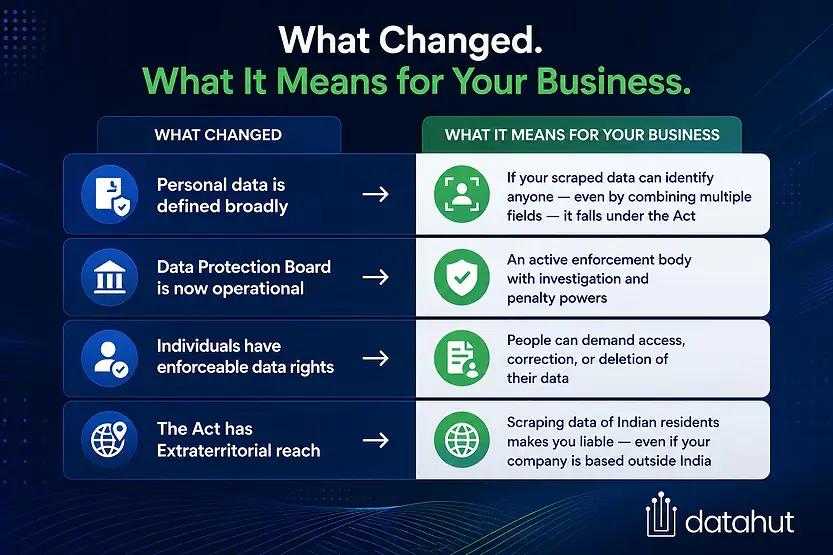
The DPDP Act changes how businesses collect, store, and use personal data, and web scraping operations are directly in scope. Following MeitY's notification of the DPDP Rules in November 2025, businesses can no longer treat data collection as a purely technical decision. There are legal obligations attached to it now.
Is Your Web Scraping Safe or Risky Under the DPDP Act?
Key insight: The difference between compliant and non-compliant scraping often comes down to one question: are you collecting commercial information or information about an identifiable individual? Stay on the left side of this table, and your DPDP exposure will be significantly reduced.
What Your Business Must Get Right: Consent Under DPDP
Under the DPDP Act, consent must be clear and in plain language: explaining exactly what data is collected and why. Buried checkboxes and vague terms no longer hold up legally. The Act also gives individuals the right to access, correct, or delete their data whenever they choose. Users must also be able to withdraw consent just as easily as they gave it. (Section 6, Digital Personal Data Protection Act, 2023)
What Happens If Your Business Suffers a Data Breach Under DPDP?
The DPDP Act requires businesses to notify the Data Protection Board and affected individuals immediately upon discovering a breach. (Section 8(6), DPDP Act 2023). The DPDP Rules 2025 specify this window as 72 hours; missing that deadline carries penalties up to ₹200 crore.
What Are the Rules for Collecting Children's Data Under DPDP?
If your platform could in any way be accessed by anyone under 18, whether it's gaming, education, or e-commerce, verifiable parental consent is required before processing their data. The Act also strictly prohibits tracking, behavioural monitoring, and targeted advertising directed at children. (Section 9, DPDP Act 2023)
How Does the DPDP Act Define Significant Data Fiduciaries?
Large platforms processing personal data at scale - e-commerce companies, social media platforms, and similar businesses - may be classified as Significant Data Fiduciaries. This comes with stricter obligations: appointing a Data Protection Officer based in India and undergoing independent data audits. (Section 10, DPDP Act 2023)
What Are the Penalties for Non-Compliance Under the DPDP Act?
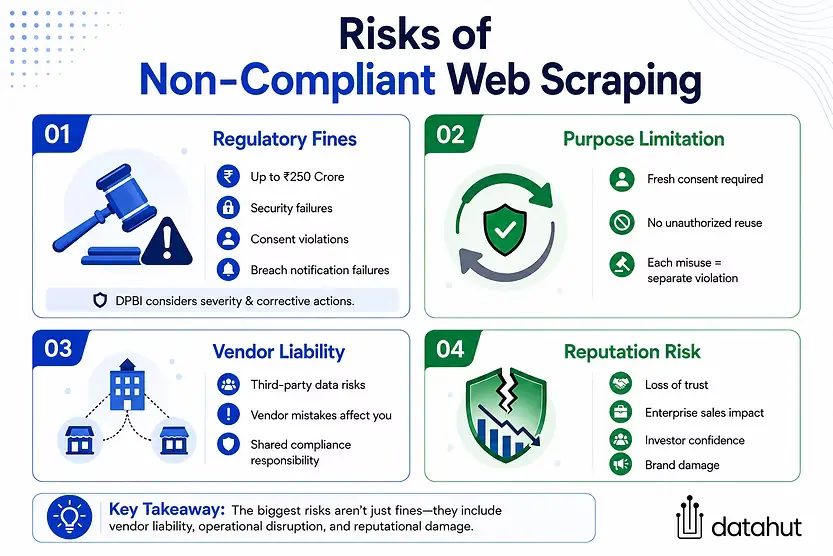
Penalties under the DPDP Act can reach up to ₹250 crore per instance. The Data Protection Board is operational as of November 2025 - it has the power to investigate, summon, and impose fines. This is not a future risk. It is a present one.(Section 33(1), DPDP Act 2023) The Board weighs the severity and your corrective actions before imposing a fine. (Section 33(2), DPDP Act 2023)
What are the Major Risks of Non-Compliant Web Scraping?
Risk 1: Heavy Financial Penalties
The fact that the DPDP Act has a tiered system of penalties is important.
Risk 2: Purpose Limitation Violations
Data collected for one purpose cannot be used for another without fresh consent. It’s easy for teams to quietly repurpose existing scraping pipelines for new internal uses, completely unaware that doing so can trigger legal and compliance risks.
A marketplace intelligence company tracks seller performance across platforms such as product ratings, pricing, and inventory levels. That's compliant commercial data. But when the same dataset is handed to the sales team to build outreach lists using seller phone numbers and personal email addresses, the original purpose has been crossed. The data was collected for market analytics; using it for direct outreach is a separate act that requires fresh consent under the DPDP Act.
Risk 3: Third-Party and Vendor Liability
Outsourcing your scraping doesn't outsource your legal risk. Under the DPDP Act, your business remains legally accountable for how your data is collected. This makes vendor selection a legal decision, not just a commercial one.
Risk 4: Reputational Damage
A Data Protection Board investigation is public. Even if it ends without a fine, it will still be part of your company's public record. A compliance investigation surfacing during a procurement process can cost you a deal worth far more than any fine.
Key takeaway: The ₹250 crore figure gets attention, but for most businesses, the bigger day-to-day risks are vendor liability, pipeline disruptions, and what happens when a Board investigation goes public.
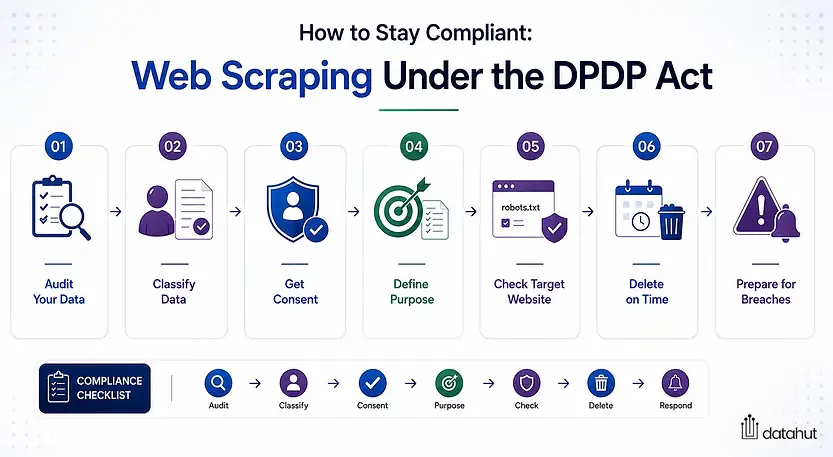
How to Stay Compliant: Web Scraping Under the DPDP Act
Step 1: Audit your existing data pipeline.
Start by mapping every active data pipeline in your business. What data are you collecting, from which websites, where is it stored, and who can access it? Most businesses can't answer all four questions cleanly, and that gap is exactly where compliance risk hides.
An Amazon seller scrapes competitor product prices every morning to adjust their own pricing automatically. This is generally low risk: product prices, discounts, and stock availability are commercial information, not personal data. But if that same scraper picks up customer review names or seller contact details, those elements fall under the DPDP Act.
Step 2: Identify whether your data is personal or non-personal
Personal data is any digital information that can identify an individual directly or indirectly. In web scraping, this includes names, emails, phone numbers, and location data.
A travel aggregator monitors flight prices every hour to recommend the cheapest fares. Collecting route information, airline names, schedules, and ticket prices is different from collecting passenger names, booking IDs, or traveller contact details. The latter introduces personal data obligations.
Takeaway: Monitor fares - not travellers
Step 3: Make Consent Clear, Specific and Withdrawable
Valid consent under the DPDP Act must be clear, specific, and deliberate, not buried in a terms document or pre-ticked by default. Users must also be able to withdraw consent just as easily as they gave it.
Step 4: Establish a Clear Purpose and Stick to It
The DPDP Act requires a clear, lawful purpose for every data collection activity. Document exactly why you need the data before you start scraping, not after. And if that purpose changes, you need fresh consent before repurposing it.
A recruitment platform analyzing job postings for hiring trends is generally on safe ground. The risk starts when the same pipeline begins pulling candidate resumes or applicant profiles. That data requires explicit consent. And if it was collected for talent matching but later used to build a marketing list, that second use is a separate DPDP violation, even if the original collection was legal.
Step 5: Target Site Pre-Screening
Before running any scraper, check the target site's robots.txt file and Terms of Service. Bypassing these restrictions can constitute unauthorised access under Section 43 of the IT Act, which immediately undermines any DPDP compliance claims your business might otherwise have.
Step 6: Automate Data Expiry and Deletion
Under the DPDP Act, holding onto personal data indefinitely isn't an option. Once data has served its purpose, it needs to go. Set clear shelf lives for every dataset, build automatic deletion routines, and keep clean logs, as you may need to show them during an audit.
Step 7: Set Up a Breach Response Plan
Write your breach response plan before you need it. Be specific: who detects the breach, who escalates it internally, who notifies the Data Protection Board, and who communicates with affected individuals. The DPDP Act gives you just 72 hours. Missing that deadline carries a penalty of up to ₹200 crore.
What Should Web Scraping Businesses Prioritise Under the DPDP Act?
If your business depends on web scraping for day-to-day decisions, these four areas need leadership attention.
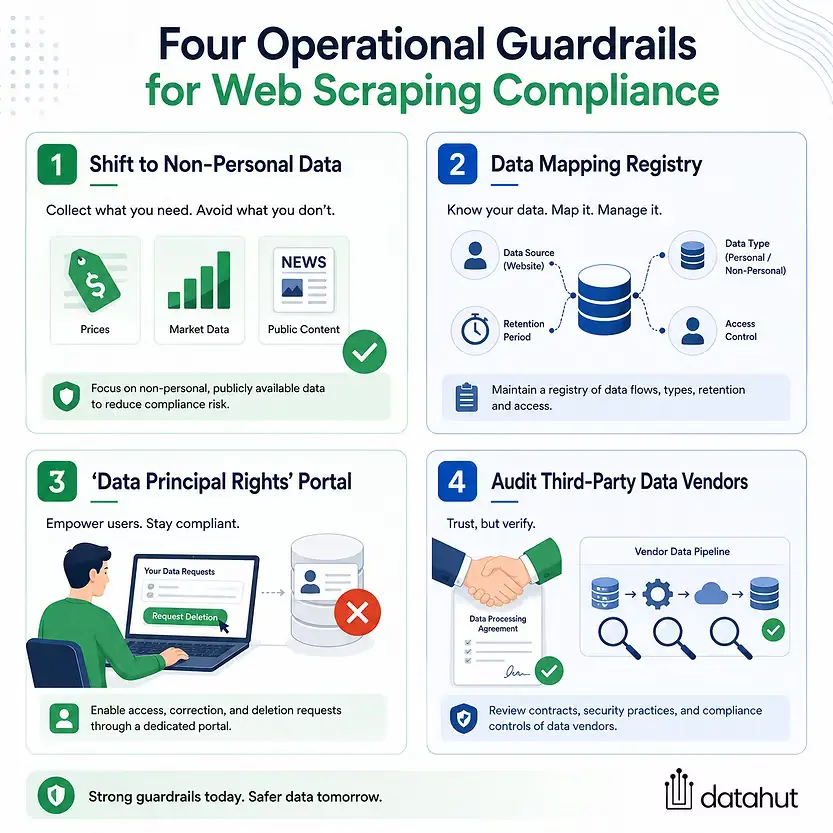
1. Shift Focus to Non-Personal Data
Commercial scraping remains fully viable if you avoid personal data. Pricing intelligence, market trends, product catalogues, news monitoring- none of these requires touching individually identifiable information. Build your pipelines around non-personal data wherever possible, and you significantly reduce your compliance exposure.
2. Maintain an Internal Data Mapping Registry
Know exactly where scraped data enters your business, who accesses it, where it lives, and when it gets deleted. Without this registry, you cannot respond to a Data Protection Board inquiry.
3. Build a "Data Principal Rights" Portal
If personal data is stored in your databases, individuals have a legal right to demand its deletion under the DPDP Act. Build a clear, accessible mechanism for users to make that request, and make sure someone inside your organisation is responsible for acting on it promptly.
4. Audit Third-Party Data Vendor
Buying ready-made scraped datasets or lead lists from vendors carries real legal risk. Under the DPDP Act, if their data was collected illegally, your business shares the liability, not just the vendor. Make them show documented proof of how consent was obtained or how PII was removed before you sign anything.
Conclusion
The DPDP Act is already active, and it does not prohibit web scraping. But it does require businesses to collect data with a clear purpose, handle it transparently, and take full accountability for how it is used. Businesses that build compliance into their data processes today will face far less disruption when full enforcement begins on 13 May 2027. Those that don't will be scrambling to catch up.
Keep Scraping. Stay Compliant. Here's How.
A consumer electronics brand wanted to monitor competitors across Amazon, Flipkart, and Croma. Their scraping pipeline was configured to collect product names, specifications, prices, discounts, and ratings, but deliberately excluded customer names, reviewer profiles, and seller contact details. By designing around commercial data from the start, the company got the market intelligence it needed without touching a single data point that triggers DPDP obligations.
Datahut has been helping businesses extract web data for 14 years. As India's DPDP Act moves toward full enforcement, we handle the compliance, so your team doesn't have to. From PII filtering to purpose-limited pipelines, we deliver clean, compliant data while you focus on decisions that grow your business.
Talk to a Datahut expert today to get a free consultation and build a DPDP-compliant data strategy for your organisation.
Frequently Asked Questions( FAQs)
1. What is the DPDP Act?
The Digital Personal Data Protection (DPDP) Act, 2023 is India's first comprehensive law governing how digital personal data is collected, stored, and used. It gives individuals greater control over their data and places clear legal obligations on businesses that process it. It moves to full enforcement in May 2027.
2. Is Web scraping illegal under the DPDP Act?
Web scraping is not illegal under the DPDP Act, provided that you are scraping non-personal data. For example, e-commerce product prices, stock availability, or information from public business directories. If you want to carry out a thorough examination of global precedents, see our guide on whether web scraping is legal.
3. What counts as personal data under the DPDP Act?
Under the DPDP Act, personal data is any digital data that can identify an individual directly or indirectly. This includes obvious identifiers like names, email addresses, and phone numbers, as well as less obvious ones like location data, financial details, and behavioural profiles built by combining multiple data points.
4. Does the DPDP Act apply if we scrape data that is already public?
Yes. Don't fall into the trap of assuming "publicly visible" means "free to collect." Under the DPDP Act, publicly accessible personal data like user profiles, contact details, or reviews is still protected. If your scrapers touch personal details, you are still legally required to follow core privacy rules.
5. What happens if my business is not DPDP compliant by May 2027?
Non-compliance after May 2027 exposes your business to financial penalties, regulatory investigation, and reputational damage. The smarter move is building compliance into your data processes now, while there's still time to do it without pressure.


