

Competitive analysis for e-commerce: A data-driven framework
An e-commerce competitor can change its price in the morning, launch a promotion in the afternoon, and run out of stock before the day is over. If you're still comparing competitors through occasional manual checks, you're working with a partial view of the market.
Competitive analysis gives you a way to compare what competitors are actually doing: their prices, products, promotions, availability, reviews, and market position.
For e-commerce brands, the useful part isn't collecting a huge amount of competitor data. It's making that data comparable and turning it into decisions.
A practical approach looks like this:
Collect → Normalize → Compare → Identify gaps → Act
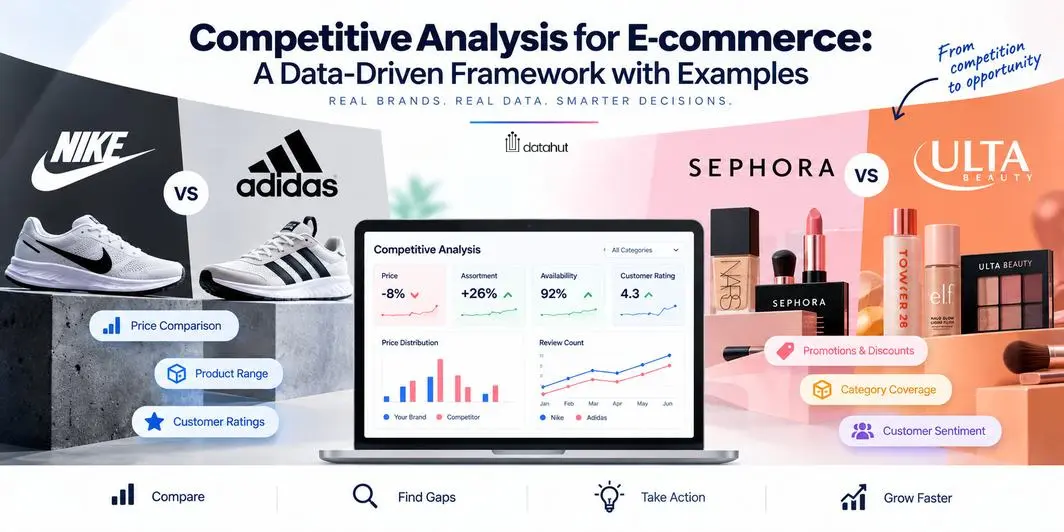
This guide covers the metrics worth tracking, a step-by-step competitive analysis framework, and examples from Datahut's Nike vs Adidas competitive analysis and Sephora vs Ulta analysis.
What is competitive analysis?
Competitive analysis is the systematic evaluation of competitors' products, pricing, positioning, promotions, customer experience, and market activity. The goal is to understand where your business stands and where competitors have an advantage.
For e-commerce, that means asking practical questions:
- What products do competitors sell?
- What price points do they target?
- How often do they discount?
- Which products stay in stock?
- Which products receive the strongest customer response?
- How broad is their assortment?
- Which customer segments are they targeting?
- Where are they stronger or weaker than us?
- What is changing in the market?
The result is competitor activity converted into comparable data.
Shopify's competitive analysis guide similarly covers competitors' strengths, weaknesses, products, pricing, marketing, distribution, and customer information.
The analysis only becomes useful when the information leads to a decision.
Why competitive analysis matters for e-commerce
E-commerce markets move quickly. A competitor can add hundreds of products, change prices, launch a promotion, run out of stock, enter a new category, or target a different customer segment.
A quarterly spreadsheet can tell you what happened. Continuous competitive intelligence gives you a better view of what is happening now.
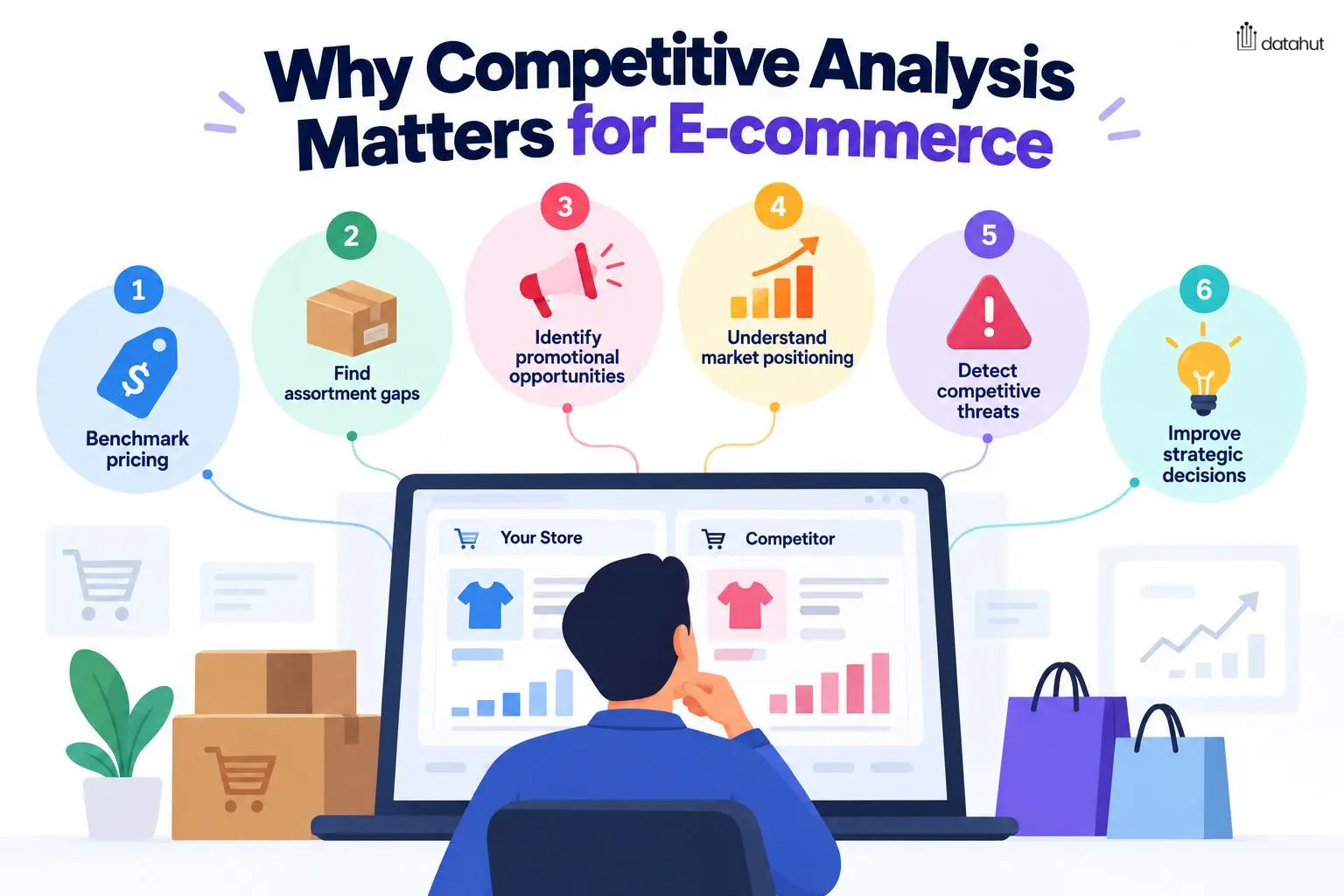
A structured analysis can help your team:
1. Benchmark pricing
You can see whether your products are above the market, below it, or sitting within the dominant price range.
2. Find assortment gaps
Competitor catalogs may contain products, sizes, colors, or variants that you don't carry.
3. Identify promotional opportunities
Competitor discounts can show when a category is becoming more promotion-driven.
4. Understand market positioning
Compare price and assortment to see whether competitors are positioned as premium, mid-market, value, specialist, or mass-market brands.
5. Detect competitive threats
A competitor doesn't have to beat you across its entire catalog. It can gain an advantage in one high-value category and still take customers from you.
6. Improve strategic decisions
Instead of guessing what competitors are doing, your team can work from structured evidence.
Competitive analysis works better as an ongoing system than as a one-time report. Shopify also recommends refreshing competitor analysis as businesses and markets change.
The 7 metrics to track in an e-commerce competitive analysis
Price alone won't tell you why one competitor is outperforming another. You need to look at several parts of the catalog and customer experience together.
1. Product assortment
Start with a basic question:
What does each competitor actually sell?
Useful fields include:
- Total SKU count
- Categories
- Subcategories
- Product variants
- Brands carried
- New products
- Discontinued products
- Product attributes
- Category coverage
Suppose Brand A sells 10,000 products and Brand B sells 4,000.
That doesn't automatically make Brand A stronger.
Look at where those products are concentrated. A competitor with a smaller catalog may dominate a category that matters more to your customers.
What to compare
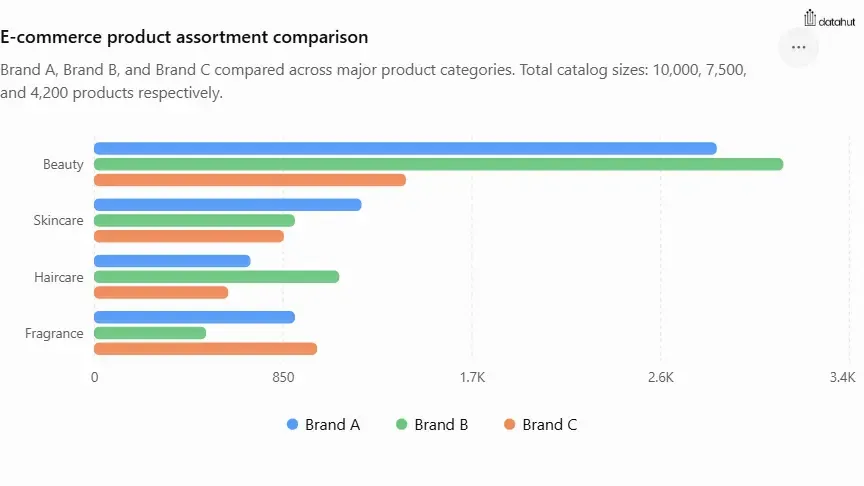
This gives you a category-level view of each catalog.
If you need to identify competitors before starting the analysis, begin with how to find e-commerce competitors and narrow the list to brands that actually compete for your customers.
2. Competitive pricing analysis
Pricing is one of the most useful parts of e-commerce competitive analysis, but checking the price of one product isn't enough.
Track:
- Average price
- Median price
- Minimum price
- Maximum price
- Price distribution
- Price bands
- Sale price
- MRP/list price
- Discount percentage
- Price changes over time
This is where competitive pricing analysis becomes more useful than manually checking competitor websites.
Example
Consider the product distribution from Datahut's Nike vs Adidas analysis:
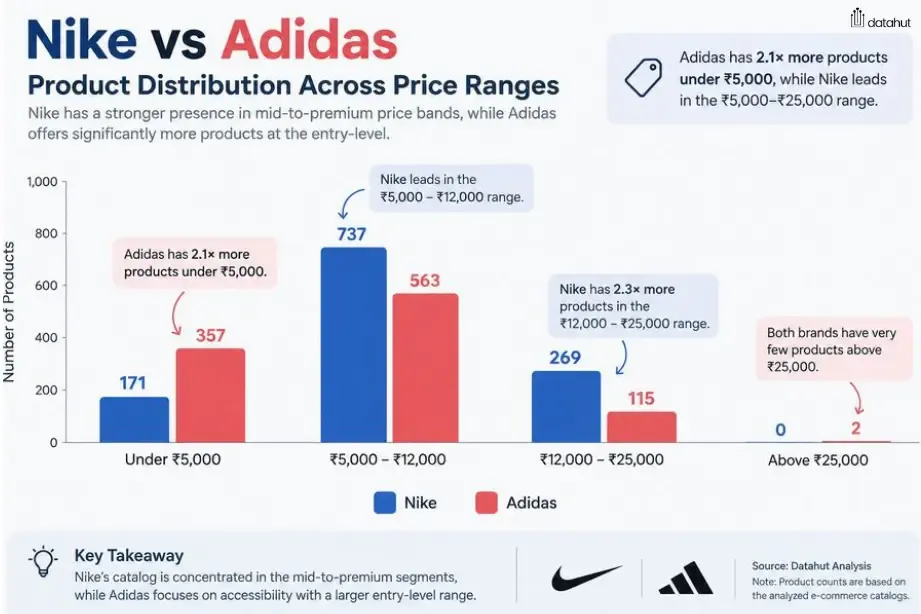
These figures come from Datahut's Nike vs Adidas product analysis and show how the two catalogs differ across price bands. See the full Nike vs Adidas analysis.
The useful conclusion isn't simply that Nike is expensive.
Nike has more products in the mid-to-premium bands, while Adidas has considerably more products below ₹5,000.
That difference tells you more about their pricing positions than a single product comparison does.
3. Discounting and promotions
Two competitors can have similar list prices and still use very different promotional strategies.
Track:
- Percentage of products discounted
- Average discount
- Median discount
- Deepest discount
- Number of products on sale
- Promotional frequency
- Sale duration
- Category-level discounts
Datahut's Nike vs Adidas analysis found substantially different discounting patterns, with Adidas showing deeper average markdowns than Nike in the analyzed catalog. See the underlying analysis.
That leads to a more useful question:
Is the competitor winning because its products are cheaper, or because it discounts more aggressively?
Those require different responses.
4. Product availability
A lower price doesn't matter much if the product is out of stock.
That's why competitor stock availability belongs in an e-commerce competitive analysis.
Track:
- In-stock percentage
- Out-of-stock percentage
- Stockouts by category
- Stockout duration
- Product availability by retailer
- Availability changes over time
For example:
Competitor A: ₹2,499 - out of stock Your brand: ₹2,699 - in stock
A price-only comparison makes your product look less competitive.
Add availability to the analysis and the situation changes. Customers can't buy the ₹2,499 product while it's unavailable, so your higher-priced product may still have an opportunity.
Monitoring when your competitor runs out of stock can therefore become part of a broader competitive intelligence setup.
5. Ratings and reviews
Reviews show how customers experience products after the purchase.
Compare:
- Average rating
- Number of reviews
- Rating distribution
- Review velocity
- Recurring complaints
- Recurring positive themes
For example:
Metric | Your Brand | Competitor A | Competitor B |
|---|---|---|---|
Average rating | 4.2 | 4.5 | 4.1 |
Reviews | 2,100 | 8,400 | 1,900 |
5-star share | 62% | 74% | 58% |
Common complaint | Shipping | Packaging | Sizing |
This can reveal problems that price data won't show.
If a competitor has a strong position but repeatedly receives complaints about delivery, customer service, sizing, or packaging, those complaints can point to areas where your brand can compete.
6. Product matching
There's a basic problem with competitor analysis: you can't compare products accurately until you know which listings refer to the same product.
Consider these two listings:
Nike Air Zoom Pegasus 41 Men's Running Shoes
and
Nike Pegasus 41 Running Shoe - Men's
Are they different products?
Probably not.
Competitor catalogs often use different:
- Titles
- SKUs
- Variants
- Sizes
- Descriptions
- Naming conventions
That's why product matching for e-commerce matters.
Product matching identifies identical or sufficiently similar products across retailers and marketplaces. This makes price comparison, inventory analysis, and competitor research more accurate. Datahut's product matching guide explains the approach in more detail.
7. Market positioning
Product-level data isn't the whole picture. You also need to understand where each competitor sits in the market.
A simple positioning map can use:
X-axis: Product breadth Y-axis: Price
This can reveal groups such as:
- Low price / broad assortment
- Low price / narrow assortment
- Premium / broad assortment
- Premium / specialist assortment
You can also compare:
- Price vs quality
- Assortment vs discounting
- Price vs ratings
- Brand positioning vs distribution
At this point, competitor data starts telling you something about the market rather than just individual products.
How to perform a competitive analysis step by step
A repeatable pipeline keeps competitor research useful. Here's a practical competitive analysis framework for e-commerce.
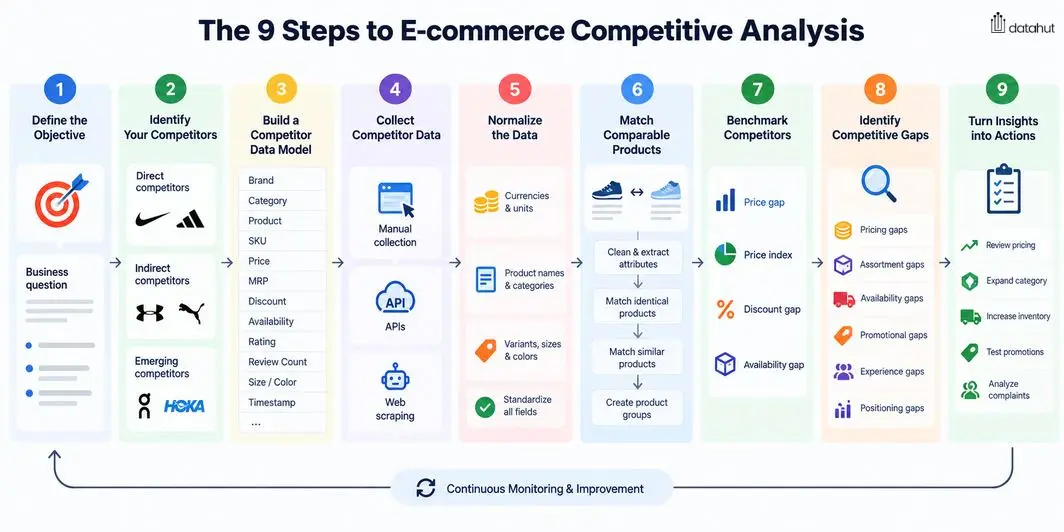
Step 1: Define the objective
Don't start by collecting everything.
Start with a business question.
For example:
Why are competitors winning our customers in the running-shoe category?
Or:
Are we priced competitively against the five largest brands?
Or:
Which product categories have the biggest assortment gaps?
The answer determines what data you actually need.
A structured competitor-analysis approach should start with a clear goal rather than collecting data without a decision in mind.
Step 2: Identify your competitors
Start with three groups.
Direct competitors
Brands selling similar products to the same customers.
Indirect competitors
Brands solving the same customer problem in a different way.
Emerging competitors
New or rapidly growing brands that could become important.
Don't assume the biggest companies are automatically your most important competitors.
A smaller brand can become a serious threat if it is:
- Expanding its assortment quickly
- Winning search demand
- Pricing aggressively
- Entering your strongest category
- Gaining customer attention
A practical starting point is 5–10 meaningful competitors. You can narrow that list based on the objective of your analysis. Shopify recommends working with a manageable competitor set rather than trying to track everyone.
Step 3: Build a competitor data model
Create one consistent schema for every competitor.
For example:
Brand
Category
Product
SKU
Product URL
Price
MRP
Discount
Availability
Rating
Review Count
Product Type
Size
Color
Timestamp
Competitor websites rarely use the same field names.
One retailer might call a field Sale Price, another Current Price, and another Offer Price.
Your pipeline needs to map all three into the same field before analysis.
Step 4: Collect competitor data
There are several ways to collect the data.
Manual collection
Works for small datasets and quick checks.
APIs
Useful when a reliable structured API is available.
Web scraping
Useful when you need to collect competitor information across large catalogs.
The objective isn't to collect as much data as possible. You need consistent, comparable data at a frequency that matches the market.
For a small catalog, weekly collection may be enough.
For highly dynamic categories, daily or more frequent monitoring may make more sense.
Step 5: Normalize the data
This step is easy to overlook and can affect every comparison that follows.
Standardize:
- Currencies
- Units
- Product names
- Categories
- Product variants
- Sizes
- Colors
- Brands
- Discounts
- Availability status
Otherwise, you can end up comparing different things.
For example:
$49.99 and ₹4,199
cannot be compared until the currency is converted.
Likewise:
500 ml and 0.5 L
represent the same quantity.
Normalization makes those records comparable.
Step 6: Match comparable products
After normalization, match equivalent products.
A simplified matching pipeline looks like this:
Raw competitor catalogs
          ↓
Clean product names
          ↓
Extract attributes
          ↓
Identify brand/model/SKU
          ↓
Match identical products
          ↓
Match similar products
          ↓
Create comparable product groups
Once the products are matched, you can answer questions such as:
What is the price difference for the exact same product across retailers?
You can also identify comparable products positioned at a lower price.
Step 7: Benchmark competitors
Now calculate metrics that make the raw data easier to interpret.
Price gap
Your price − competitor price
Price index
Your price ÷ competitor benchmark × 100
Discount gap
Your discount − competitor discount
Availability gap
Your in-stock % − competitor in-stock %
These numbers give your team a consistent way to compare competitors across categories and products.
Step 8: Identify competitive gaps
This is where the analysis should start affecting decisions.
Look for:
Pricing gaps
You're consistently more expensive.
Assortment gaps
Competitors sell products you don't.
Availability gaps
A competitor has higher in-stock rates.
Promotional gaps
Competitors discount more aggressively.
Experience gaps
Competitors make browsing, comparison, or purchase easier.
Positioning gaps
A valuable market segment is underserved.
The goal isn't to copy competitors. It's to find where the market leaves room for your business to compete.
Step 9: Turn insights into actions
Every analysis should end with decisions.
Finding | Business implication | Potential action |
|---|---|---|
Competitor prices are 8% lower | Price pressure | Review pricing |
Competitor has 40% more SKUs | Assortment gap | Expand category |
Competitor has frequent stockouts | Availability opportunity | Increase inventory |
Competitor discounts heavily | Promotion pressure | Test targeted promotions |
Competitor has better reviews | Product/experience gap | Analyze complaints |
This is the point where competitor research becomes competitive intelligence: the data now has a business implication.
Real-world competitive analysis example: Nike vs Adidas
Datahut's Nike vs Adidas competitive analysis provides a practical example of how the framework works.
The analysis examined product assortment, pricing, discounts, sale prices, market positioning, and other competitive signals.
The catalogs showed clear differences. Nike had more products in the analyzed catalog, while Adidas had greater representation at lower price points. Nike also had stronger representation in several mid-to-premium price bands.
The conclusion isn't that one brand is simply "better."
The data points to different competitive positions:
Nike: more premium and innovation-led.
Adidas: broader accessibility, stronger discounting, and a distinct lifestyle/football position.
You can read the full Nike vs Adidas competitive analysis for the underlying data and visualizations.
Real-world competitive analysis example: Sephora vs Ulta
The same framework works in beauty retail.
Datahut's Sephora vs Ulta competitive analysis looked at women's fragrances across the two retailers.
The comparison included:
- Product range
- Pricing
- Customer ratings
- Popularity
- Fragrance families
- Product contents
- Customer satisfaction
The method isn't limited to one category. You can apply the same approach to beauty, fashion, electronics, sportswear, grocery, home goods, and marketplaces.
The metrics will change by category, but the underlying data pipeline remains similar.
Competitive analysis tools: what should you track?
The right competitive analysis tool depends on the question you're trying to answer.
Instead of asking:
What's the best competitor-analysis tool?
Ask:
What competitive signal do I need to measure?
Question | Data needed |
|---|---|
Are competitors cheaper? | Pricing data |
What products do they carry? | Product data |
Are they running promotions? | Promotion data |
Which products are unavailable? | Availability data |
How do customers perceive them? | Reviews/ratings |
Who is gaining search visibility? | Search data |
What markets are they entering? | Market intelligence |
Which products are equivalent? | Product matching |
SEO tools can help with search visibility and keyword competition. Traffic-intelligence platforms can help estimate market activity. Product data collection is better suited to questions about actual products, prices, availability, and assortment.
Shopify's competitive analysis guide covers SEO, PPC, traffic, technology stack, marketing, and other tools as separate parts of competitor research.
Choose the tool based on the data you need, not because it's popular.
Competitive analysis vs competitive intelligence
The two terms are often used interchangeably, but there is a useful difference.
Competitive analysis
Usually answers:
What are competitors doing?
Competitive intelligence
Answers:
What does that activity mean for our business, and what should we do next?
For example:
Competitive analysis:
Competitor A reduced prices by 10%.
Competitive intelligence:
Competitor A reduced prices by 10% across its entry-level catalog, suggesting increased pressure in the value segment. We should evaluate our entry-level assortment and decide whether the response should be pricing, assortment, or differentiation.
The second statement gives the team something to act on.
Datahut's competitive market intelligence guide goes deeper into this move from competitor data to business intelligence.
Competitive pricing analysis: beyond price matching
One common mistake is treating competitor pricing as a race to become the cheapest seller.
It isn't.
The goal is to understand the price structure of the market and decide where your brand should sit within it.
Suppose the market looks like this:
Brand | Average price | Average discount |
|---|---|---|
Brand A | $120 | 5% |
Brand B | $110 | 15% |
Brand C | $95 | 25% |
Brand D | $125 | 3% |
There isn't one market price here. Each brand is using a different approach.
Brand C may be pursuing volume.
Brand D may be protecting premium positioning.
Brand B may be using promotions to close the price gap.
Brand A sits between them.
The useful question is:
Which pricing position makes sense for your business?
That's more useful than automatically matching the lowest price.
Datahut's dynamic pricing analysis provides more context on using market signals and changing conditions to adapt pricing strategies.
Build a competitive analysis template
A simple template can start with these fields:
Metric | Your Brand | Competitor A | Competitor B | Competitor C | Insight |
|---|---|---|---|---|---|
Product count | |||||
Average price | |||||
Median price | |||||
Average discount | |||||
In-stock % | |||||
Average rating | |||||
Review count | |||||
New products | |||||
Key categories | |||||
Premium products | |||||
Value products |
Don't use the sheet only to record numbers.
The Insight column is where the analysis becomes useful.
For example:
Competitor A has 30% more products but 18% lower average price.
That tells you much more than two separate cells containing product count and average price.
Common e-commerce competitive analysis mistakes
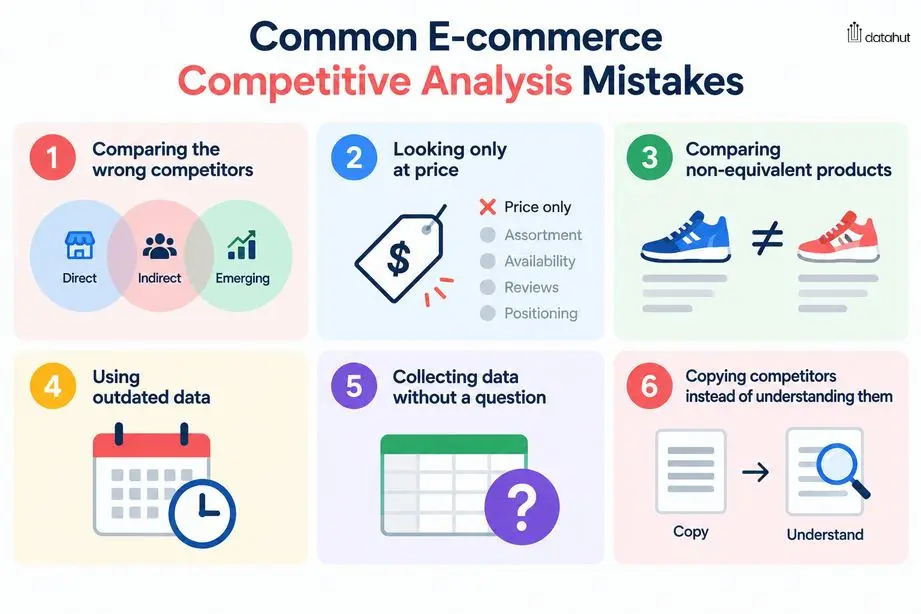
1. Comparing the wrong competitors
Not every company selling a similar product is a direct competitor.
Separate direct, indirect, and emerging competitors before you start comparing them.
2. Looking only at price
Price without assortment, availability, reviews, and positioning gives you an incomplete picture.
3. Comparing non-equivalent products
A $100 product isn't necessarily competing with another $100 product.
Specifications, sizes, features, brands, and variants matter.
4. Using outdated data
A competitor's price from three months ago may tell you very little about today's market.
This matters even more in categories where prices and availability change frequently.
5. Collecting data without a question
A huge spreadsheet isn't intelligence.
Start with a business question and collect the data needed to answer it.
6. Copying competitors instead of understanding them
The goal isn't:
"Competitor A changed its price, so we should change ours."
Ask instead:
"Why did Competitor A change its price, and what does that tell us about market conditions?"
That difference affects the decision you make next.
How often should you perform a competitive analysis?
There isn't one fixed schedule. Your monitoring cadence should match how quickly the market changes.
Slow-moving categories
Monthly or quarterly monitoring may be sufficient.
Moderately dynamic categories
Weekly monitoring may make more sense.
Highly dynamic categories
Daily or near-real-time monitoring can be useful.
Consistency matters more than picking a particular interval.
If a competitor changes pricing every day but you analyze the catalog once a quarter, you're mostly studying history rather than monitoring the market.
From competitive analysis to a competitive intelligence system
A mature e-commerce operation doesn't have to rely on occasional competitor reports.
The pipeline can run continuously:
Competitor websites
        ↓
Data collection
        ↓
Data normalization
        ↓
Product matching
        ↓
Price & availability monitoring
        ↓
Competitive benchmarks
        ↓
Alerts & dashboards
        ↓
Business decisions
For example:
Monday: Competitor reduces prices.
Tuesday: Monitoring system detects the change.
Wednesday: Pricing team evaluates affected categories.
Thursday: Merchandising team identifies overlapping products.
Friday: Business decides whether to respond.
That's the difference between reactive competitor research and an ongoing competitive intelligence system.
Datahut's competitive market intelligence framework explores why timely external data matters for strategic decisions.
The future of e-commerce competitive analysis
Competitive analysis is becoming more data-driven. Businesses can combine:
- Web data
- Product catalogs
- Pricing data
- Availability
- Reviews
- Search demand
- Marketplace data
- Customer signals
- Market trends
- Historical changes
AI can also speed up tasks such as:
- Anomaly detection
- Product matching
- Price-change detection
- Categorization
- Competitor summarization
- Trend identification
- Competitive alerts
But AI doesn't remove the need for good data.
It makes data quality even more important.
If competitor data is incomplete, inconsistent, or outdated, better analytics won't fix the underlying problem. The output will still be unreliable.
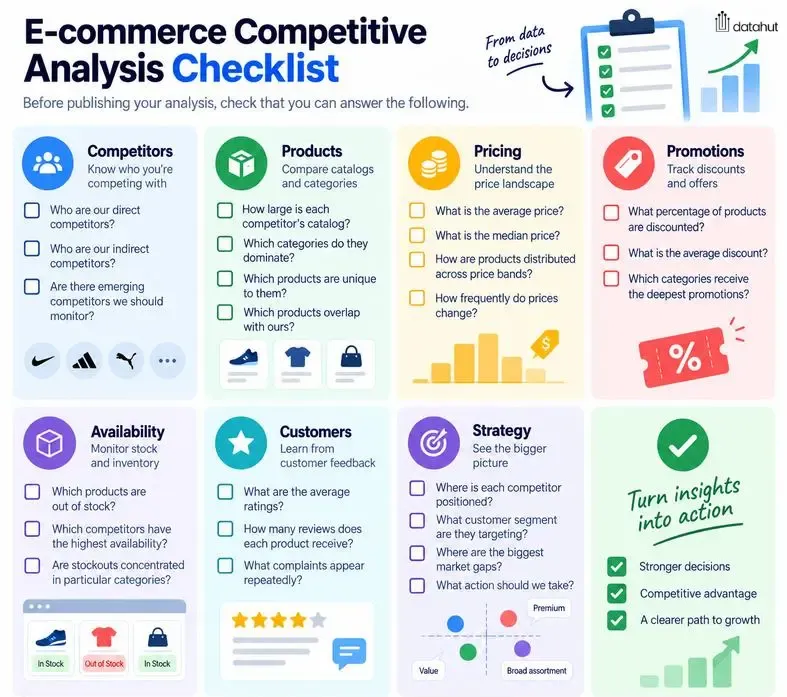
A practical e-commerce competitive analysis checklist
Before publishing your analysis, check that you can answer the following.
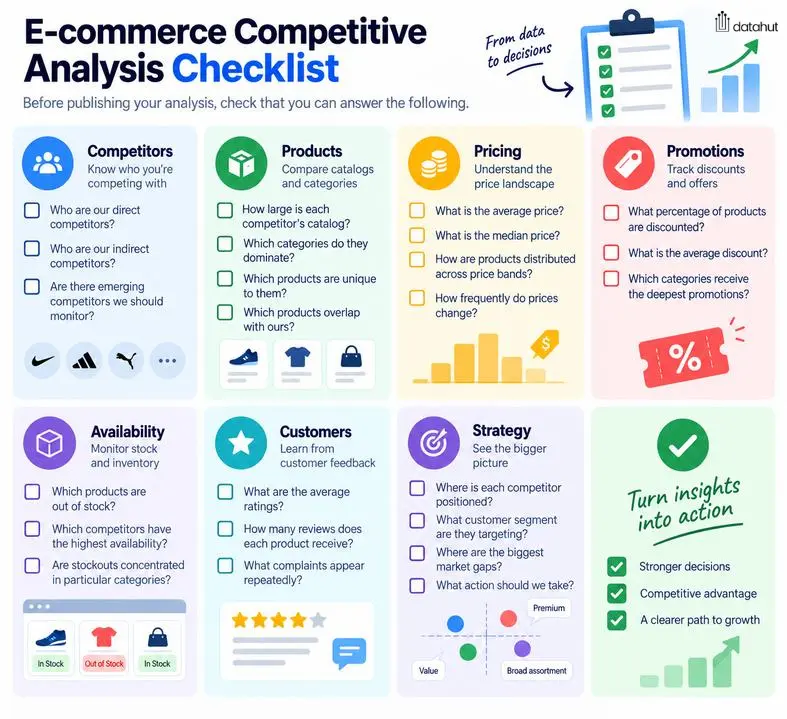
Competitors
- Who are our direct competitors?
- Who are our indirect competitors?
- Are there emerging competitors we should monitor?
Products
- How large is each competitor's catalog?
- Which categories do they dominate?
- Which products are unique to them?
- Which products overlap with ours?
Pricing
- What is the average price?
- What is the median price?
- How are products distributed across price bands?
- How frequently do prices change?
Promotions
- What percentage of products are discounted?
- What is the average discount?
- Which categories receive the deepest promotions?
Availability
- Which products are out of stock?
- Which competitors have the highest availability?
- Are stockouts concentrated in particular categories?
Customers
- What are the average ratings?
- How many reviews does each product receive?
- What complaints appear repeatedly?
Strategy
- Where is each competitor positioned?
- What customer segment are they targeting?
- Where are the biggest market gaps?
- What action should we take?
Frequently asked questions
What is competitive analysis?
Competitive analysis evaluates competitors' products, pricing, positioning, promotions, customer feedback, and other market signals to understand their strengths, weaknesses, and position in the market.
What is included in a competitive analysis?
An e-commerce competitive analysis can include product assortment, pricing, discounts, availability, ratings, reviews, positioning, marketing, distribution, and customer experience.
How do you perform a competitive analysis?
Start with a clear objective. Identify relevant competitors, collect comparable data, normalize and match products, benchmark the competitors, identify gaps, and turn the findings into business actions.
What is competitive analysis in e-commerce?
E-commerce competitive analysis applies competitor research to online retail. It focuses heavily on product catalogs, prices, promotions, inventory availability, ratings, reviews, and digital customer experience.
How often should you do a competitive analysis?
The frequency depends on how quickly your market changes. Slow-moving markets may need monthly or quarterly analysis, while highly dynamic categories may benefit from weekly, daily, or automated monitoring.
What is competitive intelligence?
Competitive intelligence is the ongoing collection and analysis of information about competitors and the market to support business decisions. Unlike a one-time competitor analysis, it continues as market conditions change.
What are the best competitive analysis tools?
The right tool depends on the data you need. SEO platforms help with search visibility, traffic-intelligence platforms can help analyze market activity, and e-commerce data collection systems can monitor products, prices, availability, and assortment at scale.
What is competitive pricing analysis?
Competitive pricing analysis compares your prices with competitors across comparable products and categories. It can include average price, median price, price distribution, discounts, price changes, and price gaps.
Recommended external resources
For readers who want to explore the broader methodology:
- Shopify's Competitive Analysis Guide - competitor selection, tools, frameworks, and templates.
- Shopify's Competitive Intelligence Guide - the difference between competitor research and ongoing competitive intelligence.
- Shopify's SEO Competitor Analysis Guide - useful when search visibility is part of the analysis.
- Shopify's Market Analysis Guide - background for understanding the broader market before comparing individual competitors.


