

Why Scaling Web Scraping Is Harder Than You Think
Web scraping is the automated process of extracting structured data from websites. It plays a vital role in data collection, market intelligence, competitive analysis, and AI-powered business strategies.
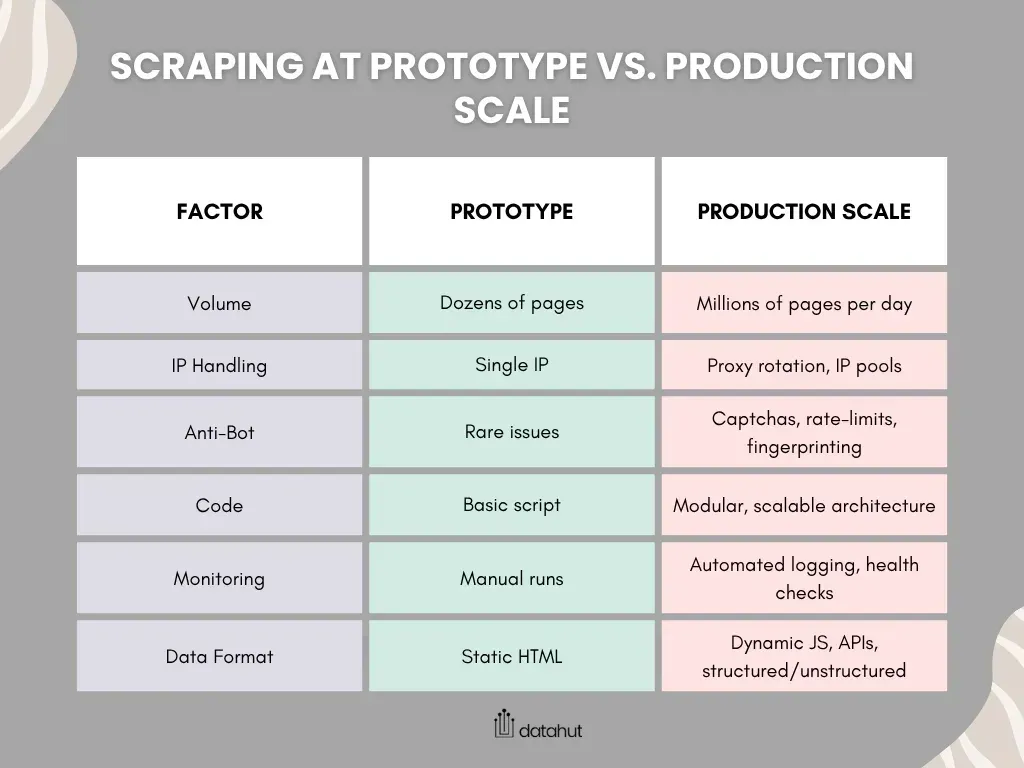
Building a prototype scraper is relatively simple—most developers can set one up with Python and BeautifulSoup in a day. But scaling that prototype to handle millions of pages across multiple geographies introduces serious challenges in data volume, compliance, infrastructure, and performance.
This guide explores the journey “from prototype to scale” and why building a scalable web scraping system is more difficult than it looks.
Related read: [Web Scraping vs API: Which is Best for Data Extraction?]
What Is the Prototype Phase in Web Scraping?
The prototype phase of a web scraping project typically involves:
- Targeting a single or small number of web pages
- Using simple tools like Python + BeautifulSoup or Puppeteer
- Handling minimal edge cases in data extraction
- Manually managing cookies, headers, and proxies
At this stage, scraping feels simple and efficient. But what’s missing are:
- Scalable architecture
- Error handling & retries
- Data pipelines
- Sustainable data quality management
Popular Prototype Tools
- BeautifulSoup
- Requests
- Scrapy
- Selenium
➡ The simplicity at this stage often hides the complexity of scaling.
Challenges in Scaling Web Scraping Systems
Scaling a scraper from prototype to production introduces multiple hurdles:
1. Managing Data Volume and Speed
Handling millions of pages requires distributed crawlers, rotating IPs, and cloud infrastructure. Without them, scrapers crash or slow down drastically.
2. Overcoming Anti-Bot Mechanisms
Websites deploy defenses like:
- Rate limiting
- Browser fingerprinting
- CAPTCHAs
You’ll need rotating proxy services, headless browsers, and resilient frameworks to avoid detection.
3. Handling Performance Bottlenecks
Without performance tuning, scrapers get blocked, delayed, or fail entirely.Related read: [Challenges of Large-Scale Web Scraping]
4. Error Handling & Recovery at Scale
When HTML structures change or 403 errors appear, scalable scrapers must use:
- Retry logic
- Adaptive parsers
- Fault-tolerant workflows
5. Infrastructure and Cost Challenges
Managing distributed scrapers requires container orchestration tools such as:
- Docker
- Kubernetes
- Apache Kafka
Real-World Examples: Scaling With Datahut
1. Retail Analytics Firm
A global retail analytics firm needed to scrape over 2 million product listings across 4 countries to track competitor pricing and promotions.
- Prototype Phase: Their Scrapy-based scraper worked for a few thousand pages.
- Problem: It broke under dynamic content, IP bans, and slow page loads.
- Solution: They shifted to Datahut’s Data-as-a-Service model, gaining:Distributed scraping infrastructureAutomated proxy rotationClean, validated data pipelines
Result: The firm scaled seamlessly, reduced infrastructure costs, and redirected resources to insights instead of scraper maintenance.
2. Financial Data Provider
A fintech company needed stock price movements, filings, and market sentiment data from multiple sources.
- Prototype Phase: Internal scripts using Puppetteer.
- Problem: Scripts failed on frequent site structure changes and couldn’t meet regulatory compliance standards.
- Solution: With Datahut, they gained:Enterprise-level monitoring and error recoveryGDPR/CCPA-compliant scraping infrastructureStructured datasets delivered via API
Result: The fintech firm scaled globally with legally compliant, high-quality datasets, boosting their financial models’ accuracy.
Takeaway: Scaling web scraping isn’t just about tech—it’s about having the right infrastructure, compliance practices, and data pipelines. Datahut helps companies achieve all three.
Best Tools and Techniques for Scalable Web Scraping
Tools to Consider
- Scrapy + Splash (JS rendering at scale)
- Playwright & Selenium (interactive scraping)
- Multiple proxy vendors (to reduce IP bans)
- Apache Kafka, Airflow, Redis (workflow orchestration)
Techniques for Optimization
- Parallel scraping with Celery or asyncio
- Caching and request deduplication
- Monitoring latency and uptime
- Using headless browsers only when required
Explore more: [Web Scraping Best Practices]
Scalable Web Scraping Architecture: Key Components
A reliable large-scale scraping system typically includes:
- Scheduler → Assigns scraping jobs
- URL Queue → Redis / Kafka
- Scraping Workers → Dockerized containers
- Proxy Manager → Manages IP rotation
- Parser Modules → Extract structured data
- Database → MongoDB / PostgreSQL
- Monitoring Systems → Prometheus & Grafana
Legal and Ethical Considerations in Large-Scale Scraping
Scaling scraping requires compliance with legal frameworks:
- Respect robots.txt and site terms
- Follow GDPR, CCPA rules
- Avoid scraping personal or copyrighted data
Data Management and Quality Assurance
Data Management Strategies
- Use cloud data management solutions
- Apply schema validation and deduplication
- Timestamp & version scraped datasets
Quality Assurance
- Run automated QA pipelines
- Audit random samples manually
- Monitor failed URLs & re-scrape intelligently
Conclusion: Building Reliable and Compliant Scrapers
Scaling web scraping is not just adding more servers or faster crawlers. It requires:
- Robust architecture (modular, distributed, fault-tolerant)
- Legal compliance (GDPR, CCPA, ToS)
- Data quality management (clean, deduplicated, structured outputs)
Key Takeaways:
- Prototypes are simple, but scaling demands enterprise-grade systems
- Compliance and ethics must be built into strategy
- Monitoring and data pipelines are critical for reliability
Want to scale your scraping project without hitting roadblocks? Talk to Datahut , datahut.co for enterprise-grade web scraping solutions.
Frequently Asked Questions
1. What are the main challenges in scaling web scraping?
Scaling introduces issues with data volume, anti-bot mechanisms, infrastructure costs, and maintaining data quality.
2. Which tools help optimize large-scale web scraping?
Tools like Scrapy, Playwright, Splash, Docker, and Apache Kafka make scrapers more resilient at scale.
3. How can I ensure legal compliance while scraping websites?
Follow ethical scraping practices: respect robots.txt, avoid personal data, and comply with GDPR/CCPA.
4. What is the difference between a prototype scraper and a scalable scraper?
A prototype scraper targets small datasets, while a scalable scraper can handle millions of pages across multiple geographies.
5. How does data management impact scraping efficiency?
Good data management ensures cleaner datasets, faster processing, and higher accuracy for analytics or AI models.
6. How much does it cost to scale web scraping?
Costs depend on infrastructure, proxies, compliance, and monitoring. Outsourcing to a provider like Datahut often reduces overhead.
7. Can AI improve large-scale web scraping?
Yes—AI-driven scrapers help with adaptive parsing, anomaly detection, and automation of QA pipelines.


