

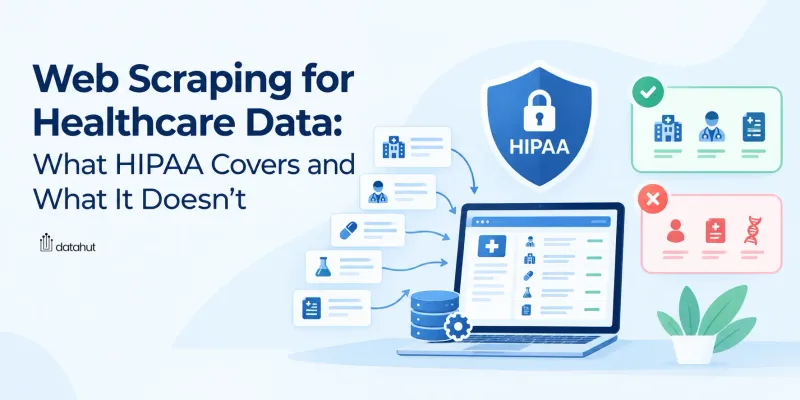
The global healthcare data technology market is projected to grow from USD 4.0 billion in 2026 to USD 9.5 billion by 2033, according to Grand View Research. More data also means more risk: the US Office for Civil Rights reported large breaches exposing records of more than 289 million individuals in 2024, according to the HIPAA Journal.
Does HIPAA prohibit web scraping for healthcare data? Usually not for publicly available information, but it depends on what data you collect, who collects it, and how you use it.
This guide covers when HIPAA applies, what healthcare data you can typically collect, how businesses use it, which other laws may matter, and a checklist for responsible data collection.
Is Web Scraping for Healthcare Data HIPAA-Compliant?
Web scraping for healthcare data is the automated collection of publicly available medical information, such as provider directories, drug data, and research, for market analysis, insurance operations, and public health tracking.
Healthcare data scraping is not automatically a HIPAA violation. HIPAA regulates Protected Health Information (PHI), not public web data. Scraping public NPI registries, physician directories, and hospital locations does not trigger HIPAA rules. However, collecting identifiable patient information from healthcare systems or other sources requires a careful assessment of privacy obligations and the circumstances.
For example, a business collecting hospital addresses, clinic hours, or physician specialities handles a different kind of data than one extracting patient names, diagnoses, or lab results from a hospital portal. The latter can raise HIPAA issues, along with unauthorized-access and contract problems.
A Court Case That Shows Where HIPAA’s Reach Ends
HHS guidance said a hospital website could be handling protected health information if it logged a visitor’s IP address along with the public health-condition page they viewed. The American Hospital Association challenged this, and in June 2024 a federal court in Texas ruled that this part of the guidance exceeded HHS’s authority. HHS later withdrew its appeal.
What HIPAA COVERS?
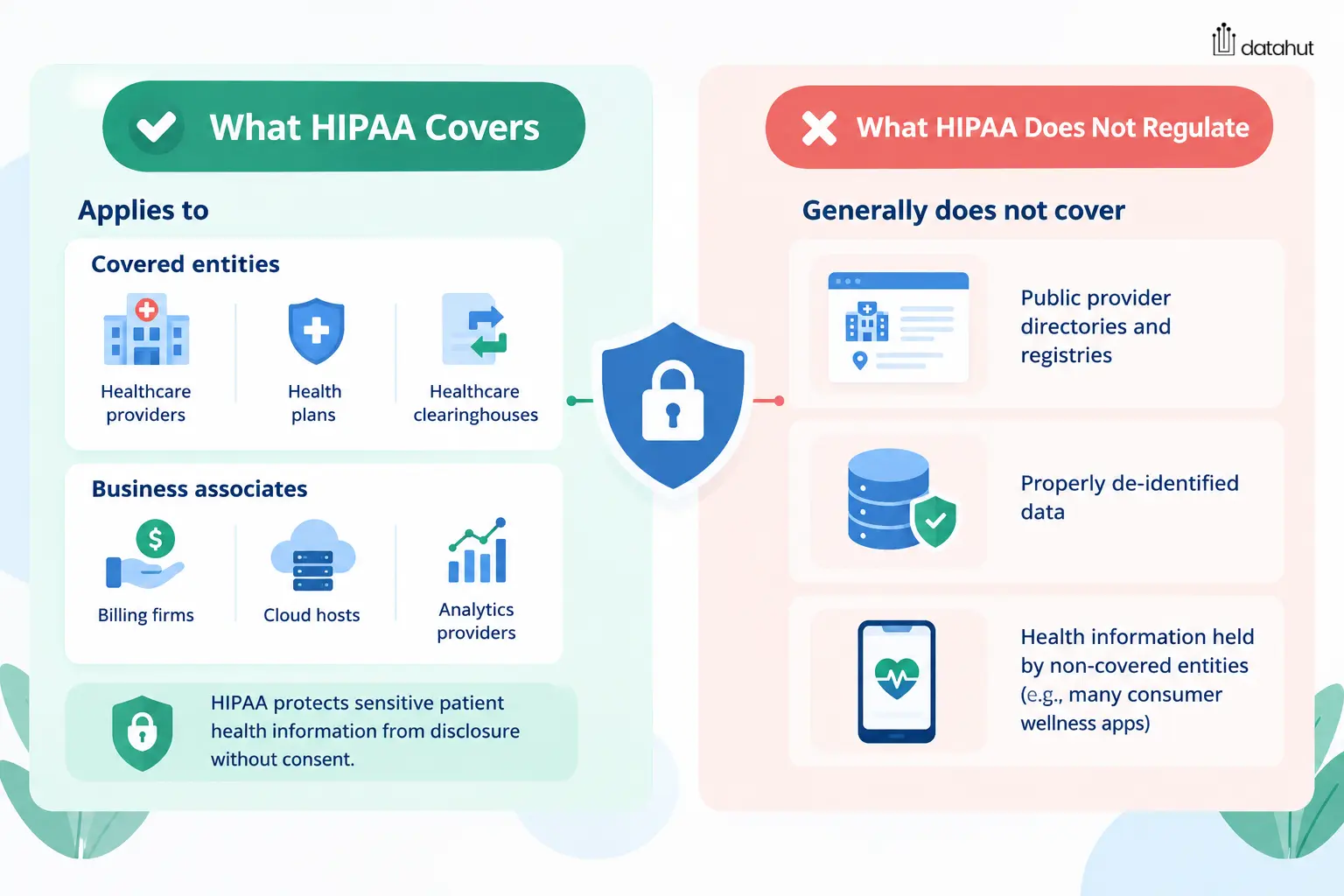
The Health Insurance Portability and Accountability Act (HIPAA) is a U.S. federal law that protects sensitive patient health information from disclosure without consent and helps workers keep health insurance when changing or losing jobs.
Who HIPAA applies to
HIPAA applies to two groups:
- Covered entities: healthcare providers that transmit health information electronically for billing, health plans, and healthcare clearinghouses.
- Business associates: vendors that handle protected health information on a covered entity’s behalf, such as billing firms, cloud hosts, and analytics providers.
A company that scrapes public web pages is usually neither, unless it works for a covered entity with PHI.
What counts as PHI
Protected health information (PHI) is individually identifiable health information about a person’s condition, treatment, or payment for care, held or transmitted by a covered entity or business associate. Identifiers include names, addresses, dates tied to a person, phone numbers, email addresses, and medical record numbers.
A diagnosis with no way to identify the patient is not PHI. A diagnosis linked to a name in a hospital system is.
What HIPAA does not regulate
HIPAA generally does not cover:
- Public provider directories and registries
- Properly de-identified data.
Data is de-identified when details that could point to a specific person, such as names, addresses, full dates and phone numbers, have been removed or altered so the person can’t reasonably be identified. - Health information held by organizations that are not covered entities or business associates, such as many consumer wellness apps
That does not make this data unrestricted. Site terms, GDPR, and state privacy laws may still apply, which later sections cover.
What the GoodRx Case Shows About Health Data Outside HIPAA
In 2023, the Federal Trade Commission fined the drug-discount company GoodRx $1.5 million for sharing users’ health information with Facebook and Google for advertising. It was the first enforcement action under the FTC’s Health Breach Notification Rule. GoodRx is not a HIPAA-covered entity, so HIPAA did not apply, but that did not leave its data practices unregulated.
What Healthcare Data Can Be Scraped?
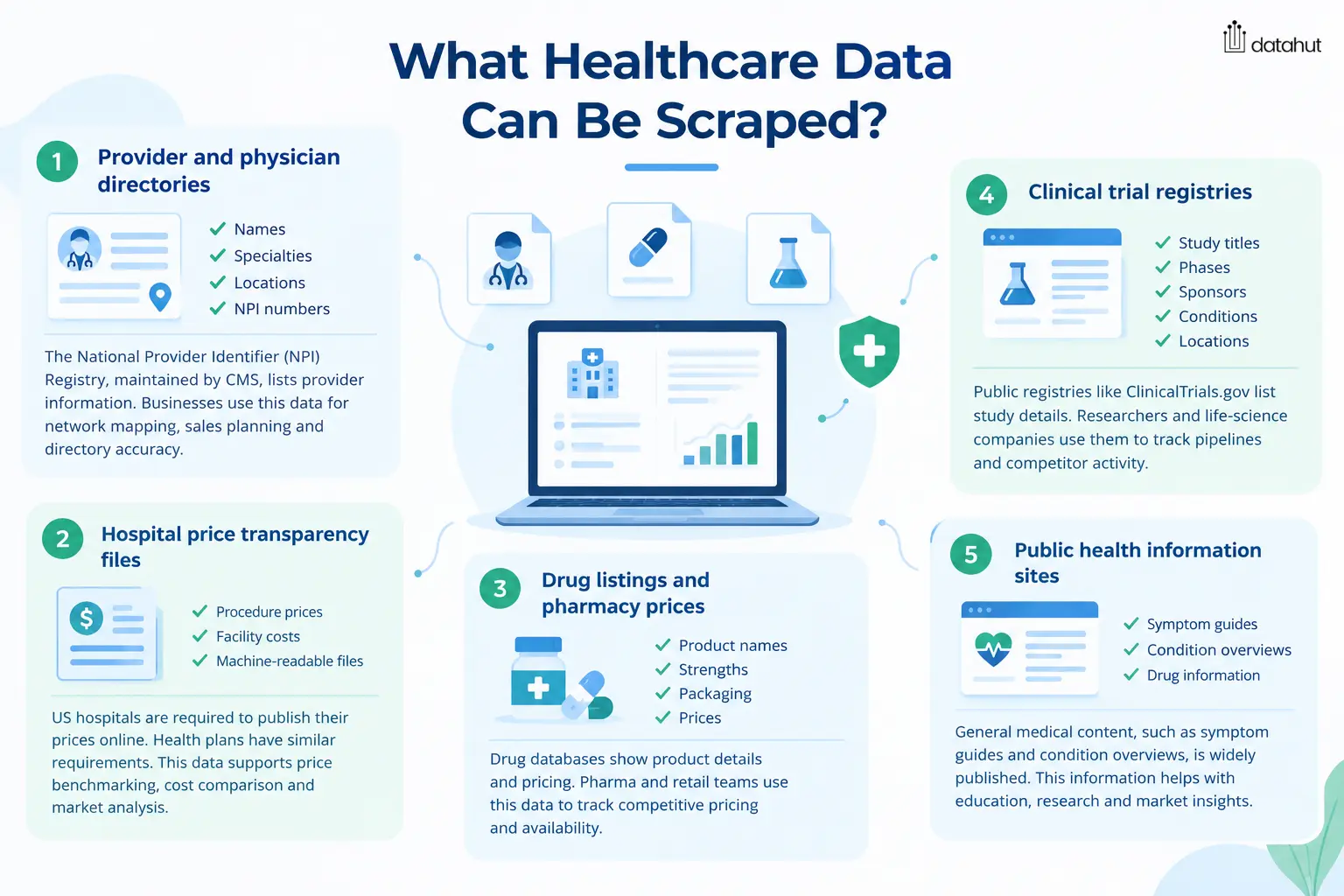
Data published openly for public use is generally the lowest-risk category. It is typically organizational or product-level, not tied to an individual patient. Here are the common examples.
Provider and physician directories
Need to know who practices where? The NPI Registry, run by CMS, is the starting point: it gives you each provider’s name, speciality, practice address and NPI number. Teams use it to map care networks, carve up sales territories, and catch errors in their own provider directories.
Hospital price transparency files
US hospitals must post their prices publicly. Analysts use these files to benchmark costs and size up local markets.
Drug listings and pharmacy prices
Drug database and pharmacy pages show what’s on sale and at what price, down to the strength and pack size. Pharma and retail teams scrape them to see how competitors price a product and whether it’s actually in stock.
Clinical trial registries
Registries like ClinicalTrials.gov show who is running which study: the title, phase, sponsor, condition and trial sites. Life-science companies and researchers read them to see what rivals have in the pipeline.
Public health information sites
General medical content, such as symptom guides, condition overviews and drug information pages, is widely published. See our guide on how scraping a site like WebMD works for a worked example.
What Healthcare Data Should Not Be Scraped Without Proper Authorization?
Risk if data can be linked to a real person and its source. Watch for these situations:
- Patient forums and reviews: Posts often include usernames, locations, dates and treatment details. Collecting them at scale can create obligations under laws such as GDPR, which treats health data as a special category.
- Re-identification: A dataset that looks anonymous can become identifying when merged with others. Research by Latanya Sweeney found that a 5-digit ZIP code, gender and date of birth could uniquely identify about 87% of the US population, based on 1990 census data. A later analysis of 2000 census data put the figure at 63%. Either way, a few ordinary details can be enough to single someone out.
- Merging with a covered entity’s records: Public data is outside HIPAA on its own, but linking it to patient records may make the combined dataset PHI.
- Login-gated portals: Patient portals and member areas raise unauthorized-access, contract and privacy problems.
Clean Before You Store
Risk doesn’t end when scraping does. A dataset that starts non-personal can become personal again during processing. Running scraped forum posts or reviews through an LLM for sentiment analysis or entity extraction can pull out usernames, signatures, clinic names, or a rare condition paired with a town and a date, enough to point to a real person.
The fix is a cleaning gate between collection and storage. Treat raw scraped data and stored analytics data as two separate stages. Before anything reaches your production database, remove usernames, handles and free-text identifiers, and run a PII filter or redaction pass.
For more detail, see our guide to data-cleaning techniques and our post on legal and transparent data practices under GDPR.
What Enforcement Actually Looks Like
HHS’s Office for Civil Rights publishes its HIPAA settlements and penalties, which range from tens of thousands of dollars to millions. Most cases involve security failures, such as phishing, ransomware, hacking, or failing to give patients timely access to their records. A few examples:
Case | Year | Amount | What went wrong |
|---|---|---|---|
Anthem | 2018 | $16 million | Data breach; a record settlement at the time |
Montefiore | 2024 | $4.75 million | Malicious insider |
Gums Dental Care | 2024 | $70,000 | Failure to provide timely access to records |
Solara Medical Supplies | 2025 | $3 million | Phishing attack |
Warby Parker | 2025 | $1.5 million | Hacking |
Ambry Genetics | 2026 | $700,000 | Phishing attack exposing 225,000 patients’ data |
Each targets a regulated organization. None involves scraping public web data, which is the point of this guide: HIPAA enforcement follows the data and the organization that holds it. Data buyers face risk when their data touches a covered entity or business associate.
Rules That Often Matter More Than HIPAA
For most scraping projects, privacy laws tied to the person whose data is collected matter more than HIPAA.
- GDPR (EU/UK): Health data is a special category with stricter conditions for processing. It applies when data relates to identifiable people in the EU, wherever the scraper is based.
- India’s DPDP Act: It governs digital personal data of individuals in India and sets its own rules on consent and exemptions, including for some publicly available data. See our guide on how it affects scraping.
- US state laws: Some states regulate consumer health data outside HIPAA. Washington’s My Health My Data Act is a well-known example, and other state privacy laws treat health information as sensitive.
- Site terms and contracts: A website’s terms of service can restrict collection even when no privacy law applies.
Takeaway: Check where the people in your dataset live, not just where your company is based. That decides which laws apply.
Healthcare Web Scraping Compliance Checklist
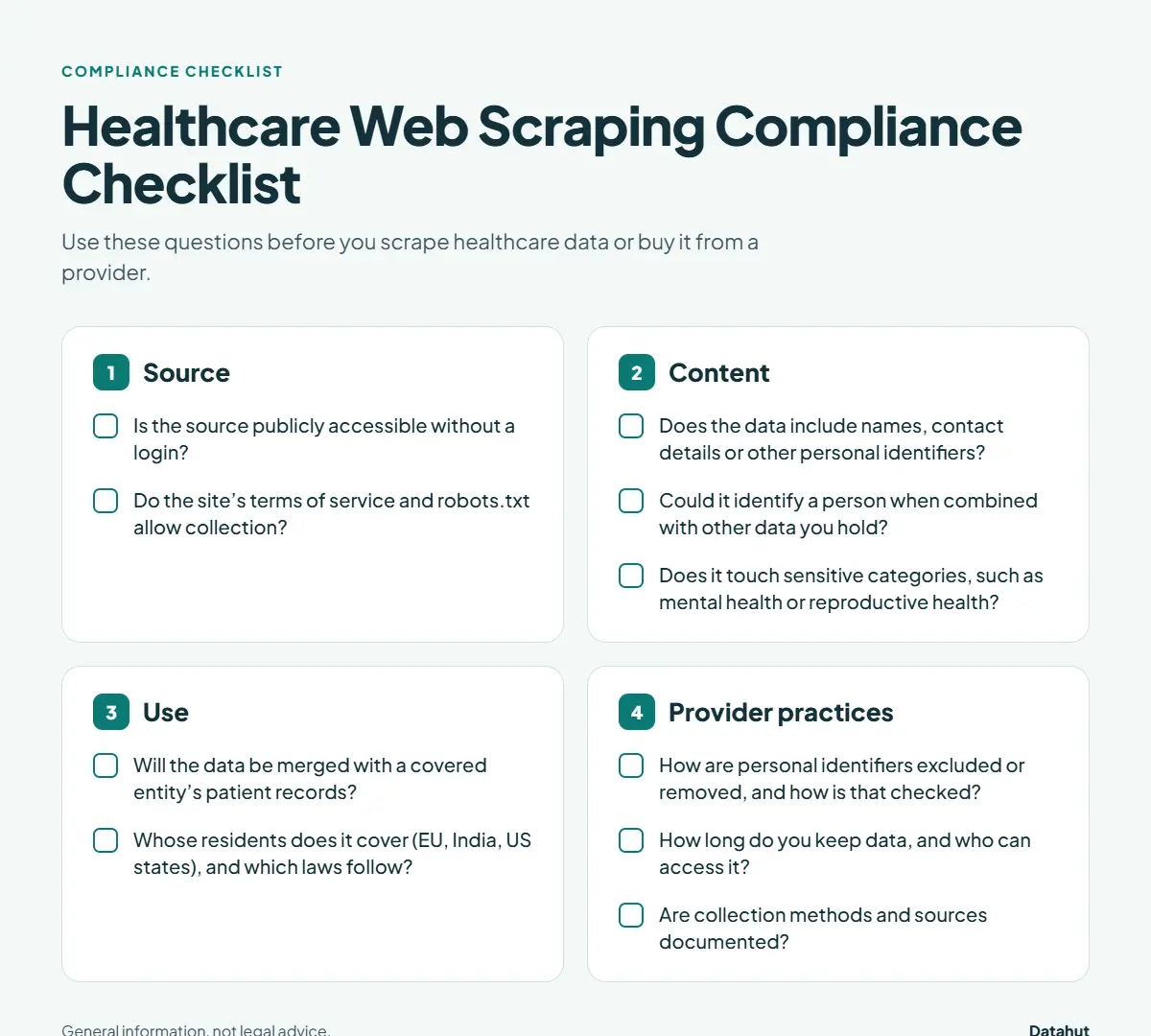
Use these questions before you scrape healthcare data or buy it from a provider.
Source
- Is the source publicly accessible without a login?
- Do the site’s terms of service and robots.txt allow collection?
Content
- Does the data include names, contact details or other personal identifiers?
- Could it identify a person when combined with other data you hold?
- Does it touch sensitive categories, such as mental health or reproductive health?
Use
- Will the data be merged with a covered entity’s patient records?
- Whose residents does it cover (EU, India, US states), and which laws follow?
Provider practices
- How are personal identifiers excluded or removed, and how is that checked?
- How long do you keep data, and who can access it?
- Are collection methods and sources documented?
This checklist is general information, not legal advice.
Conclusion
Compliant healthcare web scraping collects the right data from appropriate sources while protecting patient privacy and meeting applicable legal requirements. A well-planned approach that keeps compliance in mind can help businesses turn healthcare data into valuable insights.
Need healthcare data collected responsibly?
Datahut delivers clean, structured data from public healthcare sources, with identifiers removed before storage. Talk to our team about a compliant data feed for your project.
Frequently Asked Questions
- Does HIPAA apply to web scraping?
Generally no for public pages, because HIPAA regulates covered entities and business associates handling PHI. It can apply if a covered entity or its business associate is involved or the data is PHI.
Healthcare web scraping is legal and HIPAA-compliant only if it strictly avoids Protected Health Information (PHI) or uses publicly available, fully de-identified data sources.
- Can you scrape patient data or patient reviews?
High risk. Content that identifies individuals can fall under privacy laws such as GDPR or state health-privacy laws, and may become PHI in a covered entity's hands.
- What healthcare data is safe to scrape?
Public, non-personal data such as provider directories, price transparency files, drug listings and trial registries
- Does GDPR apply to scraped health data?
Yes, if it relates to identifiable people in the EU; health data is a special category under GDPR and needs a lawful basis.


