

Introduction
As global property demand grows, data has become essential for investors, brokerages, and proptech firms to follow market trends. According to Grand View Research, the global real estate market will reach $4.56 trillion in 2026, and the data that drives it changes daily: prices drop, listings appear and disappear, and rents shift. To succeed in real estate, you need more than intuition; you need timely, accurate data.
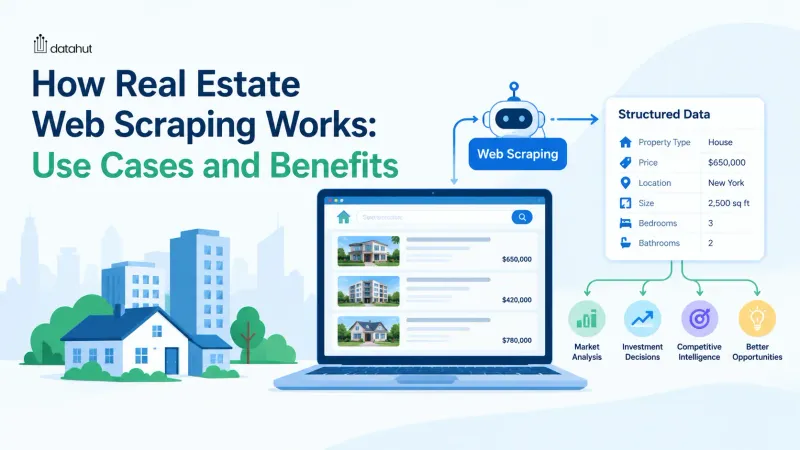
Real estate web scraping automates extracting key data fields from property websites and delivers them in a structured format you can analyze.
This guide explains how real estate web scraping works, where it's used, and what to watch out for. If you'd rather start with code, see our tutorials to scrape Trulia(US), Homes.com(US), Pararius(Netherlands), and Bayut(UAE).
What is real estate web scraping?
Real estate web scraping is the automated extraction of publicly available property data from online listing sites and MLS databases. Scrapers pull raw website information, such as price histories, square footage, property features, and listing statuses, and structure it into usable formats like CSV files or spreadsheets for market research and algorithmic pricing.
How it differs from MLS feeds and portal APIs
Scraping isn't the only way to get property data. It sits alongside two other sources, and each has trade-offs.
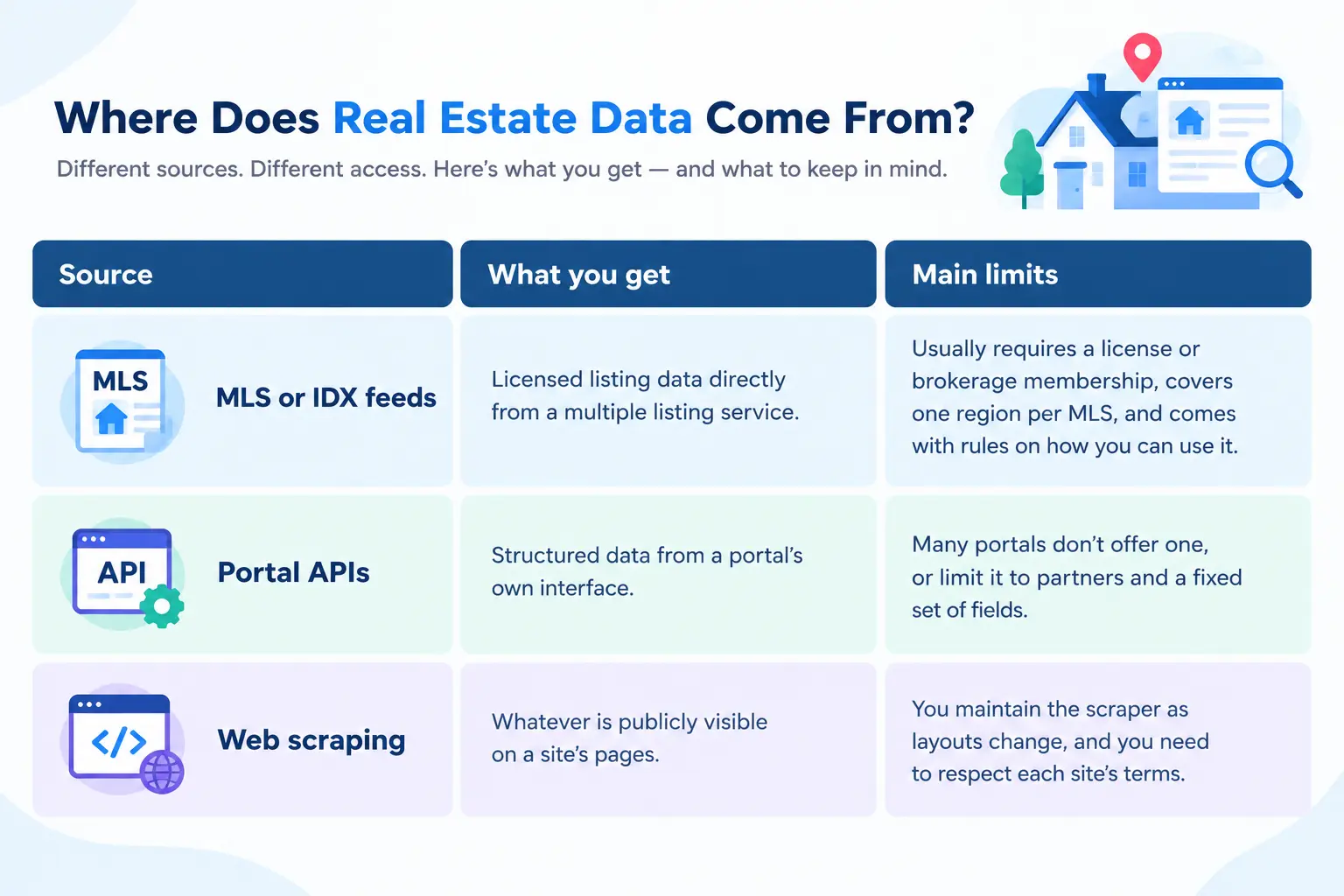
Scraping's main advantage is reach. You can pull the same fields from several portals into one dataset, including sites with no API.
What real estate data can you scrape?
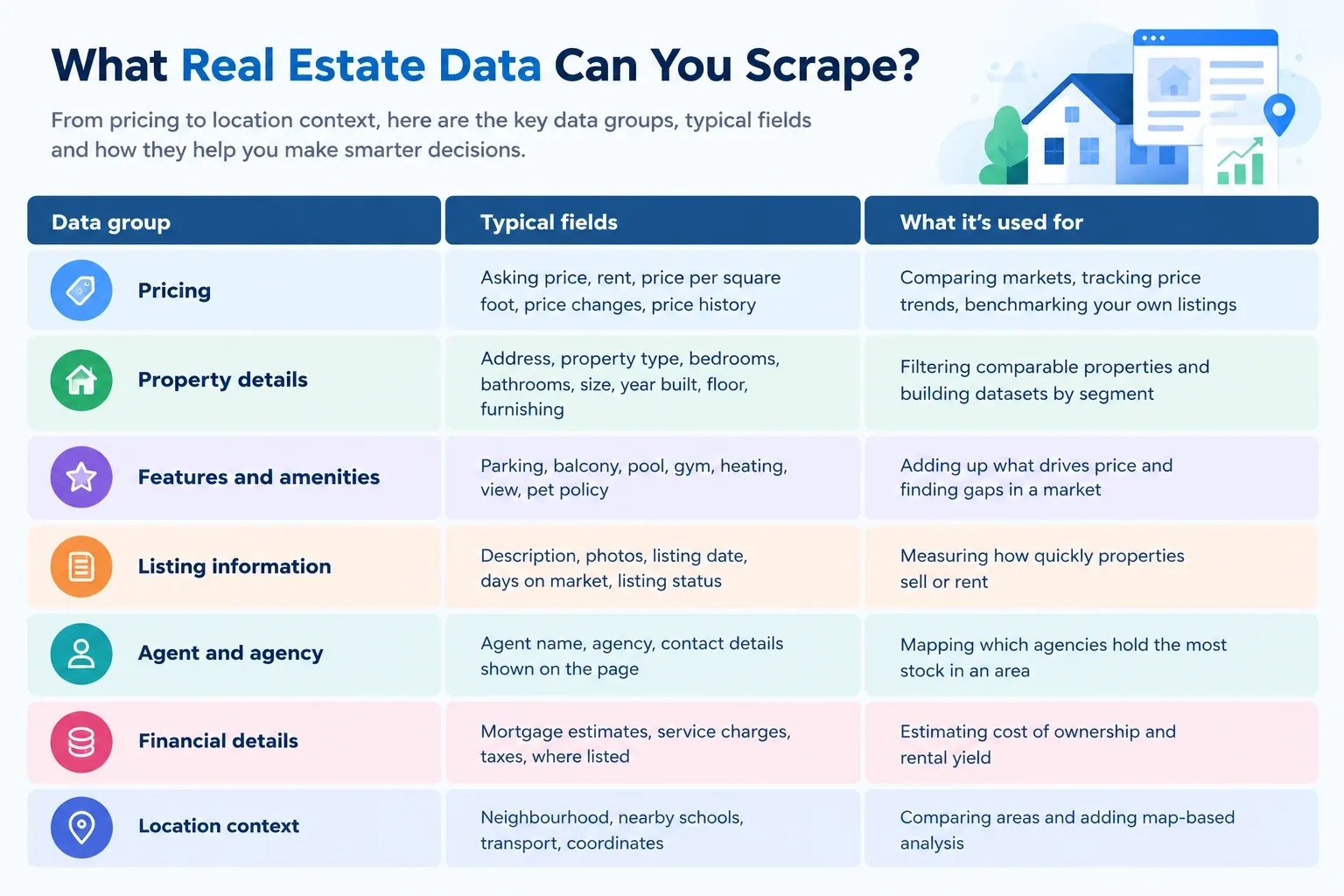
You can scrape most of what you see on a property listing page, as long as the site shows it publicly. The exact fields depend on the portal, but they fall into a few groups.
Where the data comes from
- Listing portals, such as Trulia, Homes.com, Bayut, and Pararius, which carry the widest range of sale and rental listings.
- Agency and developer websites, which often list properties not found on the big portals, along with new-build projects.
- Rental platforms, which are useful for rent levels and availability.
What this looks like in practice
The fields you can collect vary a lot between sites. In our Bayut tutorial, for example, the scraper collects price, location, property specifications, description, features and amenities, and mortgage information for apartments listed in Dubai. Another portal might show price history but no mortgage data, or vice versa. Before starting a project, look at a handful of real listings on the site and note which fields appear consistently. That's your realistic data set.
Data quality matters as much as the fields
Collecting the data is only half the job. Raw scraped data usually needs cleaning: removing duplicate listings that appear on several portals, standardizing units (square feet vs square meters) and currencies, and handling missing values. A dataset with 50 fields but inconsistent prices is less useful than one with 10 clean fields.
Benefits of web scraping for real estate
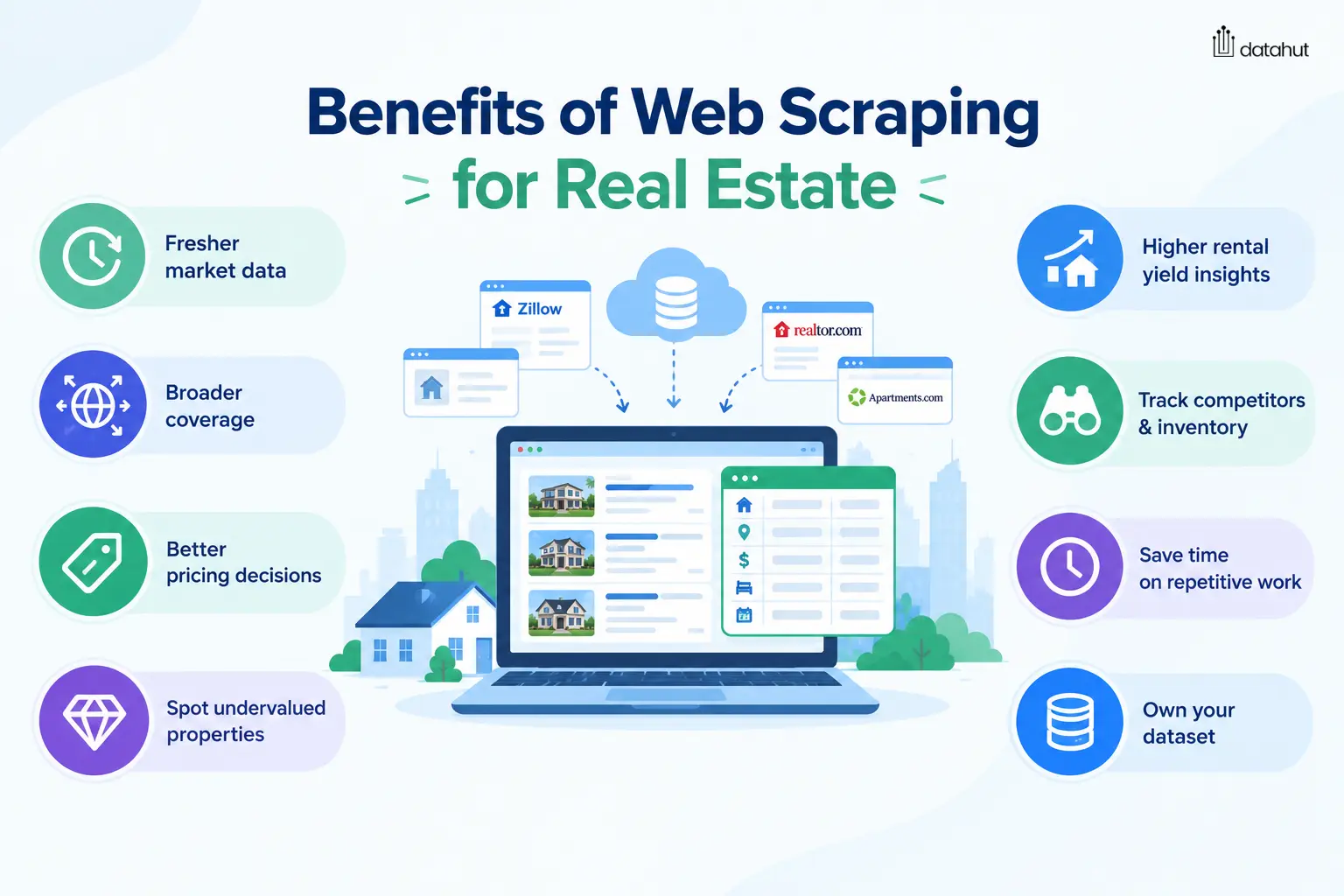
Property data is public, but it's spread across dozens of sites and changes daily. Scraping turns that scattered information into a single dataset you can use. These are the main benefits.
1. Fresher market data. Reports and quarterly summaries are weeks old by the time you read them. A scraper that runs daily shows you today's asking prices, new listings, and price cuts.
2. Broader coverage than manual research. Checking five portals by hand covers at most a few hundred listings. A scraper can cover every listing in a city across all of them, so you see the whole market and not just the first few pages.
3. Better pricing decisions. Brokerages and landlords can compare a property with similar nearby listings before setting a price. Too high and it sits unsold. Too low and you lose money you didn't have to.
4. Earlier spotting of undervalued properties. Investors can filter thousands of listings by price per square foot, days on market, or recent price drops, then look closely at the handful that stand out. For a closer look at valuation, see our post on property value appraisal with web scraping.
5. Enhanced insight into rental yield and demand. By scraping sale prices and rents within the same neighborhood, you can calculate yield and monitor listing durations to assess demand.
6. Competitor and inventory tracking. Portals, agencies, and proptech platforms can monitor agency stock levels, listing turnover rates, and inventory trends.
7. Time saved on repetitive work. Analysts spend less time copying data into spreadsheets and more time interpreting it. The same scraper keeps running while the team works on something else.
8. A dataset you own and can reuse. Store scraped data in your database so you can integrate it with other sources or use it in predictive models. See our housing price prediction tutorial for an example. You aren't limited to whatever a portal's search filters allow.
Real Estate Web Scraping Use Cases
The same listing data serves different purposes, depending on who uses it. These are the main groups.
Investors scrape sale listings and rents to calculate neighborhood rental yield, flag recent price drops, and find properties priced below similar ones nearby.
Real estate agents and brokerages use scraped data to see new comparable listings, price cuts, and how long similar homes take to sell. That helps them advise sellers on asking prices and buyers on offers.
Property portals scrape agency and developer sites to find missing listings, confirm existing ones are still available, and track competitors' pricing and coverage.
Proptech companies feed fresh listing data into valuation tools, rent estimators, and models. When the data stops updating, the product's estimates drift, so a reliable scraping pipeline becomes part of the product itself.
Lenders and appraisers use a larger, more current set of comparables to value properties.
How Real Estate Web Scraping Works
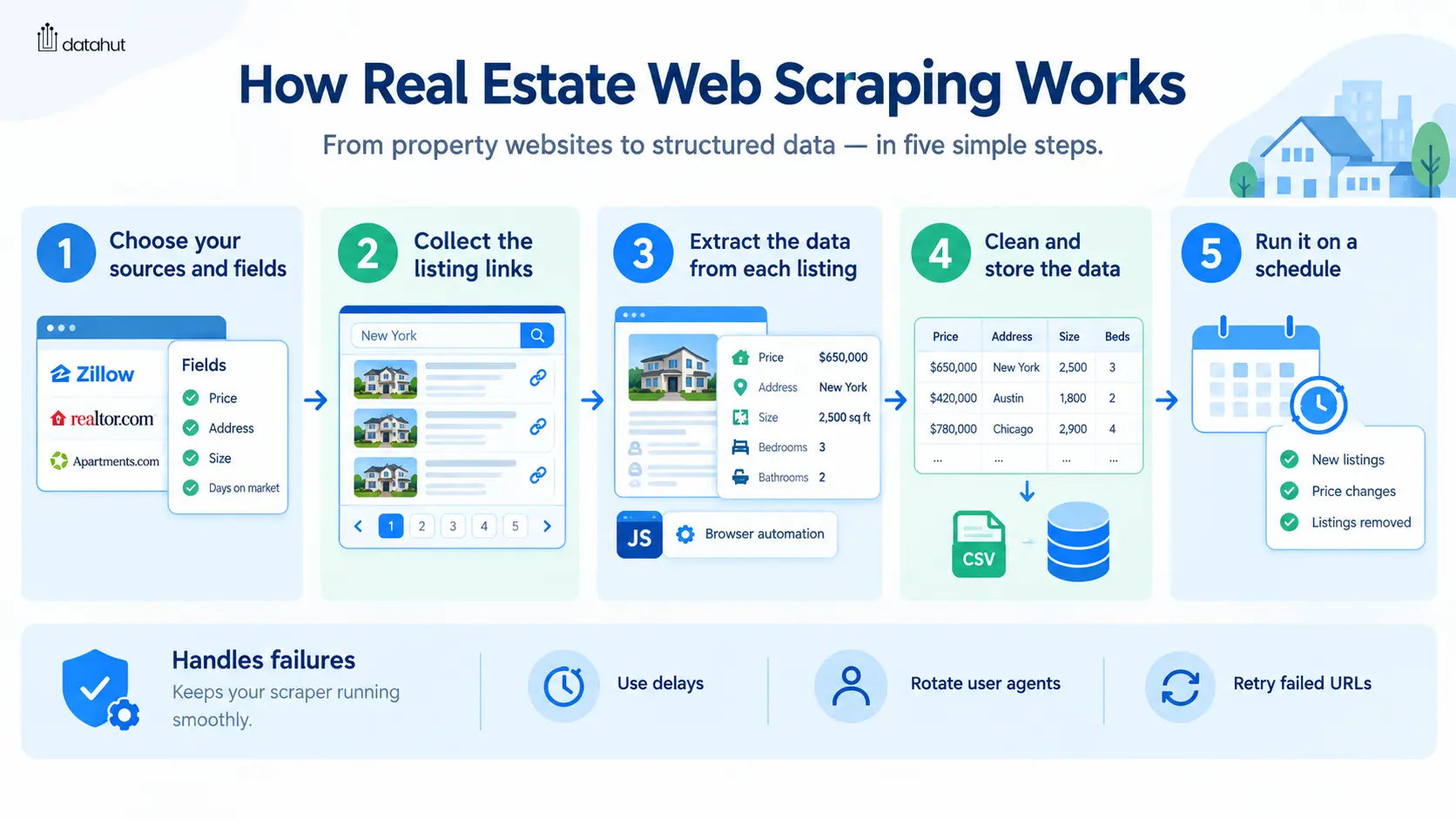
Most real estate scraping projects follow the same five steps.
- Choose your sources and fields. Decide which portals to cover and which fields you need, such as price, address, size, and days on market. Check a few real listings first to see which fields appear consistently.
- Collect the listing links. The scraper loads the search results pages for your target area and gathers the URL of each listing. It has to work through pagination to reach every result.
- Extract the data from each listing. It opens each URL and pulls out the fields you chose. Many portals load content with JavaScript, so you often need a browser automation tool like Playwright to see the full page.
- Clean and store the data. Duplicates are removed, units and currencies are standardized, and the results go into a CSV file or a database.
- Run it on a schedule. Re-running the scraper daily or weekly lets you track new listings, price changes, and listings that disappear.
Some requests will fail. Our Bayut scraper pauses between requests, switches user agents, and writes any URL that fails to a separate table, so it can try again later instead of losing the listing.
Build, Use an API, or Outsource?
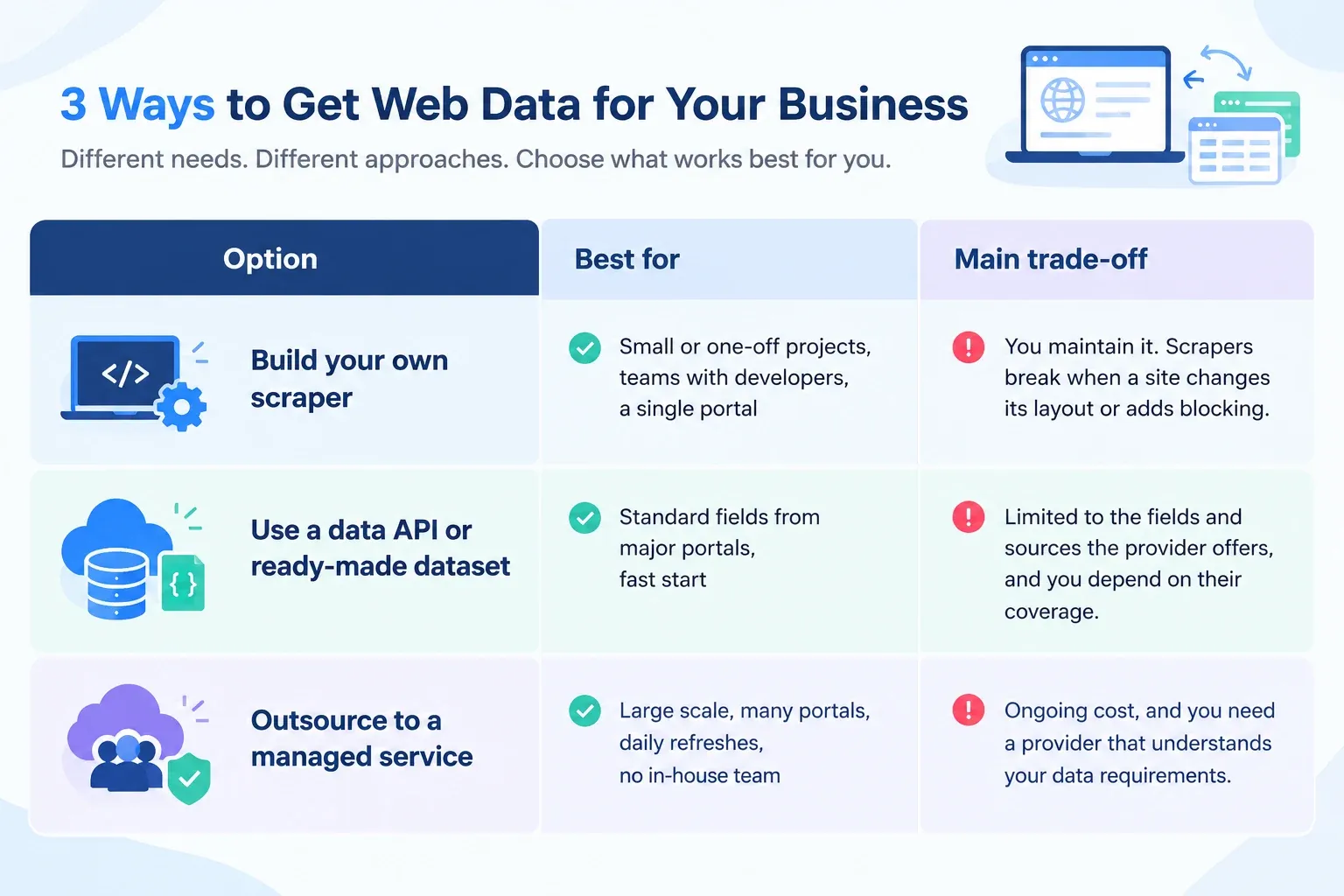
Once you know what data you need, there are three ways to get it. The right choice depends on how much data you need, how often it must refresh, and who will maintain it.
How to decide
- Volume. A few hundred listings from one portal is easy to build in-house. Hundreds of thousands across many portals is a different job.
- Freshness. A one-time snapshot is simple. Daily updates mean monitoring, retries, and fixes whenever a site changes.
- Maintenance. Building is the easy part. Keeping scrapers running takes the most time.
- Custom fields. If you need data an API doesn't offer, scraping or a managed service gives more flexibility.
Challenges of Real Estate Web Scraping
Blocking. Portals throttle or block traffic that looks automated, so a run rarely goes perfectly. Our Bayut scraper spaces out its requests and saves any URL that fails, so the listing can be retried later and isn’t lost.
Pages that don’t load plainly. Many portals build the listing page with JavaScript after it loads, so a simple request returns an empty shell. That’s why we used Playwright in the Homes.com and Bayut tutorials.
Layout changes. A portal redesign can break your extraction without warning. The scraper keeps running, but the fields return empty or incorrect data, so you need checks to catch it.
Get Real Estate Data Delivered
If you're starting, build a small scraper using one of our tutorials to see what's involved. If you need reliable, recurring data across several sources without running the infrastructure yourself, that's what we do at Datahut. With over 14 years of web scraping experience, we deliver clean, structured property data on your schedule through our real estate web scraping services.
Frequently Asked Questions
What is scraping in real estate?
Real estate scraping is the automated collection of property data, such as prices, addresses, and features, from listing websites into a structured format.
Is real estate web scraping legal?
It depends on what you collect, how you collect it, and where you operate. People commonly scrape public listing data, but site terms, personal data rules, and copyright still matter. Get legal advice before scraping at scale.
What data can you scrape from real estate websites?
You can scrape price, address, property type, size, bedrooms, amenities, listing description, days on market, and agent details, depending on what each portal shows publicly.
How often should you refresh real estate data?
Daily if you act on new listings or price changes, weekly or monthly if you’re studying trends.
Can web scraping help investors find undervalued properties?
Investors can find undervalued properties by analyzing the price per square foot, days on market, and reviews.
Should I build my own scraper or outsource?
You can build for small projects, but consider outsourcing for large-scale data.


