

The beauty industry has seen a surge in demand for fragrances in recent years. The two most popular online retailers for fragrance shoppers are Sephora and Ulta Beauty.
Our analysis examines the most popular fragrances at Ulta Beauty and Sephora, focusing on customer satisfaction ratings to identify which retailer has the most satisfied customers. We also reviewed product data to uncover trends in product range, pricing, popularity, customer satisfaction, fragrance family, and fragrance contents at both retailers. These insights are valuable for retailers and consumers, offering a clearer understanding of fragrance market preferences and behaviors.
This update expands the original analysis to include all three fragrance categories offered by each retailer, Women’s, Men’s, and Unisex, evaluated individually using the same six comparison criteria.
By integrating these findings, we aim to provide a comprehensive understanding of the fragrance market at Ulta Beauty and Sephora, as well as brand performance within each retailer.
The data for this study is obtained through Datahut’s web scraping platform.
Let’s proceed to the data.
Women’s Fragrance: Sephora vs Ulta Beauty
Six comparisons - product range, pricing, popularity, customer satisfaction, fragrance family and ingredients - applied to the women’s fragrance catalogs at both retailers.
Product Range for Different Women Fragrance at Sephora and Ulta Beauty
Sephora and Ulta Beauty offer a broad selection of women’s fragrances from both popular and high-end brands. Our detailed review of their product offerings shows the following:
- Sephora offers 104 brands and 1,422 products, including top brands like PHLUR, KAYALI and Dolce&Gabbana, as well as premium names such as TOM FORD and Jo Malone London.
- Ulta Beauty offers 165 brands and 1,399 products, featuring leading names such as Khadlaj Perfumes, Dior, and CHANEL.
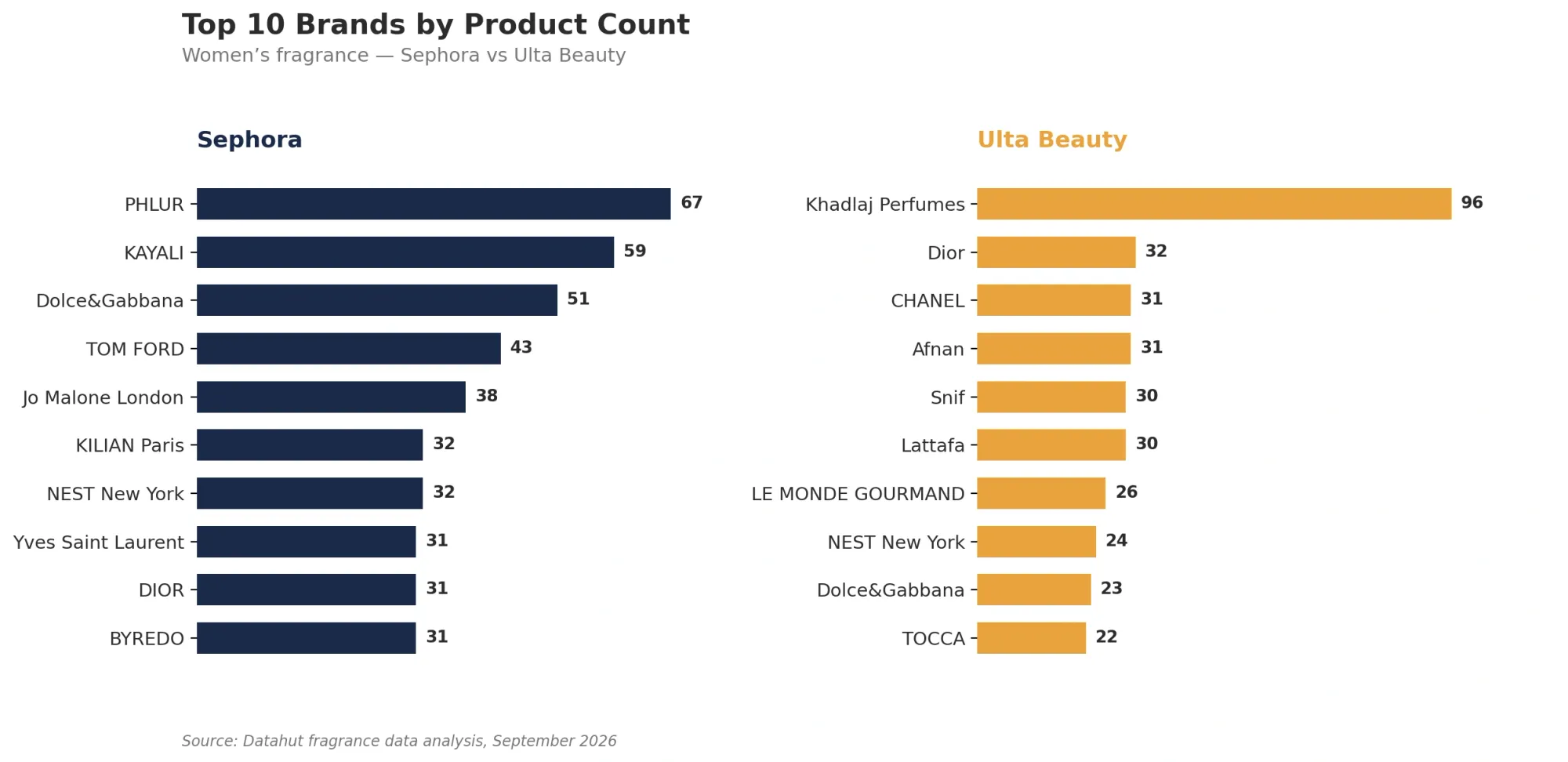
Top 10 brands by product count , Sephora vs Ulta (Women)
Additional insights include:
- At Sephora, PHLUR is the top brand by number of fragrances offered (67), followed closely by KAYALI (59) and Dolce&Gabbana (51). Sephora also carries a strong premium tier, including TOM FORD, Jo Malone London and KILIAN Paris.
- At Ulta Beauty, Khadlaj Perfumes leads with 96 fragrances, nearly triple the count of its closest competitor. Dior (32) and CHANEL (31) complete the top three, alongside accessible brands such as Afnan and Lattafa. This indicates Ulta emphasizes a broader selection of niche and value-oriented brands rather than focusing on a few major names.
- Sephora and Ulta Beauty both offer 32 common fragrance brands, including luxury names such as Chanel, Dior, Gucci, and Chloé, as well as accessible brands like Ariana Grande and Sol de Janeiro. Despite differing brand strategies, both retailers compete directly across a significant shared selection.
Pricing Ranges for Different Women Fragrance Products at Sephora and Ulta Beauty
Fragrance pricing varies significantly by brand and retailer. Sephora and Ulta Beauty both offer women’s fragrances across a broad price spectrum, from affordable drugstore brands to luxury options.
At Sephora and Ulta Beauty, prices for women’s fragrances can start as low as $4.99 and go up to $630 and $499 respectively.
For the purpose of analysis, we split items into four separate pricing ranges: affordable (below $50), economy ($50 to $100), premium ($100 to $200) and luxury (above $200).
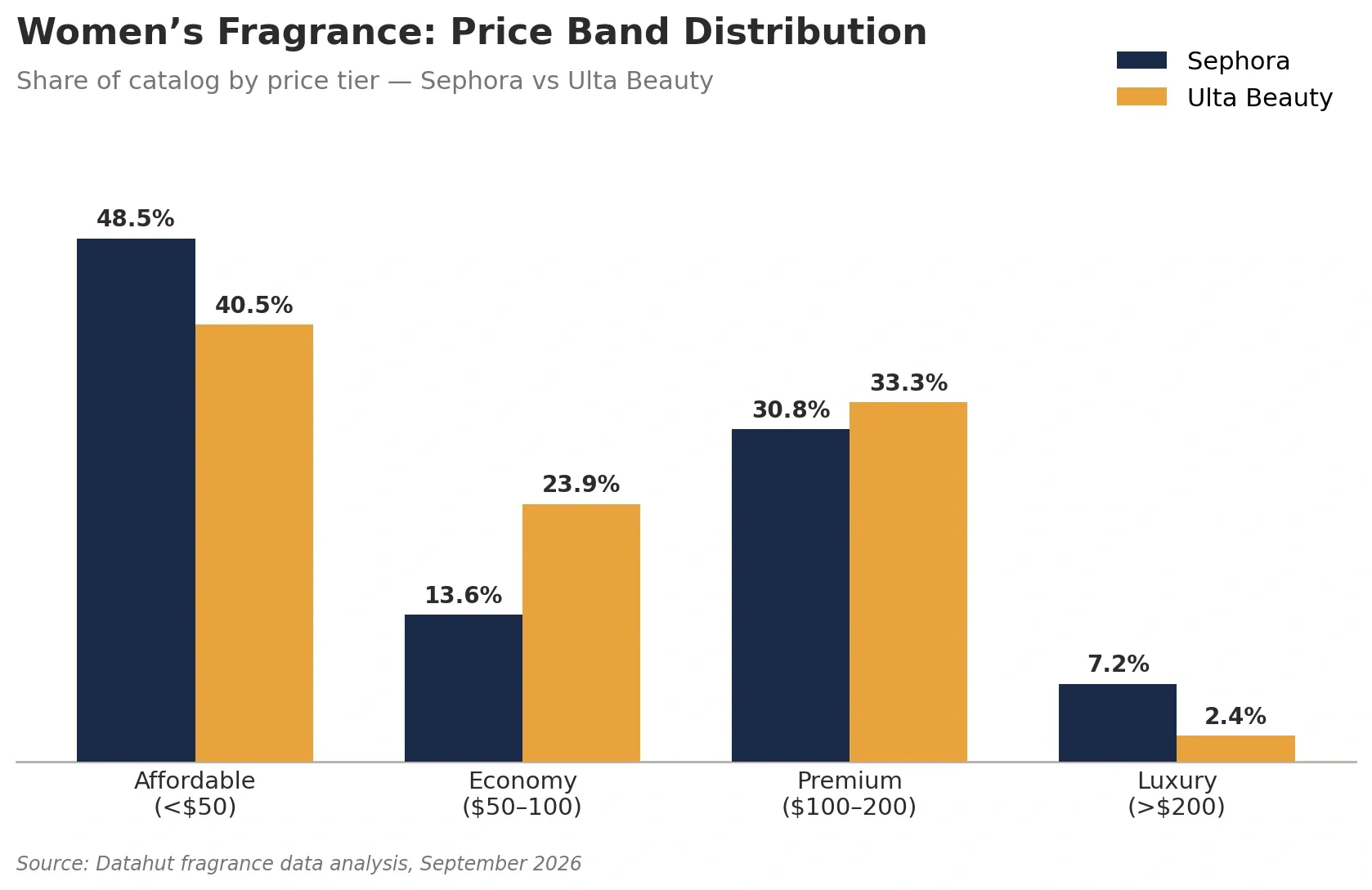
Price band distribution , % of women’s products (Sephora vs Ulta)
Pricing Insights
- Sephora has a wider range of affordable products (689 items, 48.5%) compared to Ulta Beauty (566 items, 40.5%). This suggests Sephora still prioritizes a broad selection for budget-conscious customers even while carrying more premium and luxury lines.
- In the economy band, Ulta Beauty actually leads with 23.9% of products versus Sephora’s 13.6%, reversing the near-tie seen in the original data, Ulta now offers noticeably more mid-priced options in this specific range.
- The premium category is close between the two: Ulta actually has slightly more premium products (465 vs 438), though as a share of each retailer’s total catalog the two are nearly identical (33.3% Ulta vs 30.8% Sephora).
- The luxury category shows the sharpest divide: Sephora carries 102 products above $200 (7.2%) compared to Ulta’s 33 (2.4%). This is the clearest sign that Sephora still targets the higher-end shopper more deliberately than Ulta Beauty.
Overall, the pricing data confirms that Sephora leans toward high-end offerings, while Ulta focuses on affordability and mid-range value. This core positioning remains consistent, despite changes in specific percentages.
Popularity for Different Women Fragrance Products at Sephora and Ulta Beauty
The popularity of a fragrance brand can be gauged by the number of customer reviews it receives. This analysis examines the popularity of different women’s fragrance brands by evaluating the number of reviews at Sephora and Ulta Beauty.
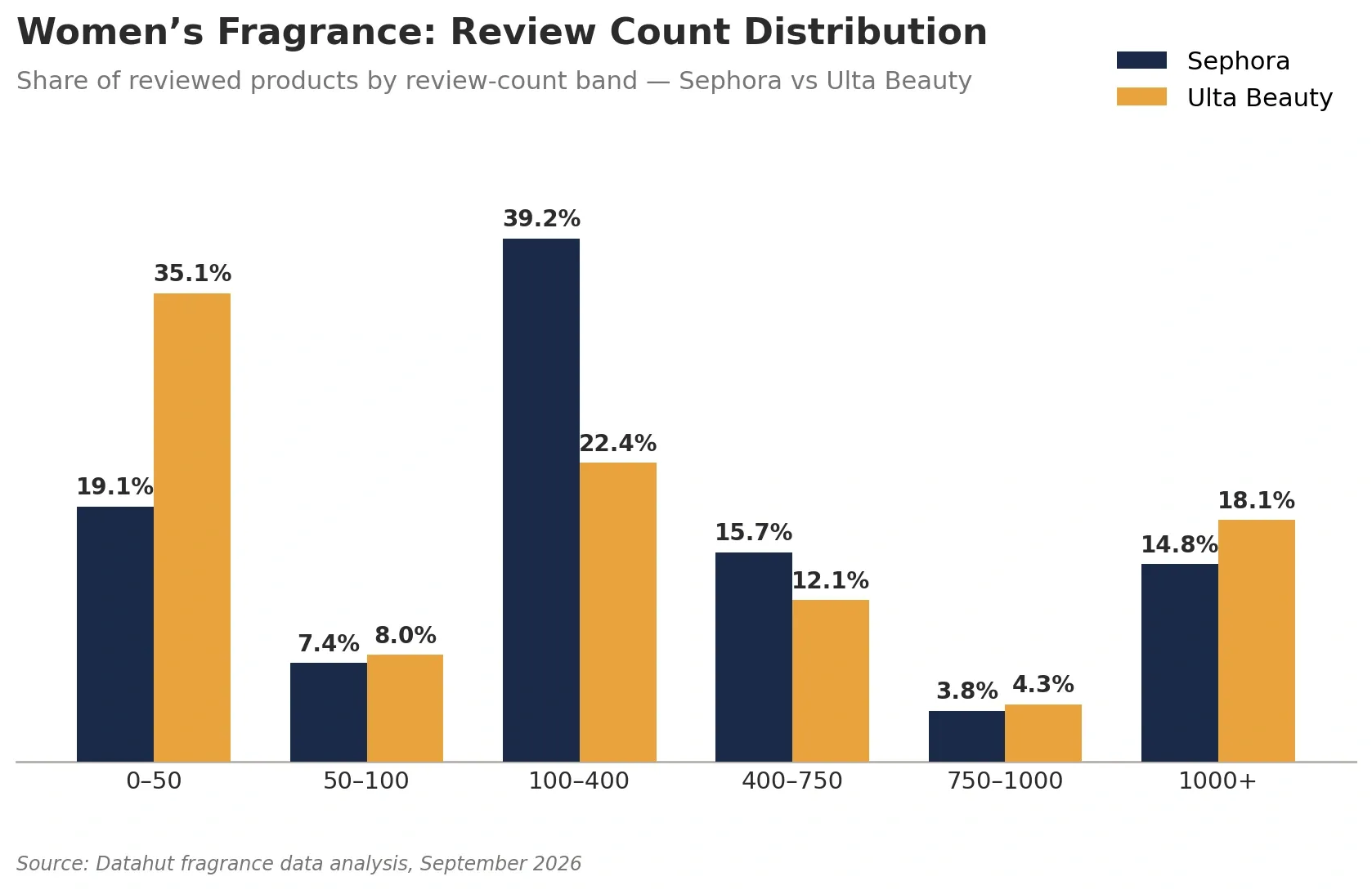
Review count distribution , % of reviewed products (Sephora vs Ulta)
Reviews Insights
- Sephora has more reviewed products overall : 1,358 of 1,422 products (95.5%) carry review data, versus 1,005 of 1,399 (71.8%) at Ulta Beauty. A meaningfully larger share of Ulta’s catalog has no reviews at all yet.
- Among reviewed products, Ulta Beauty actually has the higher share with 0–50 reviews (35.1% vs Sephora’s 19.1%), the opposite of what the original data showed. This points to a larger volume of newer or lower-traffic listings at Ulta right now.
- Sephora still dominates the 100–400 review band (39.2% vs 22.4%), its single largest bucket, consistent with the original finding that this is Sephora’s typical review range.
- Ulta Beauty maintains an advantage at the top end: 18.1% of its reviewed products have over 1,000 reviews, compared to 14.8% at Sephora. Ulta’s best-sellers continue to receive more reviews in absolute terms.
Overall, Sephora’s review base is broader and more evenly distributed across the middle ranges, while Ulta Beauty displays a more bimodal pattern, with clusters of both minimally reviewed and highly reviewed products.
Customer Satisfaction for Different Women Fragrance Products at Sephora and Ulta Beauty
Customer satisfaction is a crucial aspect when it comes to choosing a fragrance, whether it be for oneself or as a gift. One way to gauge customer satisfaction for different women’s fragrance brands at Sephora and Ulta Beauty is by looking at ratings.
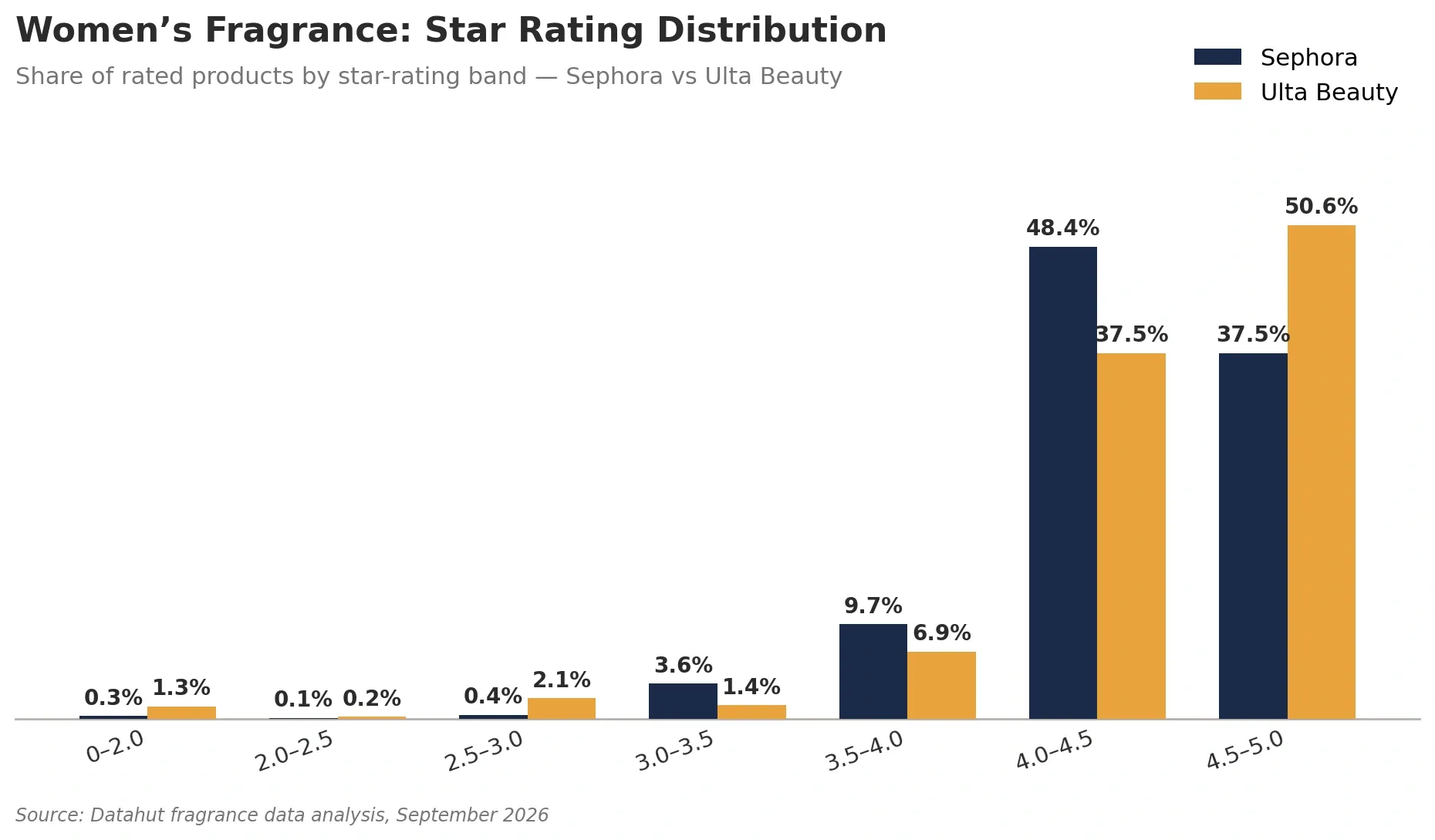
Star rating distribution , % of rated products (Sephora vs Ulta)
Customer Satisfaction Insights
- Both retailers have most products in the top two rating bands. Sephora’s largest group is now 4.0–4.5 (657 products, 48.4%), while Ulta’s largest group has shifted to 4.5–5.0 (509 products, 50.6%), up from 4.0–4.5 previously.
- Low ratings remain rare at both retailers, but Ulta now has a larger share: 13 products (1.3%) at 0–2.0 and 21 products (2.1%) at 2.5–3.0, compared with Sephora’s 4 products (0.3%) and 5 products (0.4%) in those same bands respectively.
- Averaging across all rated products, Ulta Beauty now edges out Sephora on straight mean rating: 4.45 vs 4.34 (out of 5, across 1,005 and 1,358 rated products respectively). This reverses the original conclusion that Sephora held a slight satisfaction edge.
This represents the most significant change from the original analysis: Sephora previously led in overall satisfaction, but current data shows Ulta Beauty now has a higher average rating and a larger share of top-rated (4.5–5.0) products. Both retailers continue to offer highly rated fragrances, with fewer than 3% of rated products at either store falling below a 3.0. However, the satisfaction gap has narrowed and, based on this data, reversed.
Fragrance Family for Different Women Fragrance Products at Sephora and Ulta Beauty
A fragrance family refers to the classification of a scent based on its dominant aroma and overall character. Sephora and Ulta Beauty offer a range of popular fragrance brands that cater to different fragrance families, such as floral, warm & spicy, fresh, earthy & wood, and other niche or blended scents.
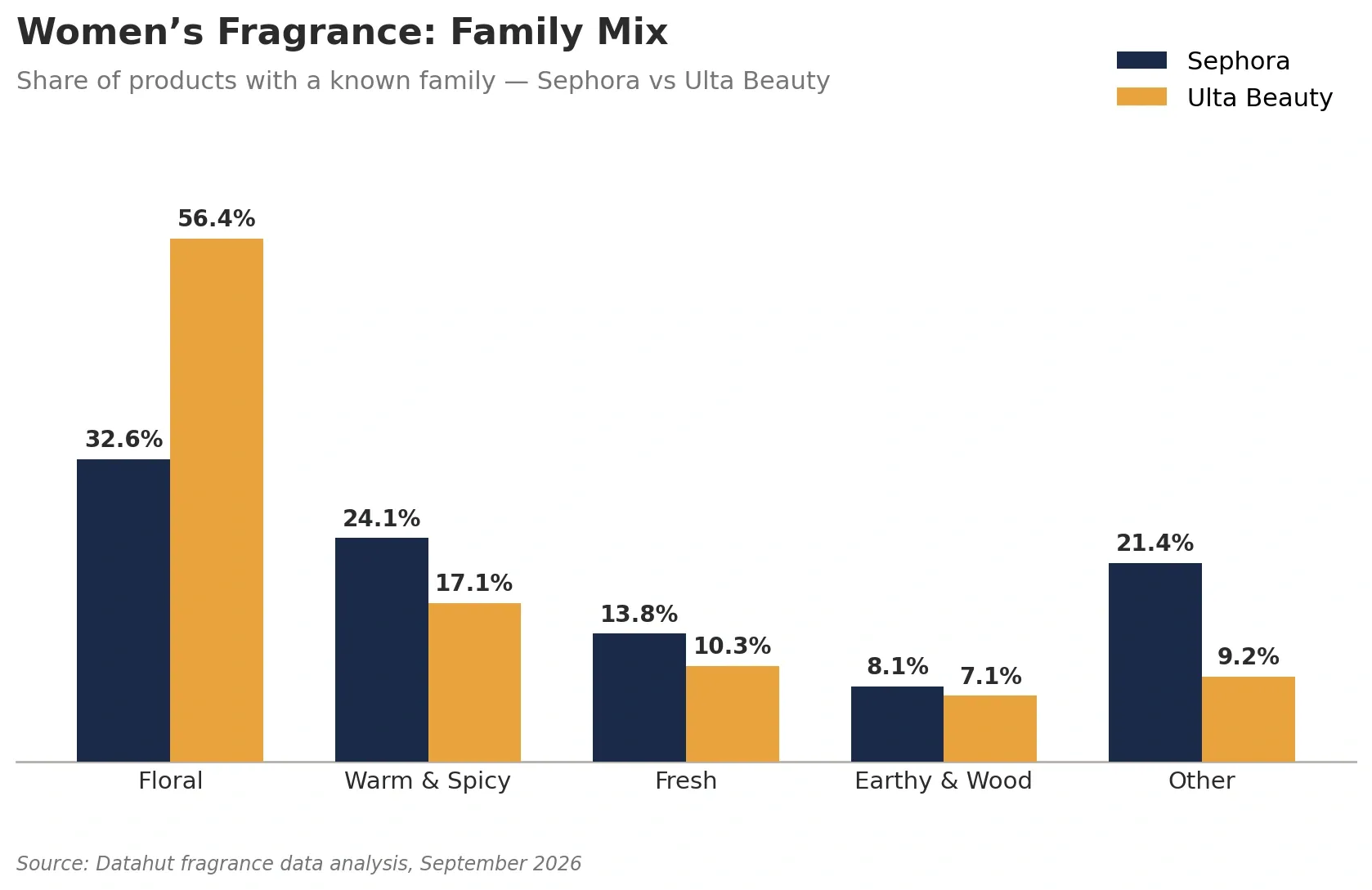
Fragrance family mix , % of products with a known family (Sephora vs Ulta)
Family Insights
- Floral remains the most popular family at both retailers, but Ulta Beauty now relies on it more heavily: 56.4% of Ulta’s catalog is Floral, compared to 32.6% at Sephora. This reverses the previous trend, where Sephora had the larger floral share. Sephora still leads in Warm & Spicy (24.1% vs 17.1%) and Fresh (13.8% vs 10.3%), consistent with the original finding that Sephora carries a broader spread across these two families.
- Earthy & Wood is now nearly even between the two (8.1% Sephora vs 7.1% Ulta), a much closer split than the original data, which had shown a clearer Ulta lead in this family.
- Sephora carries a noticeably larger “Other” share (21.4% vs 9.2%), reflecting its longer tail of niche and designer brands whose scent profiles don’t map cleanly onto the four core families.
The headline finding has flipped: Ulta Beauty, not Sephora, is now the more floral-forward retailer, while Sephora’s catalog is comparatively more spread across warm, spicy and fresh notes alongside a wider tail of unclassified niche scents.
Visualization of the 10 Most Popular Women Fragrance Product Ingredients at Sephora and Ulta Beauty
When it comes to finding the perfect fragrance, ingredients play a crucial role in determining the longevity and overall scent of a product.
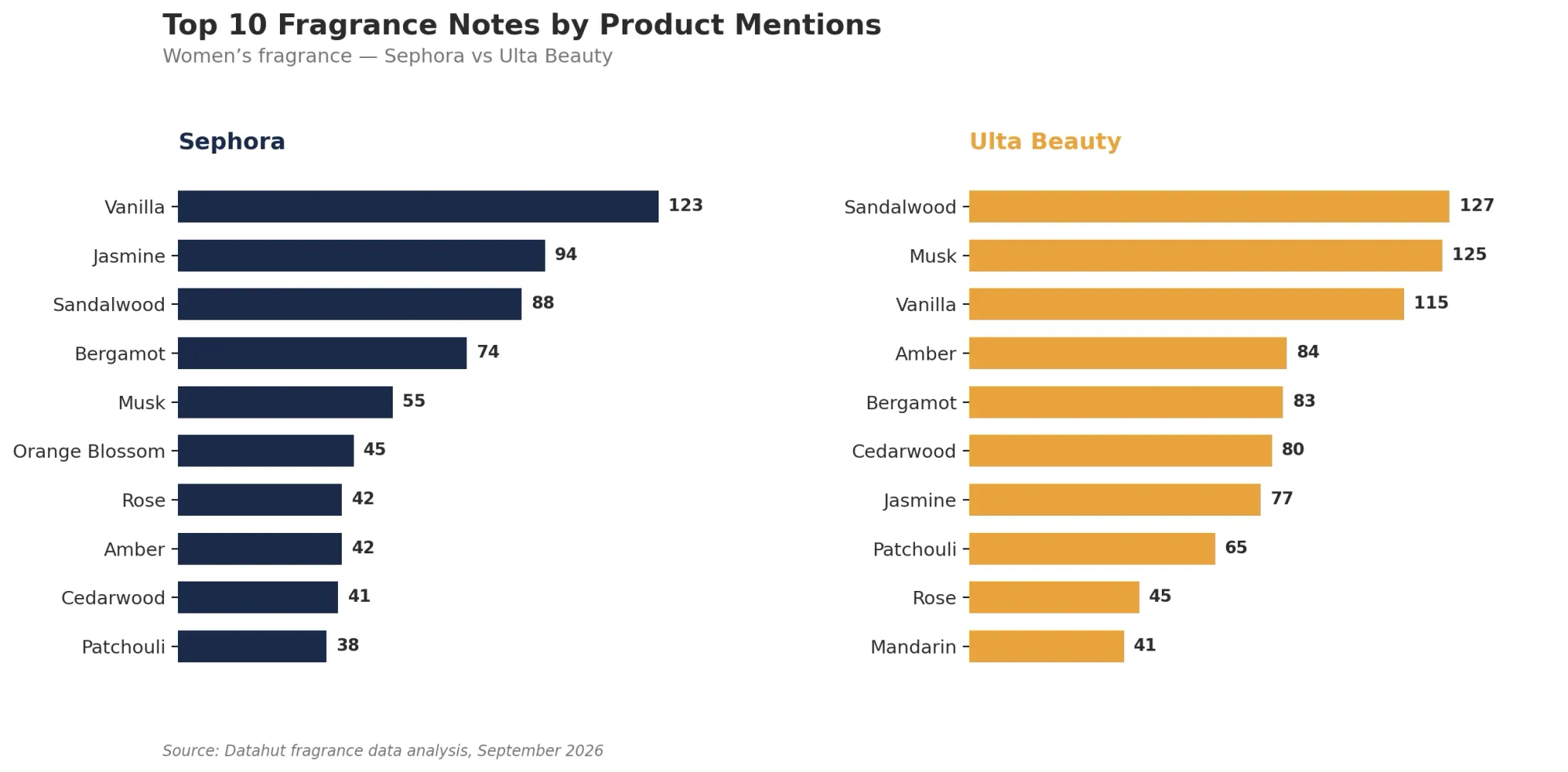
Top 10 fragrance notes by product mentions (Sephora vs Ulta)
Ingredient Insights
- Vanilla, Jasmine, and Sandalwood are the most mentioned ingredients at Sephora (123, 94, and 88 mentions), while Sandalwood, Musk, and Vanilla lead at Ulta Beauty (127, 125, and 115 mentions). The same core notes are popular at both retailers, though in a different order.
- Ulta Beauty’s top ingredients skew more toward Amber, Cedarwood and Patchouli (84, 80 and 65 mentions), reinforcing the woodier, more amber-forward profile seen in its fragrance family mix. Sephora’s list leans more floral and citrus, with Orange Blossom and Bergamot both in its top six.
- Rose ranks lower on both lists than previously observed (42 mentions at Sephora, 45 at Ulta), while Musk has become one of the most-mentioned notes at Ulta. This shift may warrant further monitoring in future analyses.
Men’s Fragrance: Sephora vs Ulta Beauty
The same six comparisons, product range, pricing, popularity, customer satisfaction, fragrance family and ingredients applied to the men’s fragrance catalogs at both retailers.
Product Range for Men’s Fragrance at Sephora and Ulta Beauty
Sephora and Ulta Beauty both carry a meaningfully smaller men’s assortment than women’s, but with the same brand-strategy split seen elsewhere:
- Sephora offers 54 brands and 529 products, led by TOM FORD, Jo Malone London and Yves Saint Laurent.
- Ulta Beauty offers 88 brands and 691 products, led by Khadlaj Perfumes, Michael Malul and Swiss Arabian.
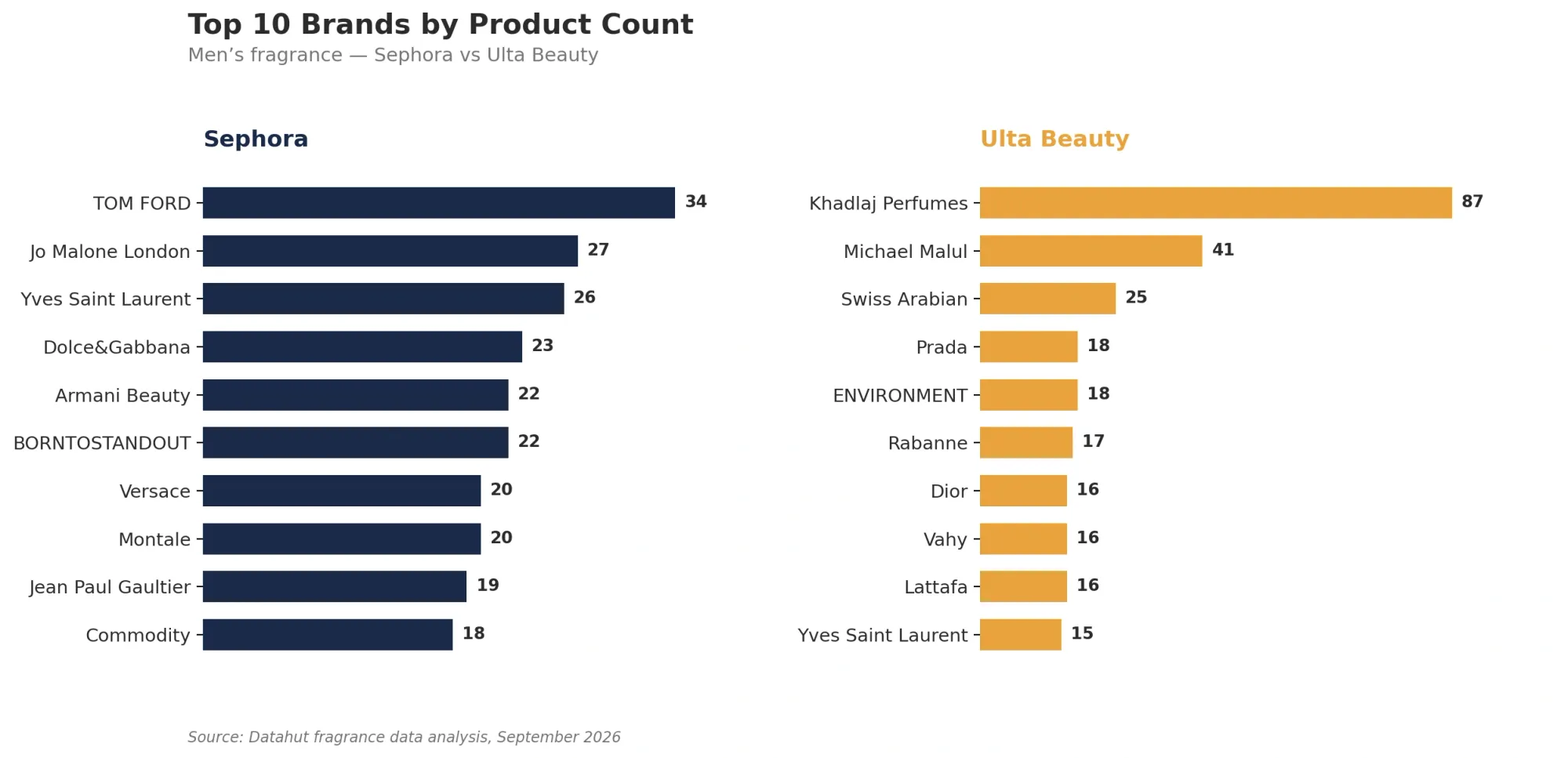
Top 10 brands by product count , Sephora vs Ulta (Men)
Some more insights include:
- At Sephora, TOM FORD is the top men’s brand with 34 products, followed by Jo Malone London (27) and Yves Saint Laurent (26) , a much more premium-skewed top three than Ulta’s.
- At Ulta Beauty, Khadlaj Perfumes again dominates with 87 products , more than double Michael Malul’s 41 , continuing the long-tail, value-brand pattern seen in the women’s category.
- Sephora and Ulta Beauty share only 18 common brands in men’s fragrance (versus 32 in women’s), including Tom Ford, Gucci, Prada and CHANEL , a noticeably smaller overlap, meaning the two retailers’ men’s assortments diverge more than their women’s do.
Pricing Ranges for Men’s Fragrance Products at Sephora and Ulta Beauty
Prices for men’s fragrances at Sephora and Ulta Beauty range from $20 to $460, and $8 to $499, respectively.
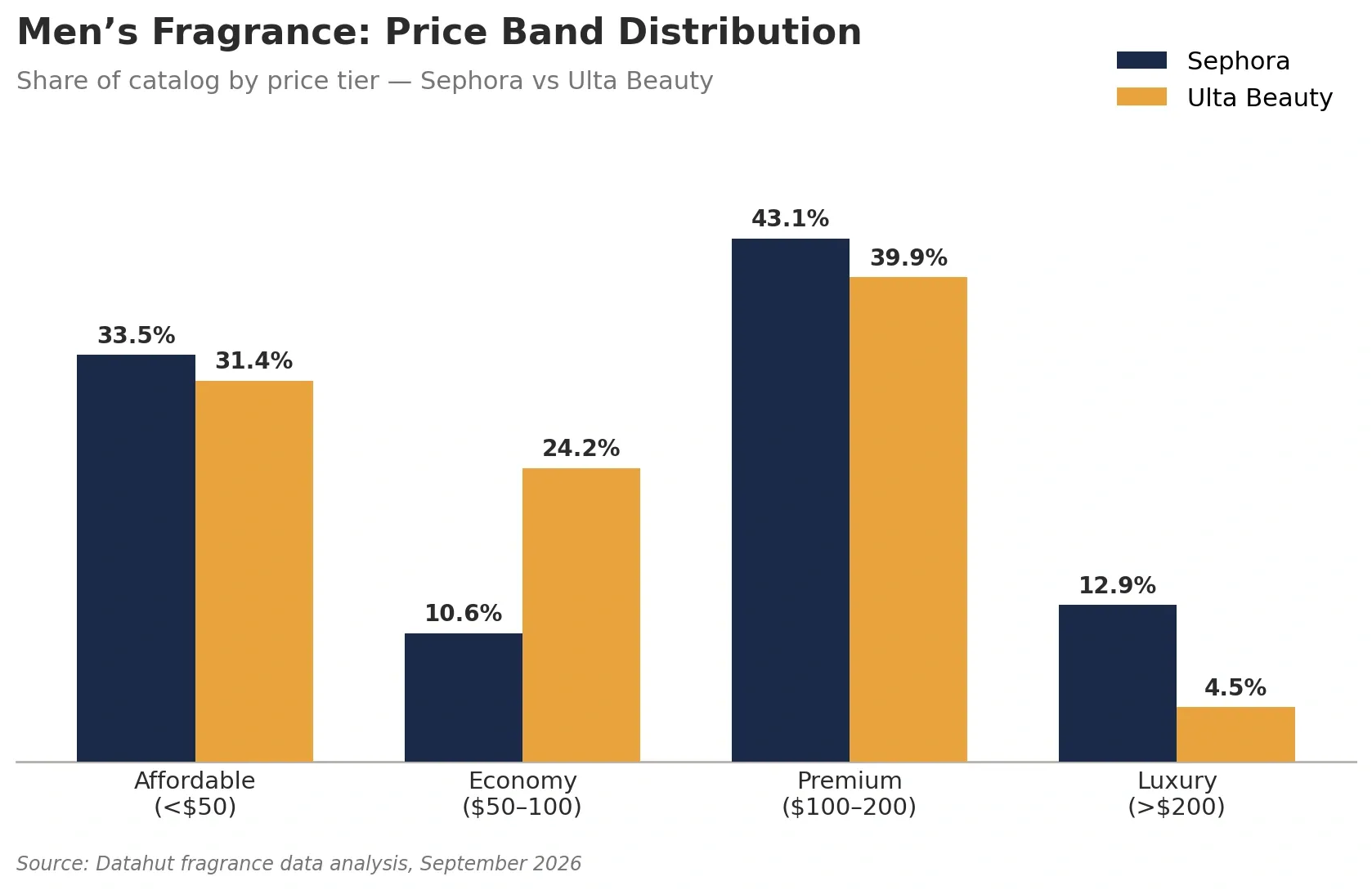
Price band distribution , % of men’s products (Sephora vs Ulta)
Pricing Insights
- Men’s fragrance skews premium at both retailers, unlike women’s, where affordable led. Sephora’s largest band is Premium (43.1%), and so is Ulta’s (39.9%).
- Sephora again carries the larger luxury tail: 12.9% of men’s products are above $200, nearly triple Ulta’s 4.5% , the same pattern as women’s, only more pronounced.
- Ulta leads in Economy (24.2% vs Sephora’s 10.6%), reinforcing that Ulta’s value positioning holds across both genders.
Popularity for Men’s Fragrance Products at Sephora and Ulta Beauty
Review coverage is thinner for men’s fragrance than women’s at both retailers, and especially at Ulta.
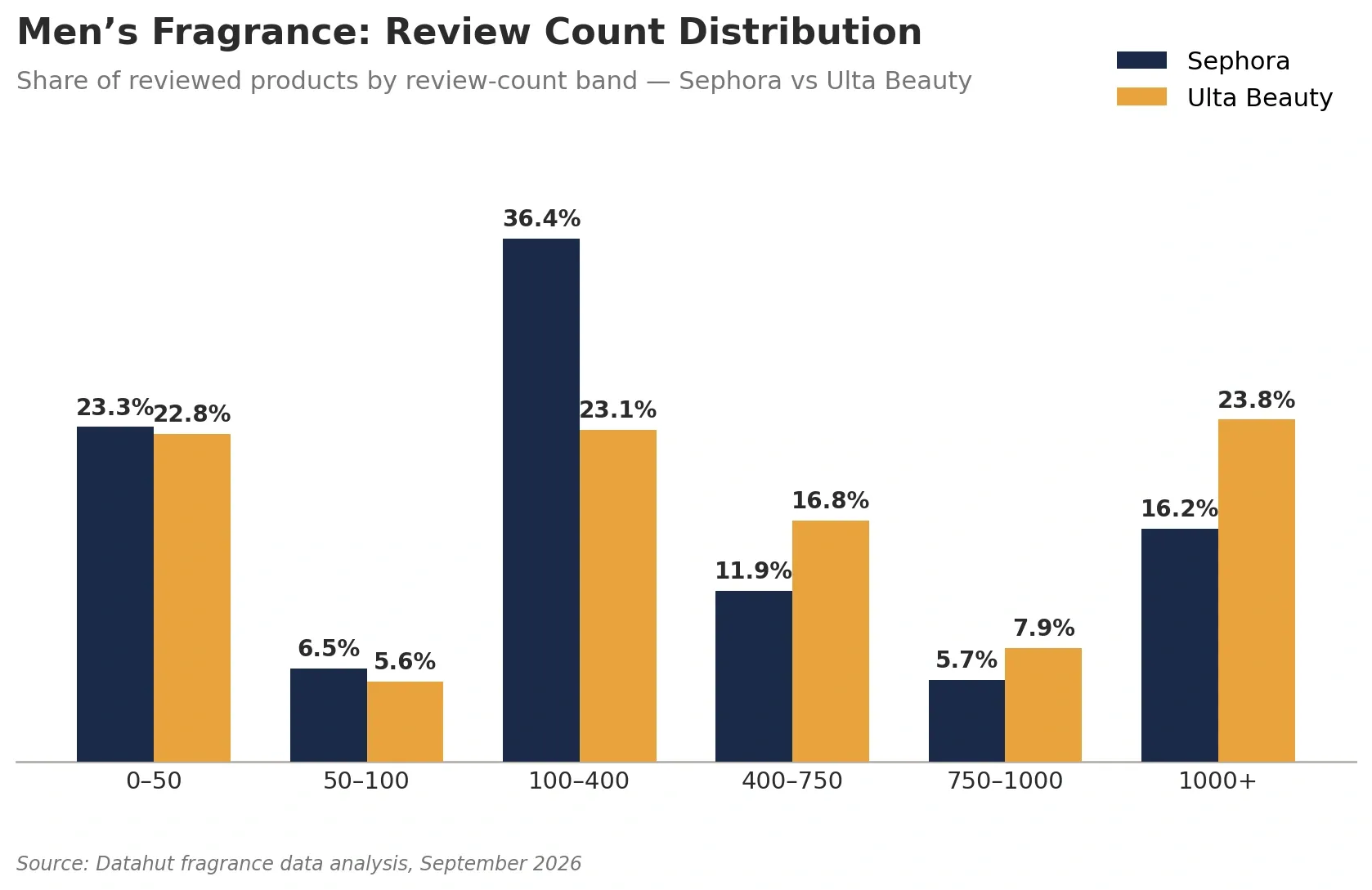
Review count distribution , % of reviewed products (Sephora vs Ulta, Men)
Reviews Insights
- Sephora has review data for 494 of 529 products (93.4%), while Ulta has it for only 303 of 691 (43.8%) , a much larger reviewed-coverage gap than in women’s fragrance.
- Ulta actually has the higher share of very heavily reviewed products: 23.8% at 1,000+ reviews vs Sephora’s 16.2%, despite reviewing a much smaller share of its catalog overall , its best-selling men’s items are extremely popular even though most of the catalog has little to no review data.
- Sephora’s reviews cluster more in the middle: 36.4% of its reviewed products fall in the 100–400 band, its single largest bucket, versus 23.1% for Ulta.
Customer Satisfaction for Men’s Fragrance Products at Sephora and Ulta Beauty
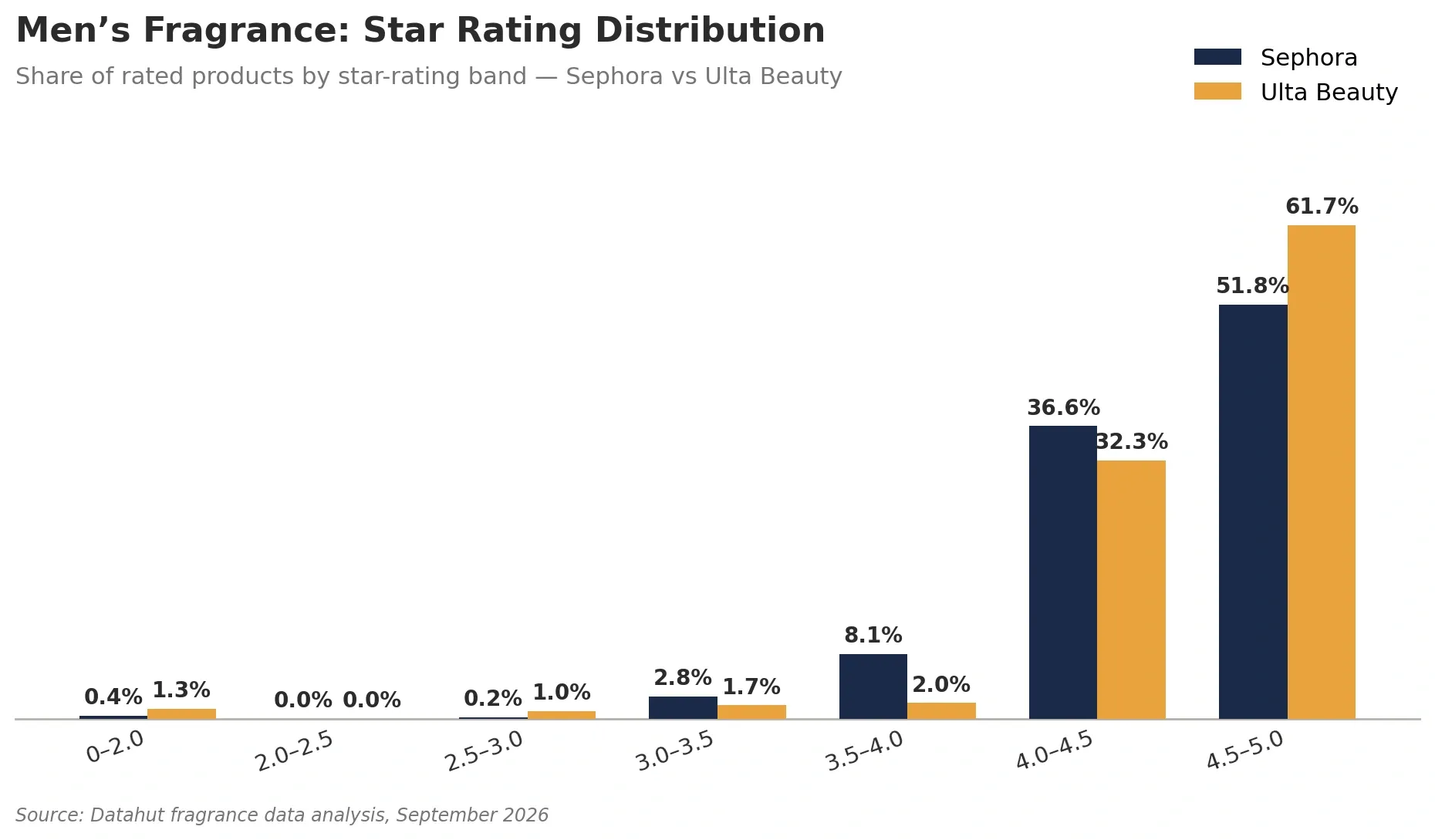
Star rating distribution , % of rated products (Sephora vs Ulta, Men)
Customer Satisfaction Insights
- Both retailers’ men’s ratings skew even higher than women’s. Ulta’s top band (4.5–5.0) captures 61.7% of its rated products, versus 51.8% for Sephora.
- Mean rating: Ulta Beauty 4.54 vs Sephora 4.43 (out of 5) , the same direction as women’s fragrance, and an even wider gap.
The satisfaction pattern found in women’s fragrance , Ulta Beauty now edging out Sephora , holds just as clearly, if not more so, in men’s fragrance.
Fragrance Family for Men’s Fragrance Products at Sephora and Ulta Beauty
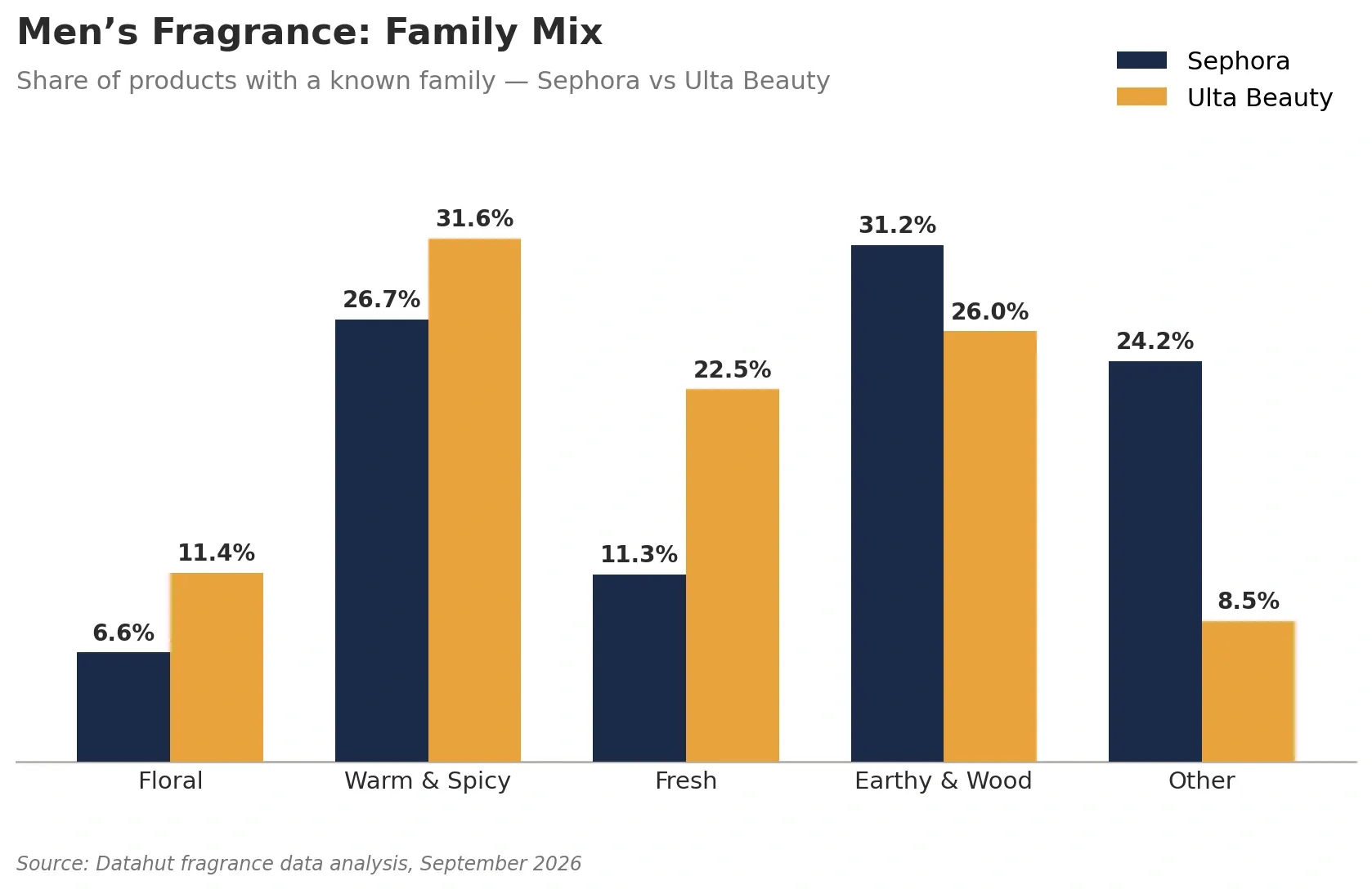
Fragrance family mix , % of products with a known family (Sephora vs Ulta, Men)
Family Insights
- Unlike women’s fragrance (Floral-led), men’s is dominated by Earthy & Wood at Sephora (31.2%) and Warm & Spicy at Ulta (31.6%) , matching typical men’s fragrance-industry positioning.
- Floral is a minor category for men’s fragrance at both retailers (6.6% Sephora, 11.4% Ulta), the smallest share of any category studied.
- Sephora carries a larger “Other” share (24.2% vs 8.5%), consistent with its broader niche-brand tail seen throughout this analysis.
Visualization of the 10 Most Popular Men’s Fragrance Product Ingredients at Sephora and Ulta Beauty
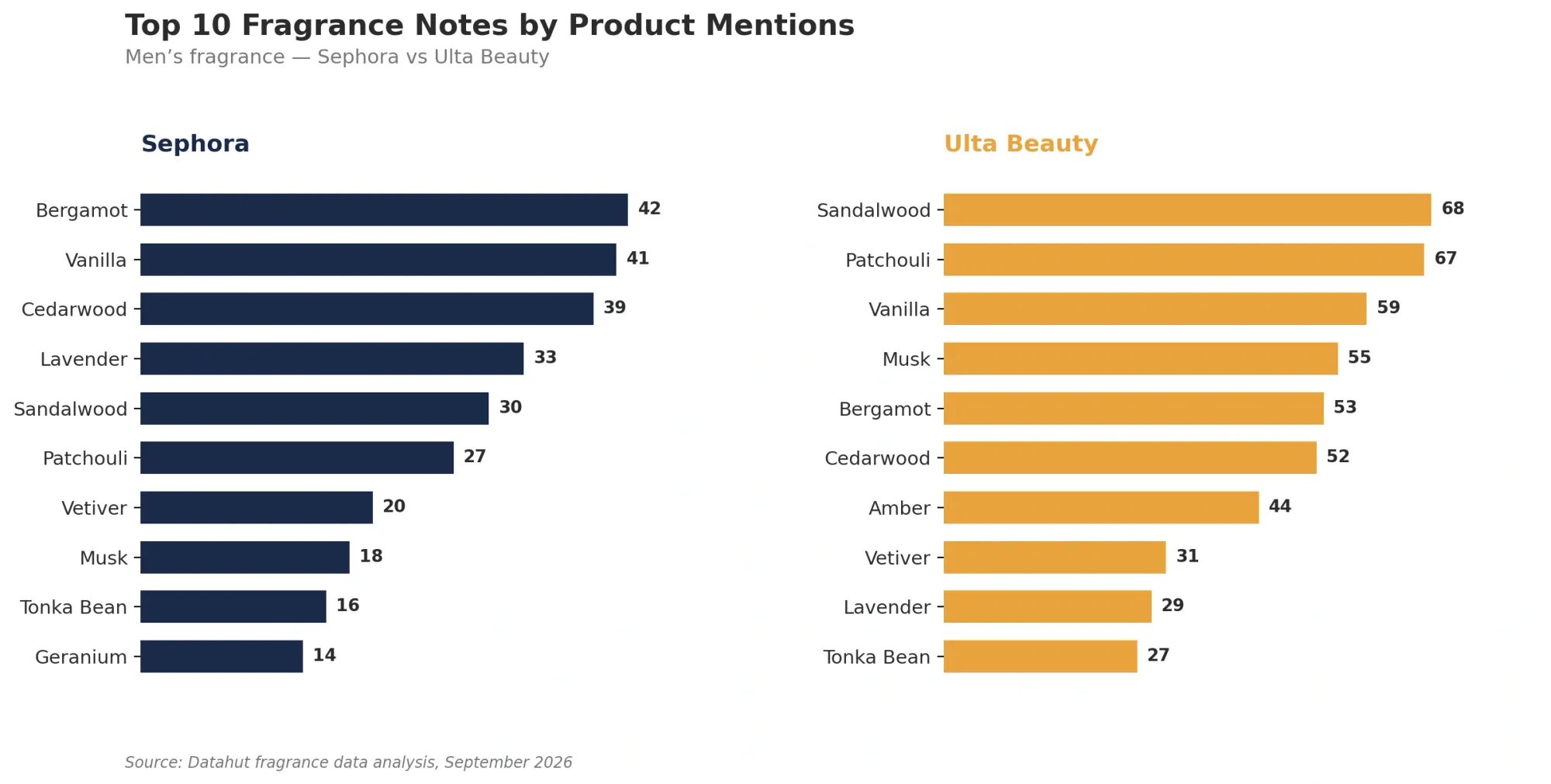
Top 10 fragrance notes by product mentions (Sephora vs Ulta, Men)
Ingredient Insights
- Bergamot, Vanilla and Cedarwood lead at Sephora (42, 41 and 39 mentions), while Sandalwood, Patchouli and Vanilla lead at Ulta Beauty (68, 67 and 59 mentions).
- Lavender and Vetiver both place in the men’s top 10 at both retailers , notes that don’t appear at all in the women’s top 10, confirming men’s fragrance draws on a distinct ingredient palette rather than just a different mix of the same notes.
Unisex Fragrance: Sephora vs Ulta Beauty
The same six comparisons applied to each retailer’s unisex fragrance catalog , the smallest of the three categories, and the one where Sephora and Ulta Beauty’s assortments overlap least.
Product Range for Unisex Fragrance at Sephora and Ulta Beauty
- Sephora offers 55 brands and 447 products, led by TOM FORD, Jo Malone London and BYREDO.
- Ulta Beauty offers 39 brands and 370 products, led by Khadlaj Perfumes, ENVIRONMENT and Who Is Elijah.
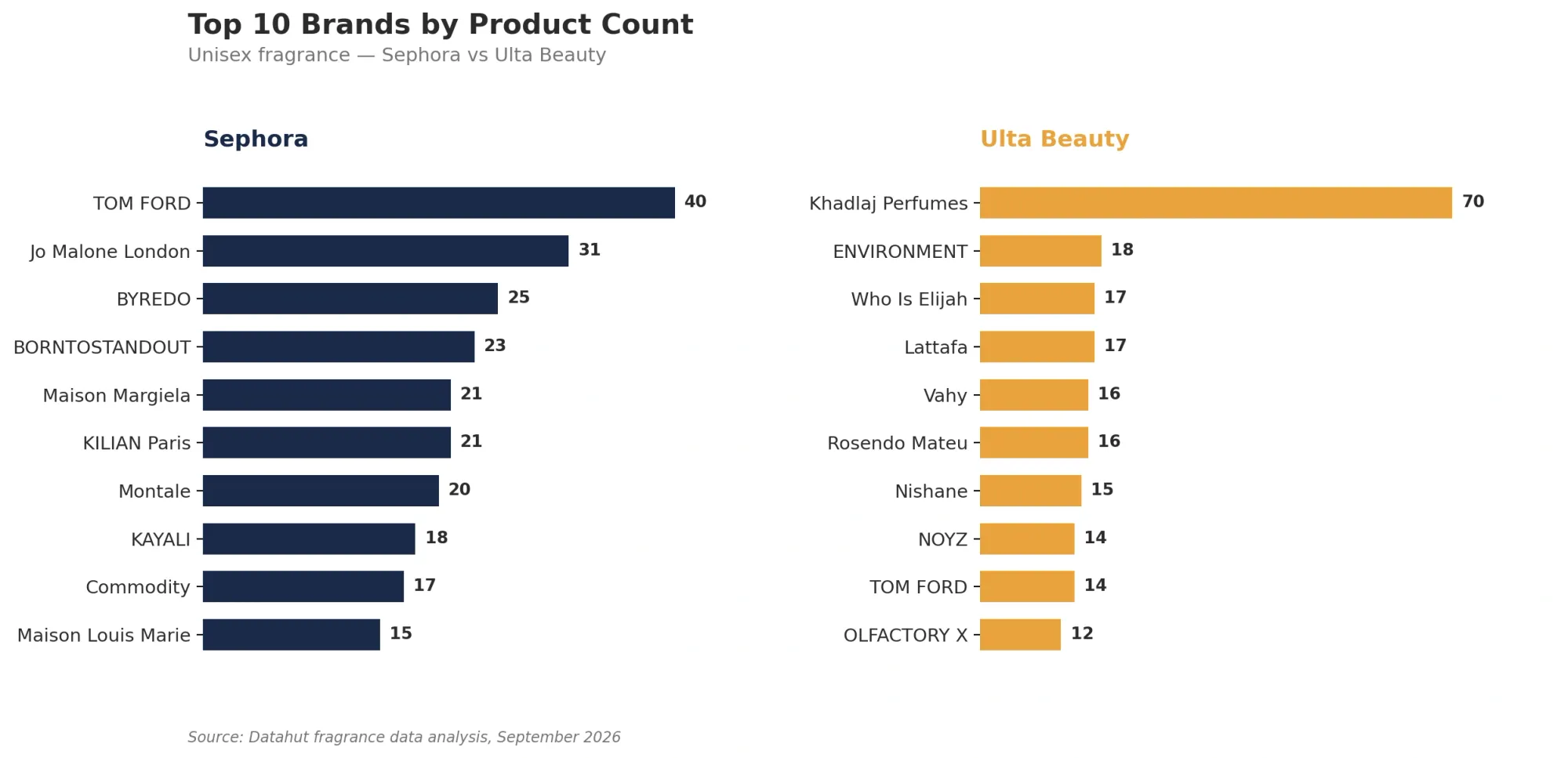
Top 10 brands by product count , Sephora vs Ulta (Unisex)
Some more insights include:
- Sephora and Ulta Beauty share only 7 common brands in unisex fragrance , the smallest overlap of any category (versus 32 in women’s and 18 in men’s). Unisex is where the two retailers’ assortments diverge the most.
- Ulta’s unisex catalog is also the most niche-brand-heavy of its three categories: none of its top 10 unisex brands are mainstream designer names, led instead by Khadlaj Perfumes (70) and smaller niche houses like Rosendo Mateu and Nishane.
Pricing Ranges for Unisex Fragrance Products at Sephora and Ulta Beauty
Prices for unisex fragrances at Sephora and Ulta Beauty range from $15 to $630, and $7 to $395, respectively.
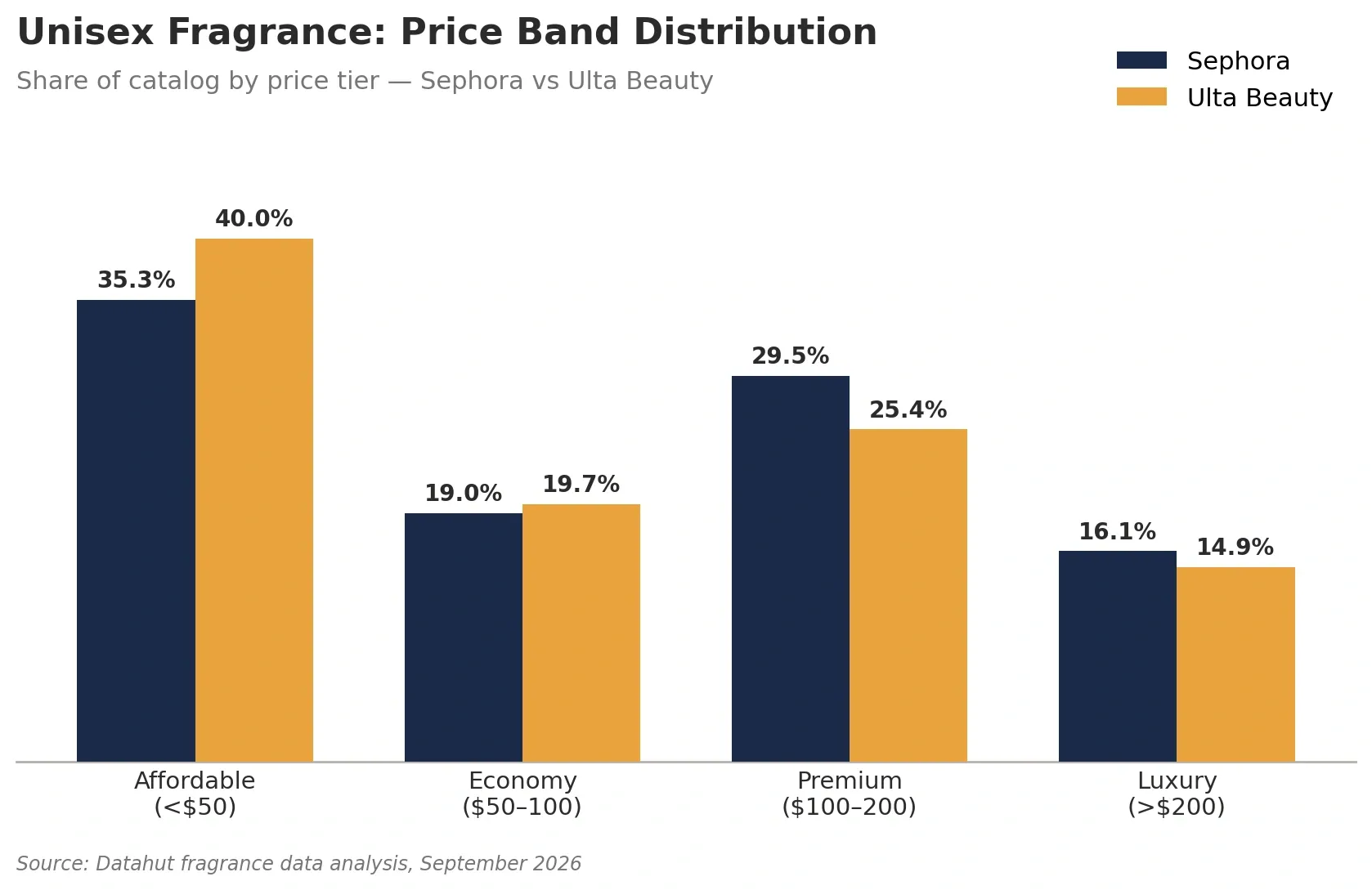
Price band distribution , % of unisex products (Sephora vs Ulta)
Pricing Insights
- Unisex is the most evenly matched pricing profile of the three categories , Sephora and Ulta land within a few points of each other across all four bands.
- Both retailers post their highest luxury share here of any category: 16.1% at Sephora, 14.9% at Ulta , unisex fragrance is where both retailers lean most heavily into premium pricing as a share of catalog.
Popularity for Unisex Fragrance Products at Sephora and Ulta Beauty
Review coverage for unisex fragrance is the thinnest of the three categories, particularly at Ulta Beauty.
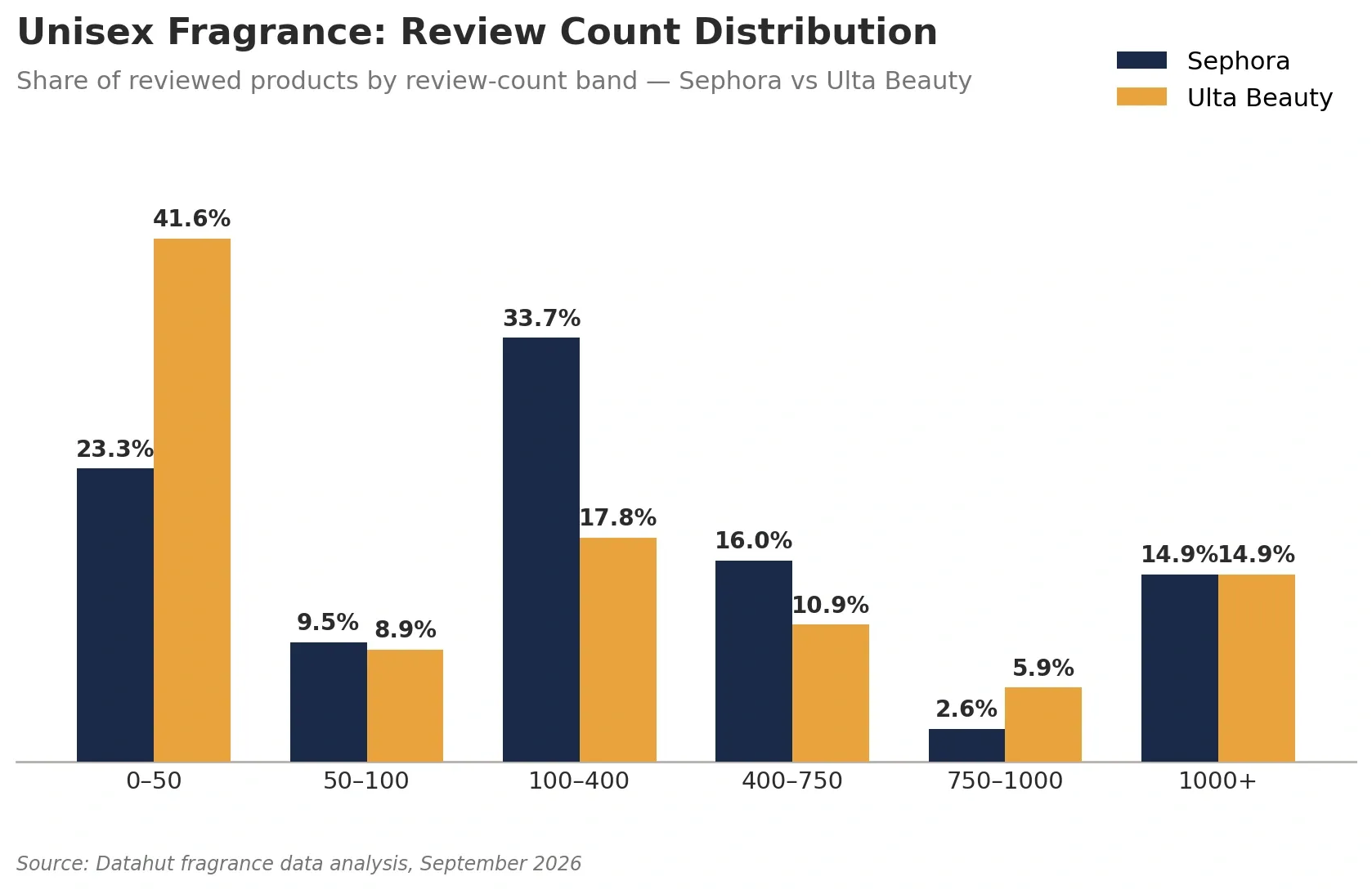
Review count distribution , % of reviewed products (Sephora vs Ulta, Unisex)
Reviews Insights
- Only 101 of Ulta’s 370 unisex products (27.3%) carry any review data at all , by far the lowest coverage of any retailer/category combination in this analysis. Sephora, by contrast, has review data for 430 of 447 (96.2%).
- Given that small base, Ulta’s unisex review-count and rating figures should be read with caution , a handful of products can swing the percentages considerably more than in the Women’s or Men’s categories.
Customer Satisfaction for Unisex Fragrance Products at Sephora and Ulta Beauty
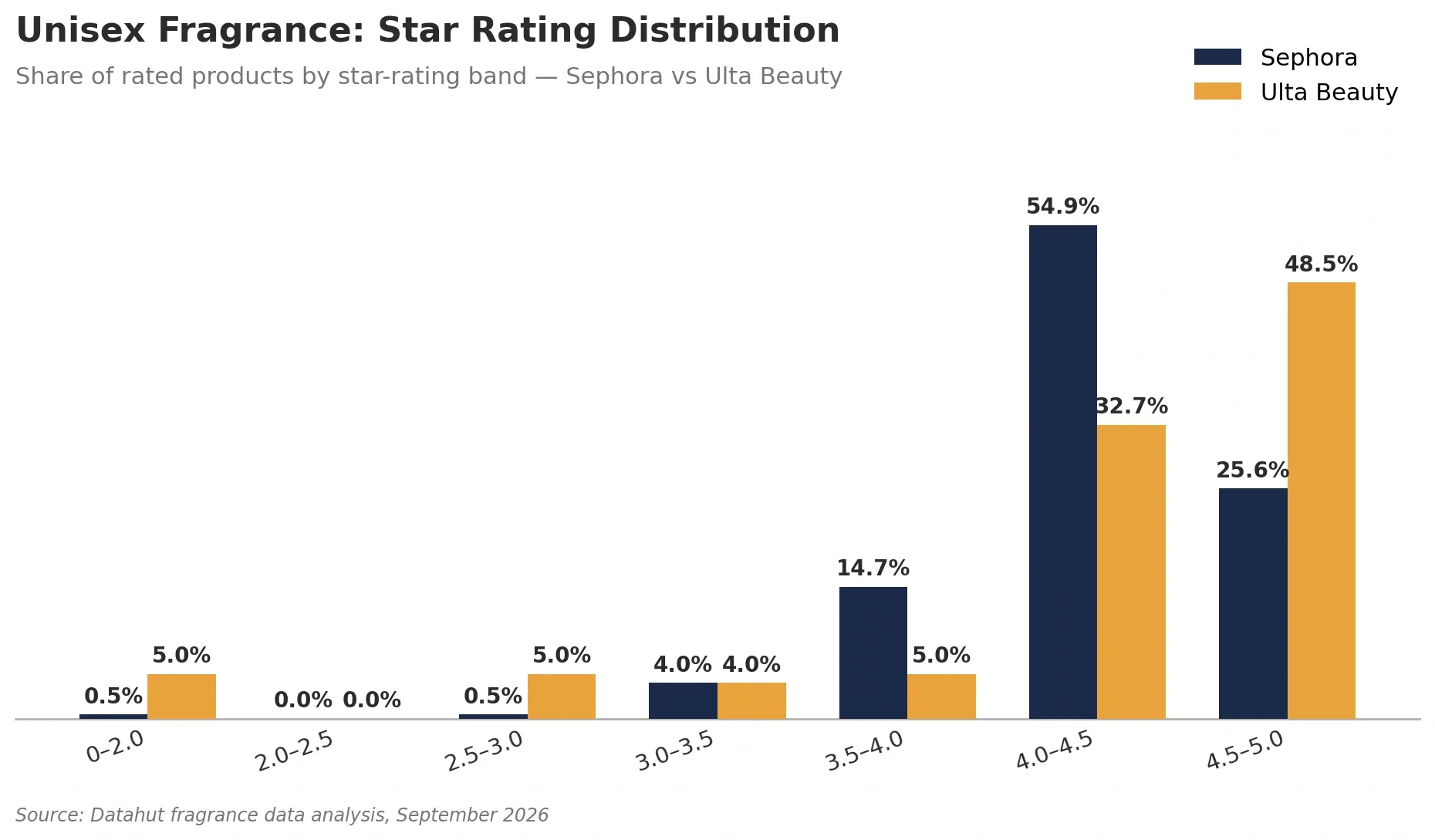
Star rating distribution , % of rated products (Sephora vs Ulta, Unisex)
Customer Satisfaction Insights
- Mean rating: Ulta Beauty 4.29 vs Sephora 4.25 , Ulta again edges ahead, though by the narrowest margin of the three categories.
- This is the only category where Sephora’s low-rating share is meaningfully cleaner than Ulta’s: 1.0% combined at 0–2.0 and 2.5–3.0 for Sephora vs 10.0% for Ulta , but with Ulta’s tiny 101-product review base noted above, this gap is far less statistically solid than the equivalent Women’s or Men’s figures.
Fragrance Family for Unisex Fragrance Products at Sephora and Ulta Beauty
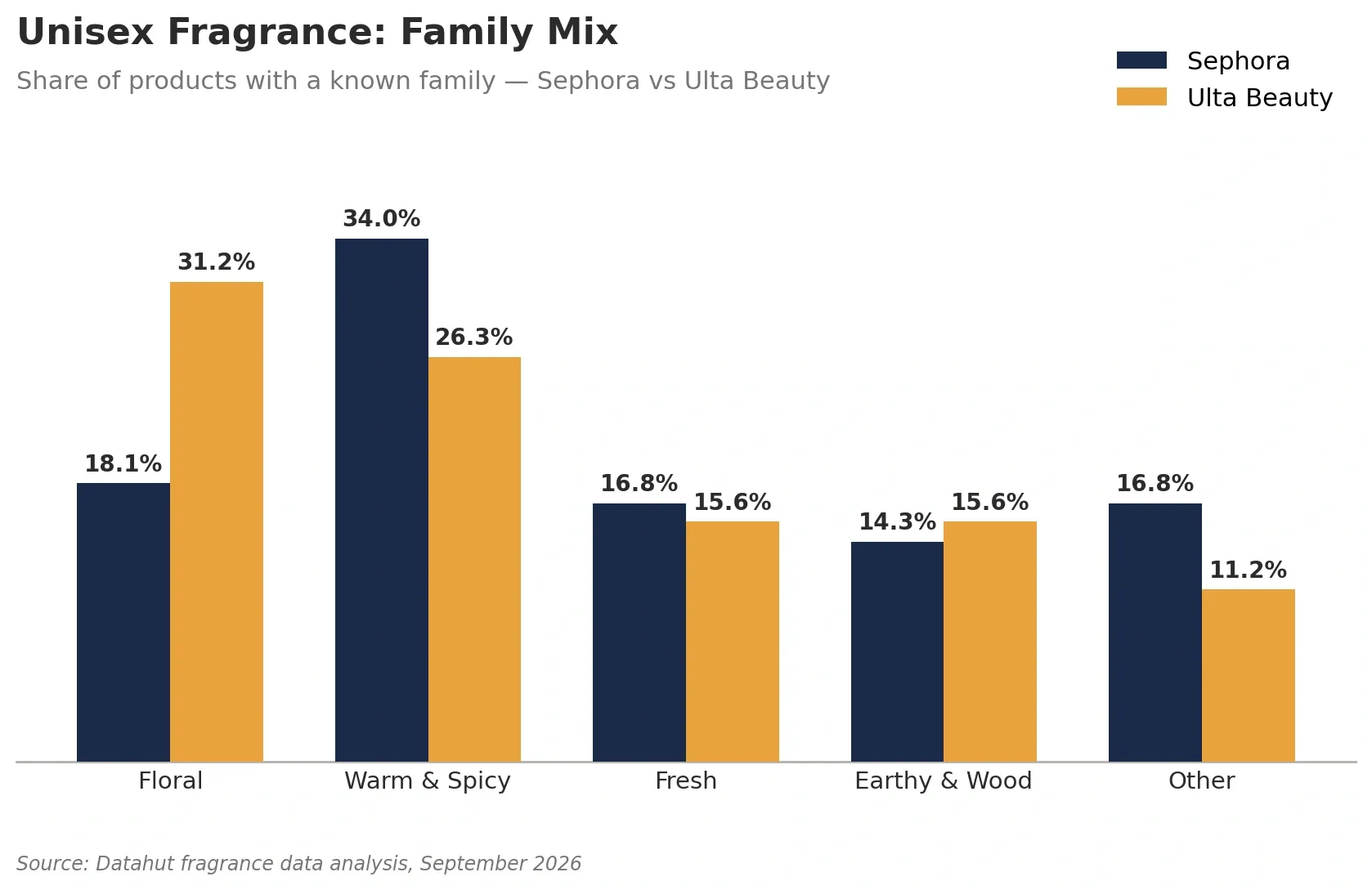
Fragrance family mix , % of products with a known family (Sephora vs Ulta, Unisex)
Family Insights
- Warm & Spicy leads at Sephora (34.0%), while Floral leads at Ulta (31.2%) , unisex fragrance sits between the Floral-heavy women’s profile and the Warm & Spicy / Earthy men’s profile, as expected for a blended category.
- Sephora and Ulta are closer together on Fresh and Earthy & Wood here than in any other category (14–17% range for both retailers on both families), suggesting unisex scent profiles are less differentiated by retailer than gendered fragrance is.
Visualization of the 10 Most Popular Unisex Fragrance Product Ingredients at Sephora and Ulta Beauty
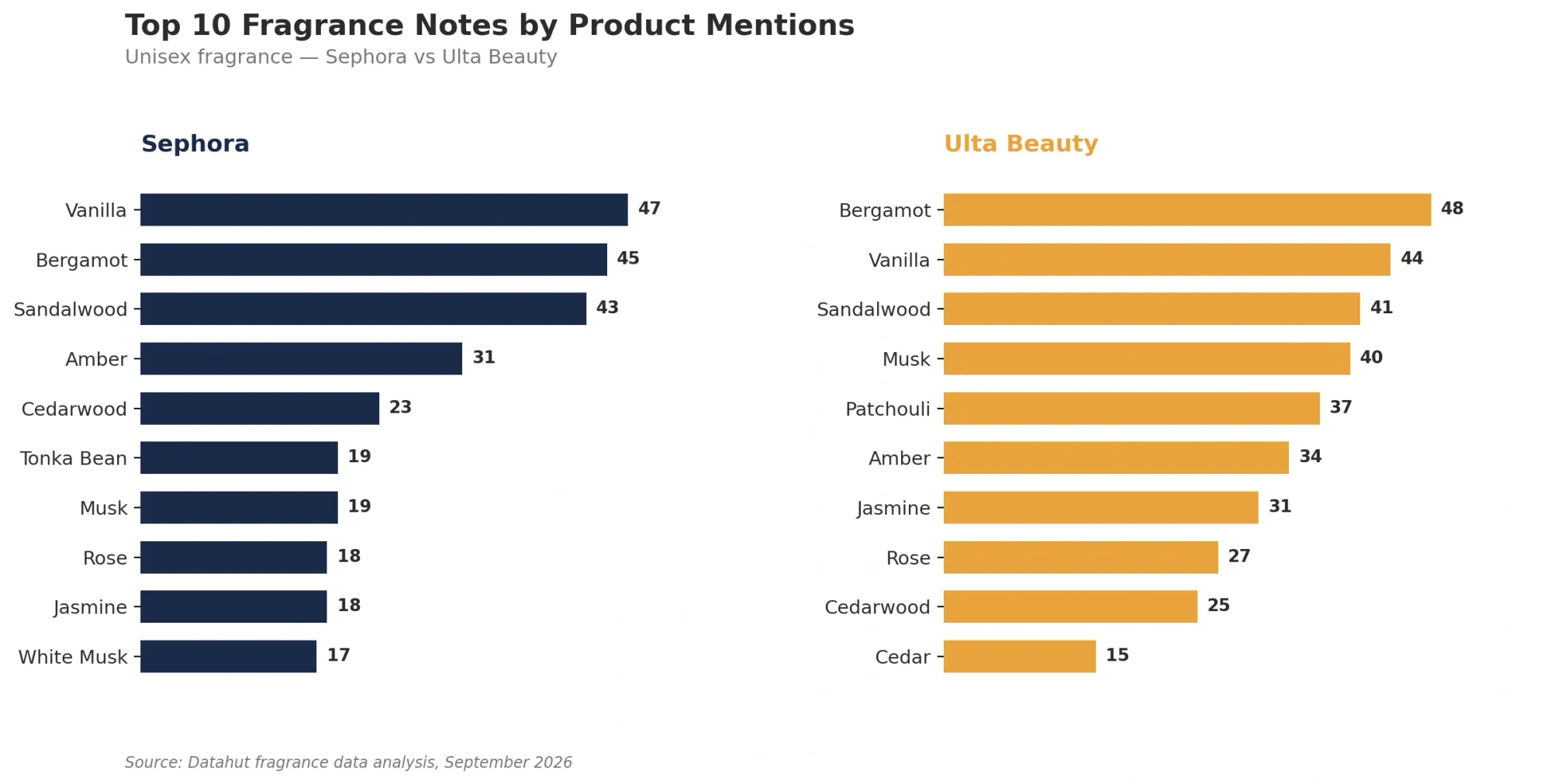
Top 10 fragrance notes by product mentions (Sephora vs Ulta, Unisex)
Ingredient Insights
- Vanilla, Bergamot and Sandalwood lead at Sephora (47, 45 and 43 mentions); Bergamot, Vanilla and Sandalwood lead at Ulta Beauty (48, 44 and 41 mentions) , the same top three notes, just reordered, at both retailers.
- This is the closest ingredient overlap of any category: unisex fragrance draws on a shared, blended note palette rather than the more gender-distinct ingredient sets seen in Women’s (floral/citrus-heavy) and Men’s (woody/spicy-heavy) fragrance.
Turn Comparisons Like This Into a Repeatable Process
This analysis took two structured retailer catalogs , Sephora and Ulta Beauty’s full fragrance assortments across Women’s, Men’s and Unisex , and a shared six-point methodology to produce: product range, pricing bands, popularity, customer satisfaction, fragrance family and ingredient mix. If you’re tracking competitors across a category like beauty and fragrance , not just one brand at a time , the real value comes from doing this continuously: fresh pricing as brands reprice, fresh review and rating data as new products launch, fresh brand and assortment tracking as catalogs shift, refreshed on a schedule instead of a one-time pull.
Datahut builds exactly this kind of structured, automatically refreshed marketplace data for teams doing competitive and category benchmarking in beauty, fashion and CPG. If you want a similar side-by-side built for your own category, request a free data audit or talk to a Datahut strategist about ongoing category monitoring.
Conclusion
Sephora and Ulta Beauty remain two of the strongest players in the beauty industry’s fragrance market, each offering a wide range of options across price points, brands and scent profiles , across Women’s, Men’s and Unisex fragrance alike.
A few patterns hold consistently across all three categories: Sephora carries the wider luxury selection and a broader tail of niche, unclassified scents in every category studied, while Ulta Beauty consistently leans toward mid-range pricing and a larger long-tail of value-oriented brands like Khadlaj Perfumes. Sephora and Ulta Beauty’s brand overlap also shrinks the further a category moves from Women’s (32 common brands) through Men’s (18) to Unisex (7), suggesting the two retailers’ catalogs diverge most where fragrance is least gendered.
The clearest change from the original analysis is on customer satisfaction, and it now holds across all three categories: Ulta Beauty posts a higher average rating than Sephora in Women’s (4.45 vs 4.34), Men’s (4.54 vs 4.43) and Unisex (4.29 vs 4.25) fragrance alike , reversing the original finding that gave Sephora a slight satisfaction edge. The gap is widest in Men’s fragrance and narrowest in Unisex, where Ulta’s much smaller review base also makes the comparison less statistically solid.
Fragrance family mix is the one place the three categories tell genuinely different stories: Floral dominates Women’s (more so at Ulta), Earthy & Wood and Warm & Spicy dominate Men’s, and Unisex sits in between , Warm & Spicy-led at Sephora, Floral-led at Ulta , confirming that unisex fragrance isn’t simply a blend of the other two but has its own distinct positioning at each retailer.
Ultimately, the decision of which retailer to purchase from will still depend on the individual consumer’s preferences, budget and which category they’re shopping , but on the current data, Ulta Beauty has closed, and arguably reversed, the satisfaction gap it previously trailed on, across every fragrance category studied.
Turn Competitor Data Into Actionable Insights
Want to see how your products, pricing, reviews, and assortment compare with competitors? Datahut can collect, structure, and continuously refresh marketplace data so your team can track category shifts and make faster, data-backed decisions.
Get a free data audit and discover what competitive insights you can unlock for your category.
Frequently Asked Questions
1. Which retailer offers more affordable fragrances, Sephora or Ulta Beauty?
Sephora carries a larger share of affordable women’s fragrances under $50 (48.5% of its catalog versus 40.5% at Ulta Beauty). Ulta Beauty, however, leads in the economy band ($50 to $100), so the more affordable retailer depends on exactly which price band a shopper is looking at.
2. Does Sephora or Ulta Beauty have a wider selection of luxury fragrances?
Sephora has the clear edge on luxury. Across every category studied, women’s, men’s and unisex, Sephora carries a larger share of products priced above $200. In women’s fragrance alone, Sephora offers 102 luxury products (7.2% of its catalog) compared to just 33 at Ulta Beauty (2.4%).
3. Which retailer has more customer reviews for its fragrances?
Sephora has broader review coverage overall. For example, 95.5% of Sephora’s women’s fragrance catalog has review data, compared to 71.8% at Ulta Beauty. That said, Ulta Beauty’s best-selling items tend to rack up more reviews at the very top end, with a higher share of products crossing 1,000+ reviews in most categories.
4. What is the most popular fragrance family at Sephora and Ulta Beauty?
Floral is the leading fragrance family for women’s fragrance at both retailers, though Ulta Beauty leans on it more heavily (56.4% of its catalog versus 32.6% at Sephora). Men’s fragrance skews toward Earthy & Wood and Warm & Spicy at both retailers instead, and unisex fragrance splits the difference, with Warm & Spicy leading at Sephora and Floral leading at Ulta Beauty.
5. How was the data for this Sephora vs Ulta Beauty comparison collected?
All figures, including product counts, pricing, review volumes, star ratings and ingredient mentions, were collected directly from the live Sephora and Ulta Beauty websites using Datahut’s web scraping platform, not third-party estimates or survey data. The original analysis was published in February 2023 and refreshed with newly scraped data in September 2026.


