

The luxury watch market is one of the most prized segments within the fashion and accessory industry, and no brand defines that segment more completely than Rolex — a name built on heritage, craftsmanship, and deliberate exclusivity. For decades, Rolex has attracted a global following of collectors, enthusiasts, and status-seekers willing to pay a significant premium simply to own one. But premium pricing and complex market dynamics create real challenges for anyone looking to buy, sell, or invest in this space without leaving money on the table.
This Rolex data strategy unpacks pricing tiers, seller reputation, and discount patterns drawn from real ultra-luxury listings on eBay - each priced above $15,000. Rather than stopping at what the numbers show, the analysis connects each finding to what it means in practice: which product conditions hold value, which seller signals predict a safe transaction, which colors command a price premium, and where the genuine opportunities lie in a market built on perception as much as precision.
Rolex Market Analysis: A Closer Look at Ultra-High-End Pricing
Let’s have a closer look at the luxury landscape:
Average Price: For most items, a general amount you can get is around $30,609.
Price Variance: Price ranges are highly dispersed. The standard difference is estimated to be around $27,193 from the average in order to show that while some items are way cheaper, others are more pricey than the others.
Lowest Price: An item that is priced is $13,187.70.
Mid-range prices: 50 percent of the prices fall between $18,218.60 and $35,029.00; midpoint $22,884.00
Price extreme: the highest cost is $550,000; thus, some are extremely high priced.
Distribution skew: Since the mean is higher than the middle point, it means a couple of very high price values are driving the mean high.
Outliers: The extreme value highest price compared with the remainder in a way suggests there might exist outliers for a few dramatically high-priced items in the database.
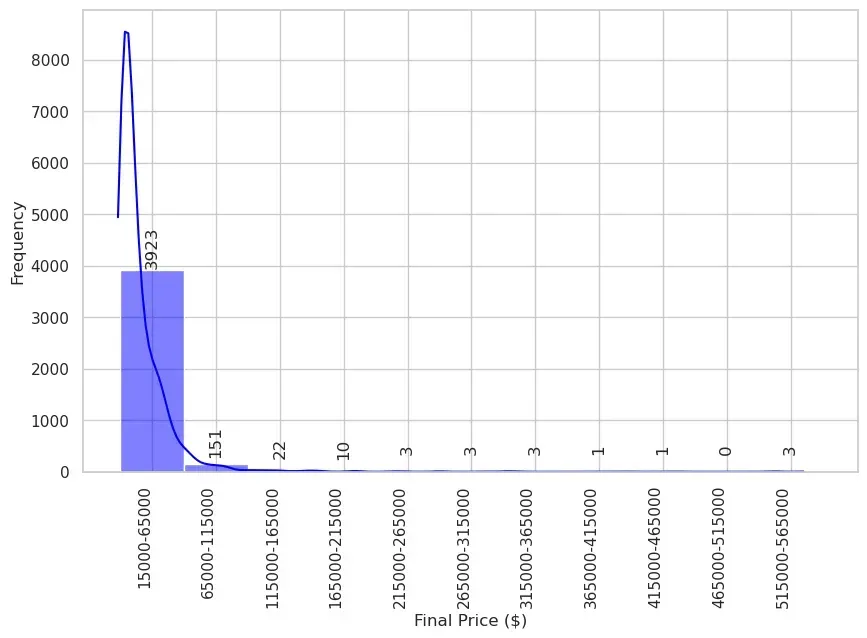
Luxury Market Skew: This graph displays the distribution of ultra-luxury goods, all over $15,000. The vast majority of these high-end goods skew towards the lower end of the luxury spectrum, right at $15,000. This means most luxury goods are on the "more affordable" side of luxury rather than being extreme high-end.
Rarity of Very Expensive Items: Every step of increase in the price scale cuts down to a significant extent the corresponding number of items. There would thus be a rarity of items at very top prices while ultra-luxury items exist at incredibly high prices. The isolated data points on the highest ends could represent one-of-a- kind, highly exclusive luxurious items.
Demand Concentration: The data points are concentrated on the lower end of the luxury market, which would indicate more demand for items just above the $15,000 mark. Consumers want luxury but are price-sensitive within this high-end market.
Niche Market at the Top: A niche market is long tail reaching up to very high prices, with very few items. This may be the ultra-rich who pay a premium for exclusivity and brand prestige.
Exclusive Savings: The Hidden Discounts in High-End Markets
Analysis of Discount Percentage Data
Mean Discount: The mean discount value for all records is about 2.67%, so the discounts are generally pretty low.
Discount Dispersion: There is a huge dispersion in the discounts since the standard difference is about 6.99%. This shows that while many items have no discount at all, some items get highly discounted.
Minimum Discount for Most Products: The median discount is 0%, as well as the 25th and 75th percentiles, meaning most items have a discount of 0%.
Maximum Discount: The highest discount was 51%. This could be interpreted to mean that some of the items have large discounts.
No Discount Majority: Because the median discount is 0%, the majority of the items in the dataset are not discounted at all.
Outliers: The maximum discount of 51% is quite high compared to the average, which means that very few items have unusually large discounts.
Skewed Distribution: Since the average discount is larger than the median, this means that while most of the items do not enjoy any discounts at all, a few items with enormous discounts are pushing the average.
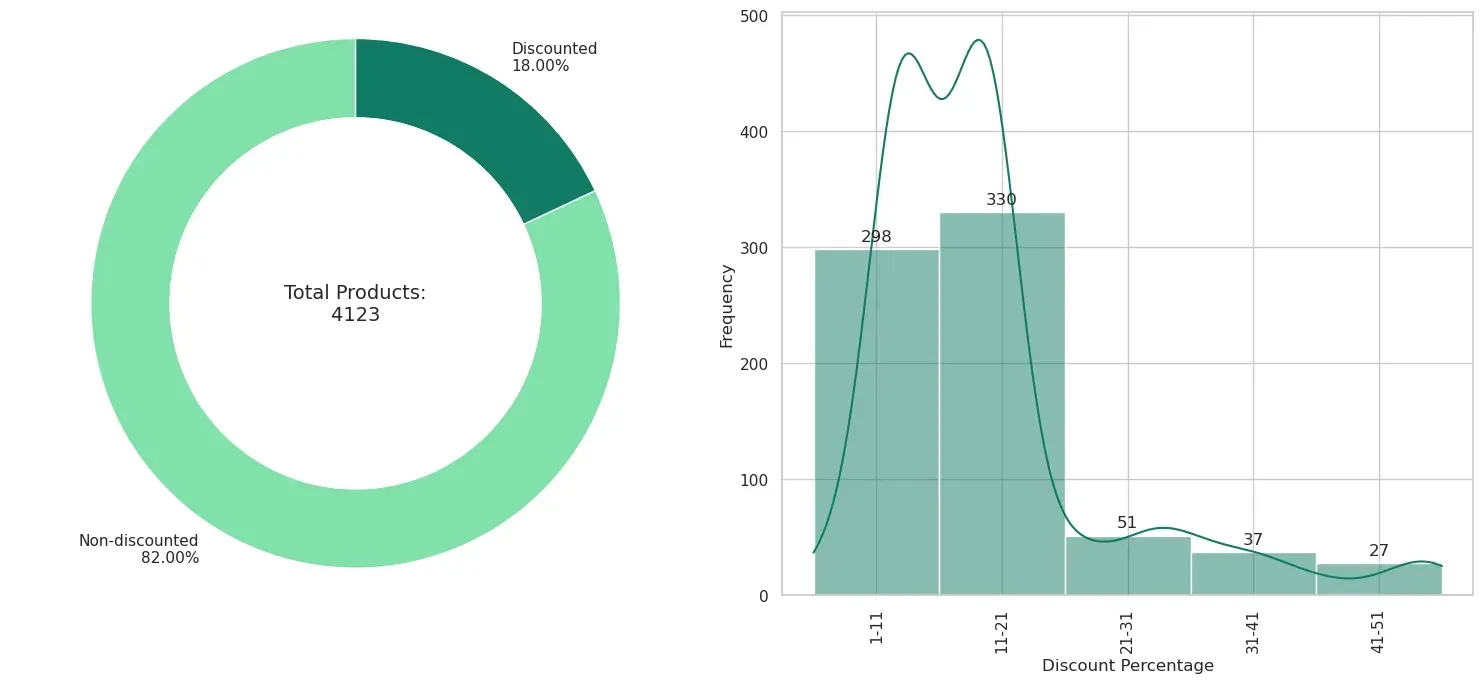
Rare Discounts in a Premium Market:
Nondiscounted Majority: The left side donut chart shows that of all ultra-luxurious products, each of which sells for well over $15,000, 82% will never be discounted. Discounting is indeed rare on an ultra-luxurious product, for which such factors as exclusivity or prestige are better maintained and the perceived value of higher price stability is preserved on a majority of high-end branded products or sold by specific merchants.
The Minority of Discounted Products:
Low Price Segment: 18% of these luxury products have low prices. It means that the discount applies to only this segment, but only for some products or on limited occasions or specifically on some promotions only for attracting the desired segment of buyers without damaging the brand image.
Discounting Trends:
Common Discount Range: The right histogram of the discounted items indicates that the most common discount range is between 11% and 21%. This shows that when luxury brands do discount, they tend to be modest, enough to entice buyers but not so large as to undermine the product's luxury status.
Very few of anything higher than 21% off: Price cut-offs for luxury brands in the order of 30-40% are really exceptional and constitute a rare case. Luxury products have not gone through significant cuts, and the brands maintain the feeling of exclusivity of the brand and cannot be identified with a sharp reduction in price. For items that exceed 40%, one can only think these to be some seriously isolated cases, such as all of these after-season clearances or overhauled product lines.
Strategic discounting :
Targeted Reductions: What the data shows is that it is not a random cut in the ultra-luxury market. It must be calculated, perhaps targeted enough to make the buyer believe there is value created when, in fact, that is not the reality for the seller. A seller does this in hopes of reaching price-sensitive buyers within that high-end bracket without undervaluing brand premium status.
The Luxury Delivery Paradox
Let’s have a Rolex Market Analysis on the Shipping Charges:
Average Freight Price: The average price of freight is $127.97.
Shipping Charges Deviation: Shipping charges tend to be quite wide ranging, meaning that the average differs by $157.24, and in some cases, freight costs are more expensive or lower than the average cost.
Freight Charges of $0.00: There is a minimum recorded freight charge at $0.00. That is to say, cargo shipment in some cases will incur no freight cost.
Middle Range Shipping Charges: This middle range of shipping charges is between $25.00 and $185.30 with an average cost of $99.00.
Highest Shipping Charge: The highest shipping charge is $1,500.00 which shows that some items have very high shipping charges
Most Charges: With a median of $99.00, most shipping charges are less than $100.00.
Outliers: The big gap between the average and the maximum shipping costs means that a few items have very high shipping charges that inflate the average.
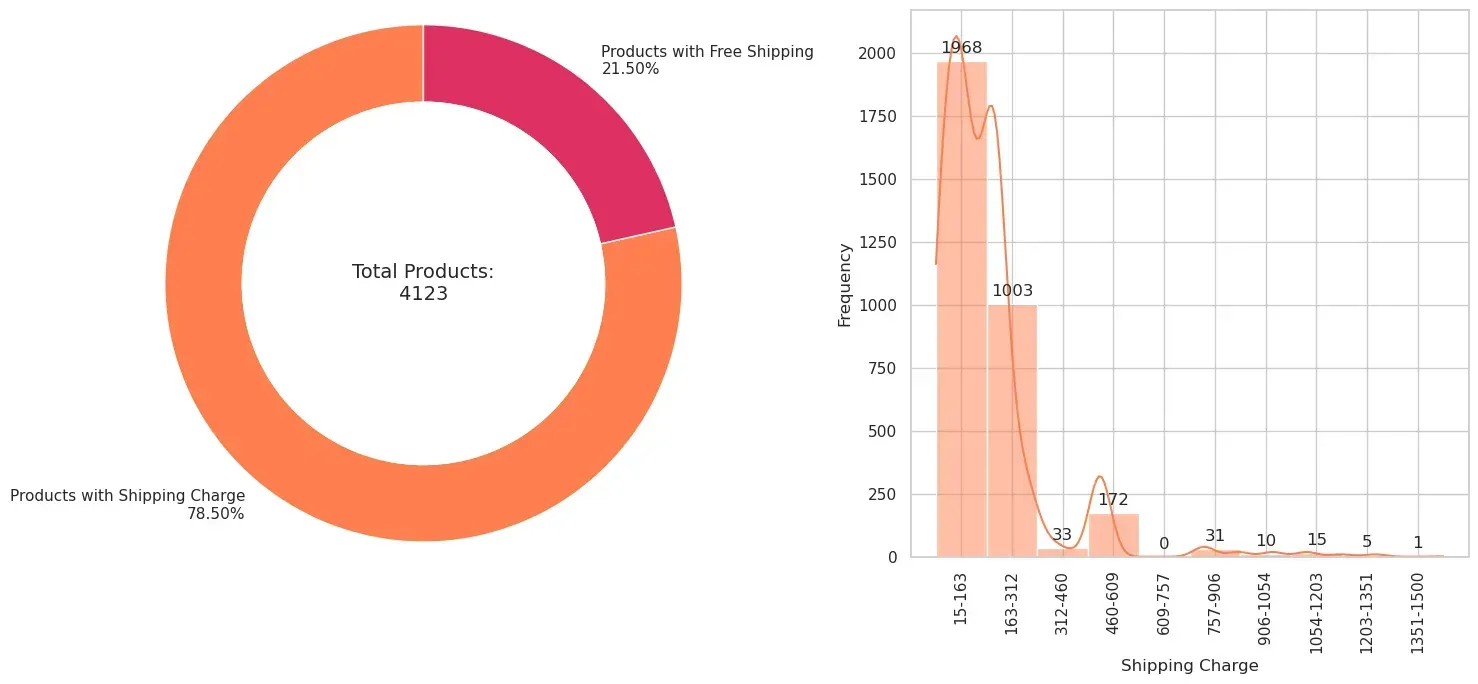
Proportion of Products with Shipping Charges vs. Free Shipping:
The donut chart on the left shows that out of 4,123 ultra-luxury products (each costing more than $15,000), 78.5% of them charge extra shipping, and 21.5% of them provide free shipping. This depicts that most of the sellers of high-value products are passing the shipping cost to the customer, which might be because of the expensive logistics and security measures that need to be undertaken while transporting such valuable goods.
Distribution of Shipping Charges (in US Dollars):
The following histogram displays the shipping charge distribution for those goods that don't offer free shipping. This is what we see there:
$15-$163: This bracket holds the largest numbers of products: 1,968; thus, most expensive luxury goods, though priced high, are shipped moderately compared to the total price.
$163-$312: The smallest but highly significant number was in this middle category range for shipping charges: 1,003 products.
Above $312: The number of products drops sharply as shipping charges increase beyond $312. There are very few products with shipping fees higher than $609, and only a handful reach charges up to $1,500.
Even in the ultra-luxury market, where products are priced over $15,000, most sellers impose shipping fees. However, these fees are relatively modest, especially when compared to the product prices. This implies that though the sellers do not want to consume the shipping cost, they will also try to keep them as low as possible without deterring the potential buyer. That few products carry high shipping fees suggests the sellers may balance between absorbing shipping costs and keeping satisfied customers.
Luxury Condition Spectrum: From Tags to Refurbished
Let’s check out the proportion of product conditions:
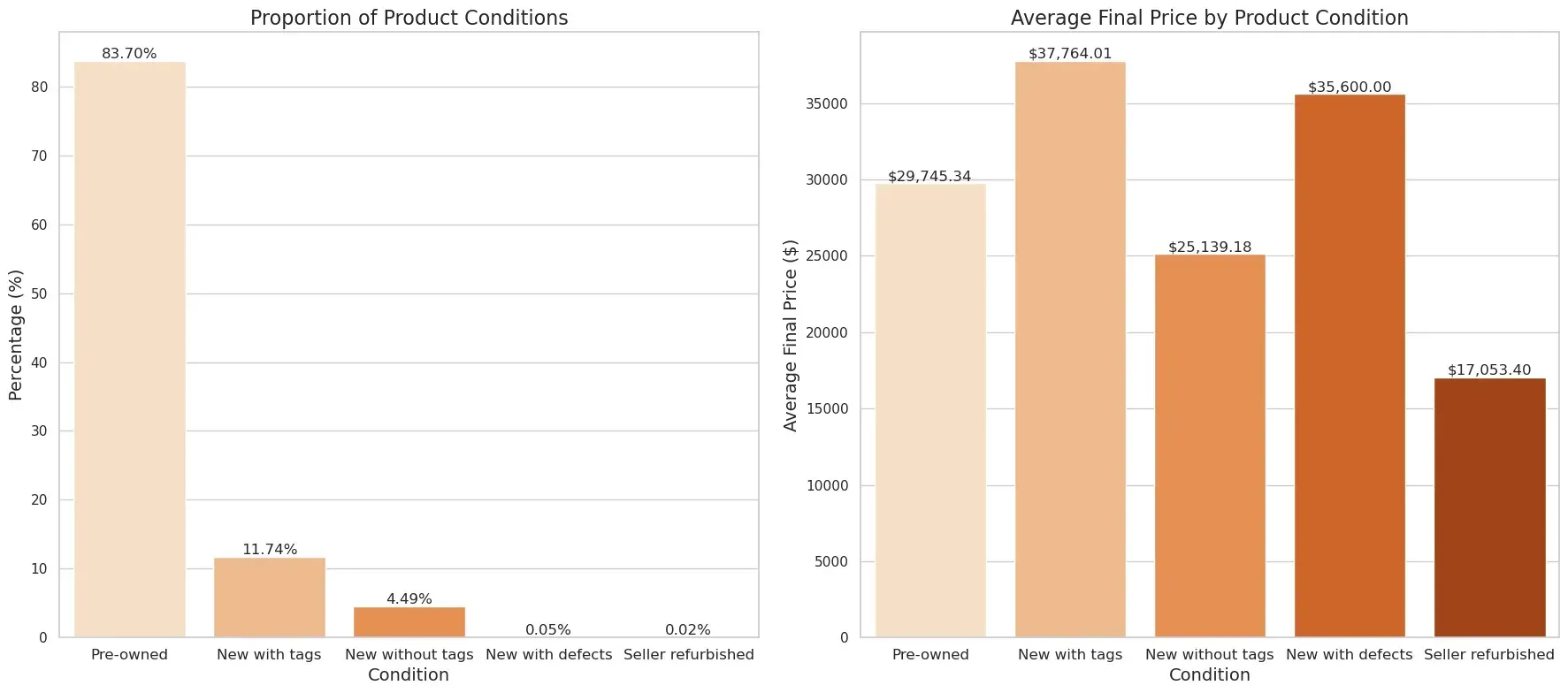
Ratio of Product Avenues:
- The bar chart on the left shows that most of the ultra-high end products at over $15,000 are pre-owned. It is perceived that in the high end range, more people tend to buy the pre-owned because they end up saving much more as compared to purchasing a new one
- Only a minimal number are new:New with tags: 11.74%New without tags: 4.49%New with flaws: 0.05%
- Seller refurbished products are only found in 0.02% of the total.
Average Final Price by Product Condition:
The right chart displays the average final price for these ultra-luxury products, by condition:
- New with tags: This category receives the highest average price of $37,764.01 and indicates that there are more willing buyers of an item new with tags inasmuch as it has money for new items that include original tags; possibly because such items are near to their state untouched from the beginning.
- New with defects: The average price of the product is still $35,600, which represents the inherent value of such luxury items, even though they're defective.
- Used: Although this is the most common category, used items have an average price of $29,745.34, indicating a loss in value following the initial purchase.
- New without tags: These products have an average price of $25,139.18, which is lower than both "new with tags" and "new with defects," likely because the tags are missing and would affect the perceived authenticity or completeness.
- Seller refurbished: The lowest average price is for seller-refurbished items, at $17,053.40, which suggests that even though these items have been restored, buyers still view them as less valuable than other categories.
Ultra-luxury products have a pre-owned market dominance because they are relatively more affordable for buyers than the new products. However, new products, especially tagged and even defective ones, fetch much higher prices than their pre-owned counterparts. The condition, therefore, determines the value of luxury products, with pristine and tagged items fetching the highest price.
The Return Dilemma: Flexibility vs. Finality in Luxury Sales
Let’s look at the products and the return policies:
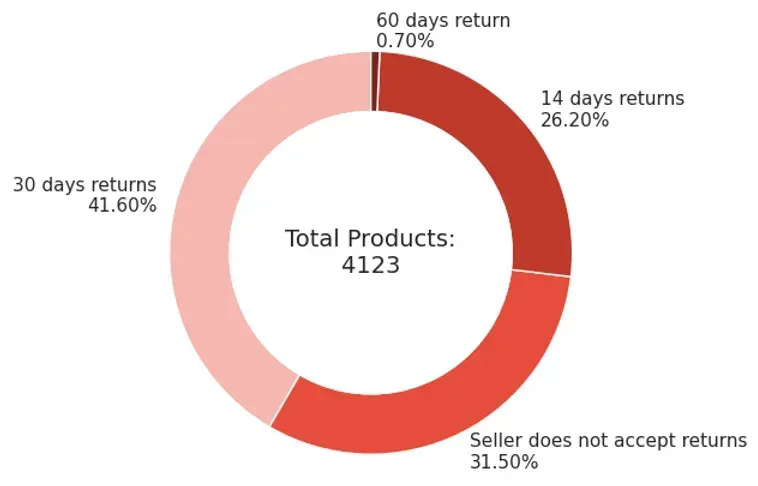
The donut chart illustrates the return policy in relation to ultra-luxury products that cost more than $15,000:
- 30 Days Return: It is the most common return policy offered by 41.6% of the products. From this, it can be deduced that many persons selling high-value items might be offering a relatively broad return window to encourage greater buyer confidence in making that significant purchase.
- Seller Does not Accept Returns: Most sellers (31.5%) do not accept return. It can be attributed to the desire of sellers to reduce risks possibly because the products sold have a high value and could also lead to complexities in selling returns.
- 14 Days Return: 26.2% of the products accept return within 14 days. It is rather shorter but gives the customer an opportunity for changing his or her decision relating to the purchase.
- 60 Days Return: Only 0.7% of the items have a 60 days return policy, indicating very few sellers would allow this extended return period.
Return policies in the ultra-luxury market are considerably different. While there are quite a few sellers who provide for a 30-day return period, a significantly greater number does not accept returns at all, perhaps because of the problems relating to transactions of high-value goods. The 14-day returns and even rarer 60-day return policy reflect the diversity among sellers as they handle buyer satisfaction and risk.
The Luxury Palette: Top 5 Colors & Their Worth
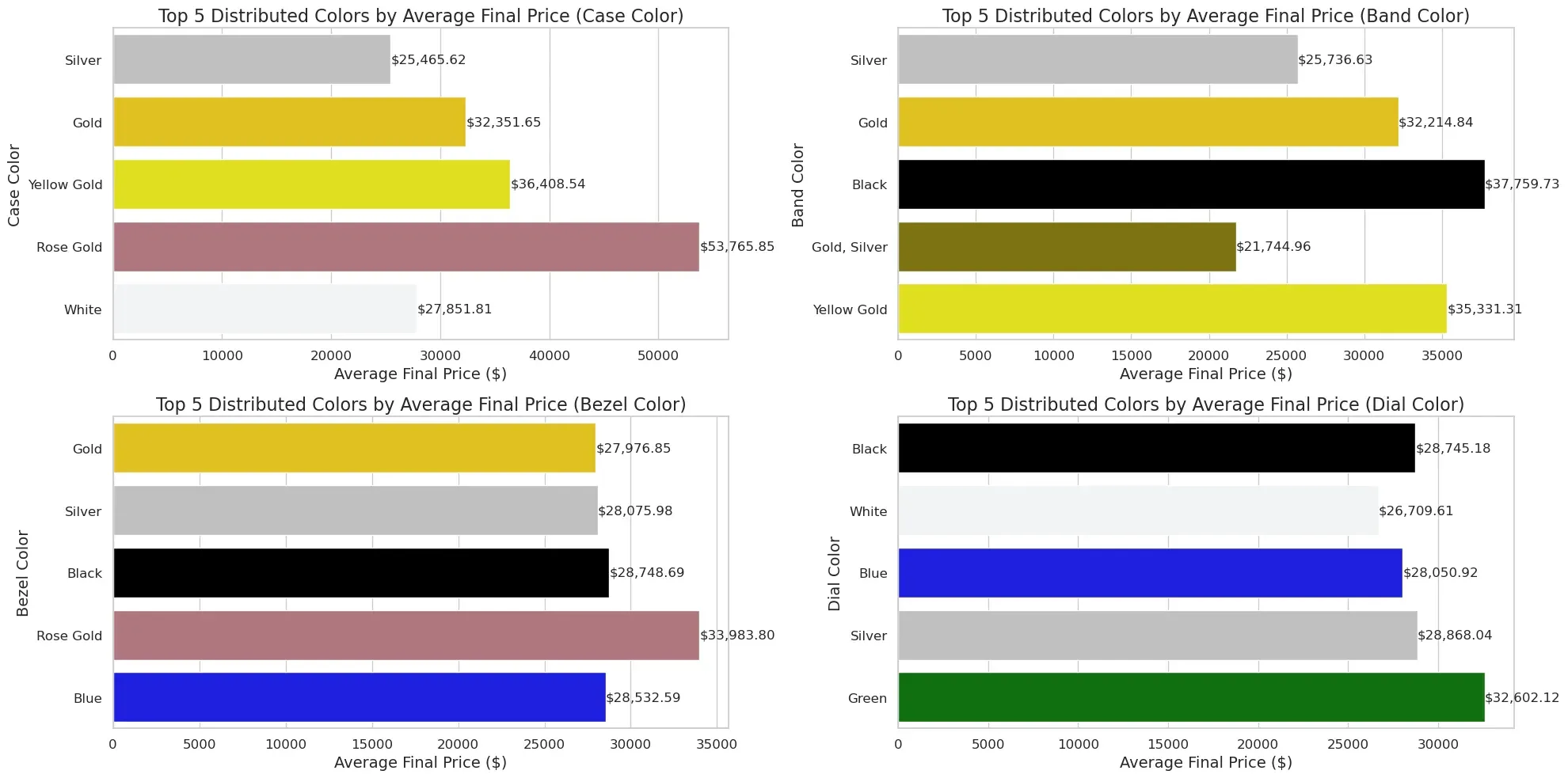
- Case Color:
The highest-priced case color was revealed to be Rose Gold, priced at an average final amount of $53,765.85, representing a color that is richly sought after for its exquisite beauty.
Yellow Gold and Gold feature as follows with average amounts of $36,408.54 and $32,351.65 respectively, that demonstrate ultra-luxury preference for gold-coloured cases.
White and Silver are more mid-range at $27,851.81 and $25,465.62. These colors are perhaps popular but not as expensive as the gold tones are.
- Band Color:
The highest average final price, at $37,759.73, is offered by black bands, pointing to their premium status. And maybe, just maybe, to the versatility and sophistication inherent in black.
Yellow Gold bands follow at $35,331.31 to reinforce the luxurious appeal of gold tones.
Gold bands although not cheap at $32,214.84 but much less of a premium compared with their yellow cousin.
The cheapest is Silver bands costing at $25,736.63. The gold-silver color combination does not average $21,744.96 which may explain mixed metals being less in demand.
- Bezel Color:
Rose Gold still maintains the same expensive tag of the bezel family while averaging at a final sales price of $33,983.80, thereby establishing it as a luxury family for any part.
Black, Blue, Silver, and Gold is approximately the same, where all these colors can retail between $27,976.85 and $28,748.69, whereby none of these colors has equal value to the rose gold, which is never leveled on par with any other one.
- Dial Color:
Green dials are the most costly option, with an average of $32,602.12 as final price for this color, and thereby it can be interpreted that people opt for this color and are ready to pay a high amount simply because it's expensive; it might have an upper hand over exclusivity, or maybe for that distinct style.
Silver dials run in the cost at an amount of $28,868.04, while Black and Blue dials range for the same price.
White faces, while very pricey at $26,709.61, would be the lowest of the five most costly as it could very well suggest they are much more ubiquitous or in low demand.
Among the top five distributed colors by case, band, bezel and face: the Rose Gold is consistently at its highest price position, especially if considered on cases and bezels. Another high-end color that bands love is Black, because that color commands the highest average price; it's just such a versatile color and so time-less. Then comes a premium dial color: Green, perhaps because it is not very commonly found in this highly exclusive market. Gold and Yellow Gold will still be luxurious options for all the parts, while Silver and White, though widely in demand, are a tad less expensive, suggesting a higher affordability but lower positioning within the ultra-luxury segment.
Mechanics of Prestige: Distribution and Pricing of Luxury Movements
Let’s analyze the distribution and pricing of luxury movements:
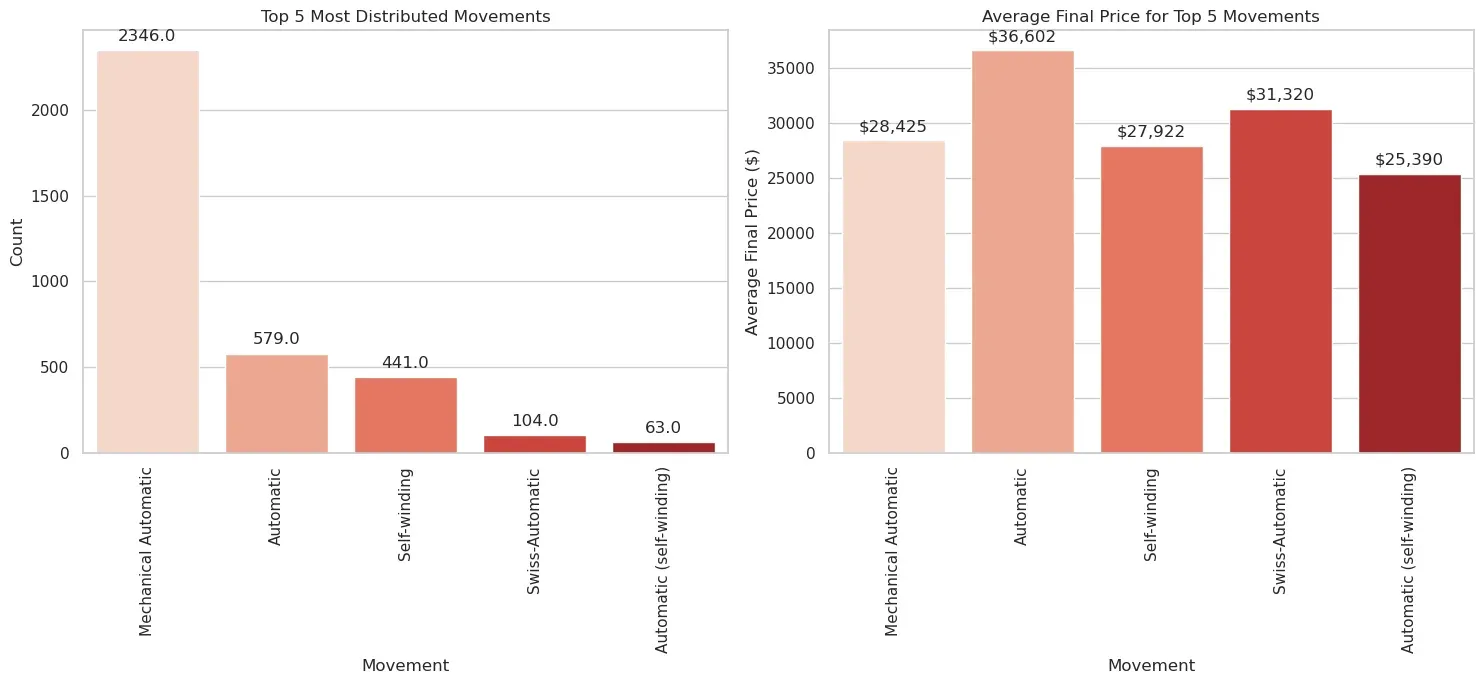
Preeminence of Mechanical Automatic Movements: The left bar chart shows that Mechanical Automatic movements are the most occurring, at 2,346, which is considerably higher than any other form of movement. This signifies that in the ultra-luxury segment, it is Mechanical Automatic watches, possibly because of precision and craftsmanship and status associated with such mechanisms.
High-Value Movements: The bar graph to the right shows that while Mechanical Automatic movements are by far the most common, they also command a relatively high average final price of $28,425. This is to say, their ubiquity does not dilute their value-probably because they are associated with high-end luxury watches.
Premium on Swiss-Automatic Movements: It features only 104 pieces in the Swiss-Automatic movement type, a much more infrequent variation; nevertheless, the final price comes out to $36,602 on an average basis. Here it is really the premium that the market will pay for the craft associated with Switzerland. As well, this is probably a word synonymous with both luxury and quality in watches.
Rarity vs. Value: The Automatic (self-winding) movement is the least rare, with 63 occurrences, but its average final price is $25,390. That means though rarity does indeed drive value, it is far from the only factor that influences the final sale price-the reputation of the brand, craftsmanship, and market demand are significant factors.
Self-Winding and Automatic Movements: The number of occurrences is moderate, (441 and 579 each) with average sales prices standing at about $27,922 and $31,320, respectively. Such types are prized but on a smaller scale than Swiss-Automatic, hence suggesting tiering in the rating of movements in luxury watches.
Market Preferences: Overall, the data reveals a pretty clear preference in the ultra-luxury market for a mechanical movement, particularly if it's Swiss. The automatic types of course hold their own at prices somewhat lower than the former.
Reputation at the Top: Feedback Analysis of Leading Rolex Sellers on eBay
Analysis of Seller Positive Feedback
- Average Feedback: Sellers received an average positive feedback of 95.92%, that is, generally, the buyers are satisfied with the sellers.
- Feedback Consistency: The standard deviation is at 14.38%. This shows that although a majority of the sellers hold a high rating, some variation exists.
- Lowest Feedback: The lowest ever recorded positive feedback is at 33.30%, which shows that some sellers had much lower ratings.
- High Rating for many sellers: the 25th percentile stands at 98.60%, this implies that 75% of sellers were near perfect scores.
- High score: Median, mode, and max scored 100, thus the majority have maximum rated or nearly rated scores.
- Predominance of High Ratings: With a median and mode of 100%, most sellers are viewed very positively by customers.
- Minor Outliers: A handful of really low feedback scores bring the average a small amount below 100%. However, all in all, the seller's ratings are still overwhelmingly positive.
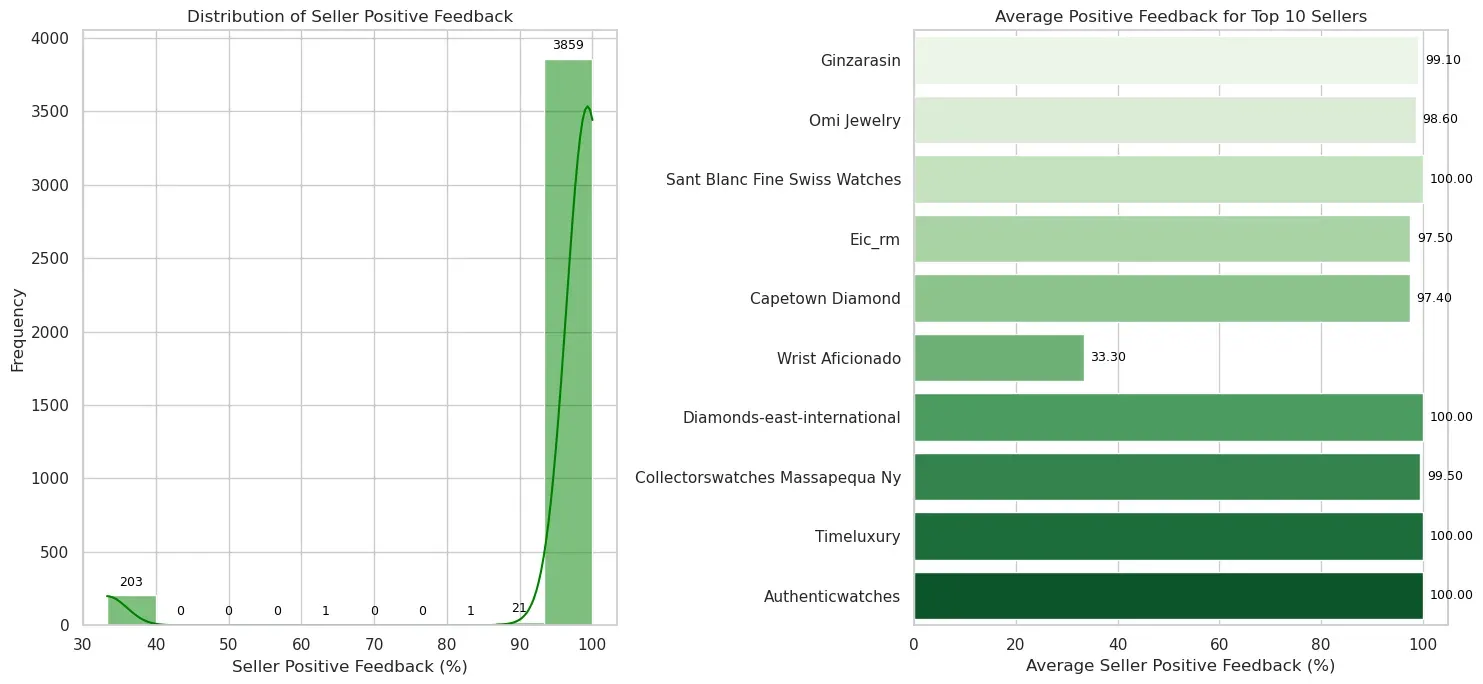
Overview of Distribution of Feedback:
- This first plot indicates that most ultra-luxury Rolex sellers on eBay are extremely positive, with the majority in the 95% to 100% range and a strong focus of 3,859 sellers in this range. This reflects that these sellers focus more on reputation rather than any other aspect.
- There is a deviation in one small set of sellers (203 sellers) whose feedback ratings are drastically lower around 33%. Sellers might have faced trouble in fulfilling the requirements of their customers, or certain isolated incidents would have hugely impacted their rating.
Top Seller Feedback:
- The second plot focuses on the top 10 sellers based on product distribution and their average positive feedback scores. In most of these top-selling items, such as Sant Blanc Fine Swiss Watches, Diamonds-east-international, Time luxury, and Authentic watches, the perfect feedback scores reach 100%, which shows excellent reputation and reliability.
- The best seller that can be highlighted as an exception is Wrist Aficionado. This seller received the lowest average positive feedback score, which is about 33.30%. It clearly indicates that either customer satisfaction or product quality issues might be there for the time being, especially at this stage when they sell such highly-priced Rolex watches.
Reputation and Market Success:
- The data shows that top sellers of ultra-luxury Rolex watches on eBay have near-perfect feedback scores, and maintaining a good reputation is important in this market. A high feedback score probably contributes to higher sales volumes and customer trust, which are important for the luxury segment.
- Specifically, the low feedback score of Wrist Aficionado may be of particular concern as it might discourage buyers who are keen on high-end products. This would then show that even in the luxury market, reputation matters a lot, and bad feedback can greatly affect business.
Strategic Considerations:
- Sellers with a very high feedback score must then continue to serve customers flawlessly and their offerings high in quality so that a good reputation can be long sustained and maintained.
- It can require going back and ascertaining the reasons that lead to a low score through feedback to avoid permanent damage on their brand and sales in such a competitive market characterized by mistrust.
A Historical View of Sellers Joining eBay's High-End Rolex Market
Let’s have a look at the historical view of sellers:
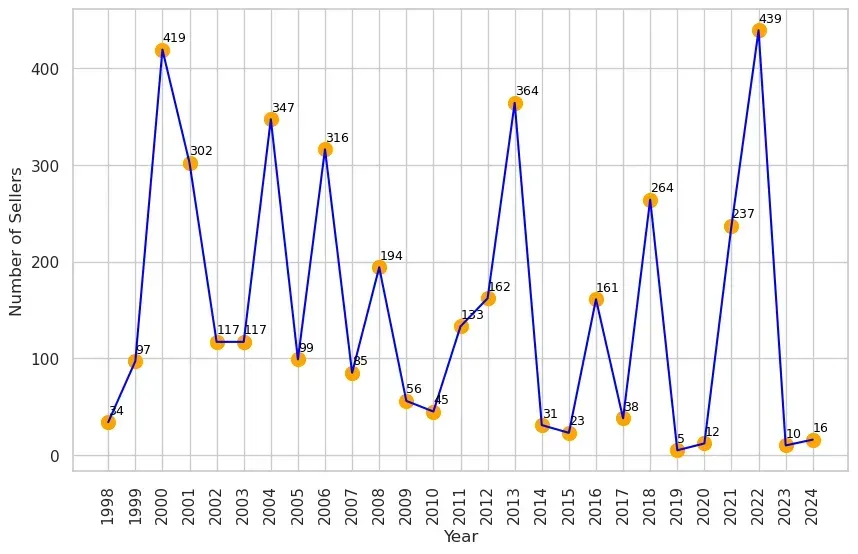
Seller Activity Trends:
- The graph below depicts the fluctuation trend in the number of sellers joining the platform to sell ultra-luxury Rolex watches. The number of sellers who joined the site had high fluctuations over the years. The peaks that are depicted include the years 1999, 2004, 2007, 2013, and 2021.
- There was a tremendous rise in the year 1999 when 419 sellers joined, possibly because of the interest gained in online marketplaces during the time when the internet became mainstream.
- Another peak was recorded in 2021 when 439 sellers joined, probably because of the general surge in online commerce during the COVID-19 pandemic that pushed more sellers on online marketplaces like eBay.
Declining Periods:
- Clearly visible are the periods of significant decline as the number of new sellers fell sharply during those times. For example, the number decreased as low as 56 in 2009, during which period the global financial crisis must have reduced spending by consumers and thus caused fewer numbers of sellers.
- Declines in 2010 (45 vendors), 2015 (23 vendors), and 2020 (12 vendors), which might be due to economic slump or changes in market forces, are presented.
Recovery After the COVID-19 Pandemic:
After having dropped sharply in 2020, probably due to uncertainty regarding the pandemic, it bounced back in 2021 to the highest new seller count ever recorded: 439. This infers that sellers found the opportunity to sell luxury watches online again during the phase of recovery from the pandemic.
Recent Trends:
There was a decline again in recent years in new sellers as only 16 joined the fray in 2024. This might be considered as market saturation or increasing competition where the ultra-luxury Rolex segment remains open to just a handful of new sellers.
Trend over a Long Term:
Thus, overall, the pattern, through the period, shows peaking and sharp declines after the peaking, reflecting the volatile nature of this market in selling ultra-luxury Rolex watches on eBay.
Five-Star Excellence: Leading eBay Sellers in the Luxury Rolex Segment
Curious to know the leading ebay sellers? Let’s see!
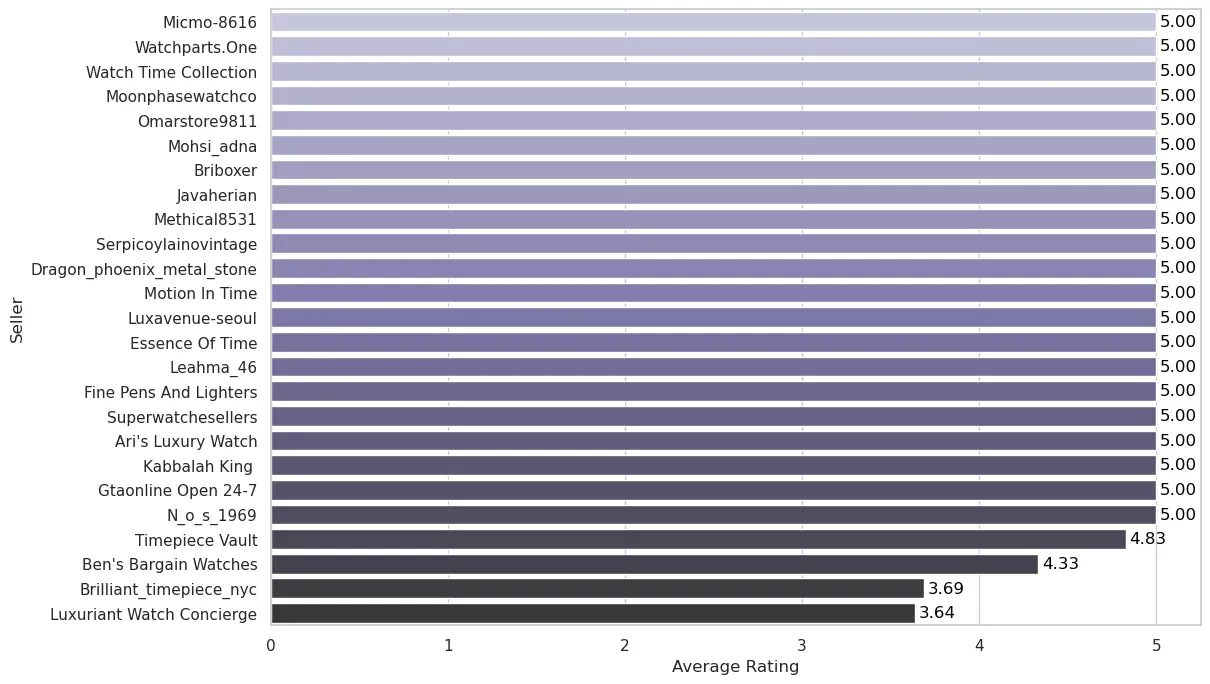
Top-Selling Ultra-Luxury Rolex Sellers:
The plot is based on the top 25 eBay sellers according to their average product ratings for Rolex watches sold at more than $15,000. The characteristics of the sellers are represented by the very high level of customer satisfaction indicated by the average ratings.
Perfect Ratings: Most of these sellers have managed to achieve a perfect 5.00 average rating. This means that these sellers deliver high-quality goods and provide excellent customer service, which is a big requirement in the ultra-luxury segment.
Near-Perfect Ratings: Some of the sellers have ratings a little lower than 5.00. These are Timepiece Vault with 4.83, Ben's Bargain Watches with 4.33, Brilliant_timepiece_nyc with 3.69, and Luxuriant Watch Concierge with 3.64. Although these ratings are excellent, they may mean that these sellers sometimes had minor problems or a bit of lower customer satisfaction than the sellers with a rating of 5.00.
Implications for Buyers
For ultra-luxury Rolex watch buyers, ratings of the sellers are critical in deciding who to do business with. Near-universal high ratings of the top 25 sellers will assure these buyers that such sellers are reliable and previous buyers have been very satisfied with their purchases.
To the wise customer, the slight fluctuations in ratings among the most best-selling items can become pretty important when making the ultimate decision, especially when considering it has the absolute best in quality product and service.
Relevance of Customer Trust
Trust in the customer is paramount in the high-stakes luxury goods world, especially in Rolex watches worth over $15,000. The top-rated sellers have established that they can be trusted to deliver not only a product but also an experience that meets the expectations of luxury watch buyers at the highest level.
Rolex Data Analytics Strategy: What the Numbers Tell Us
This deep dive into the Rolex resale market on eBay goes beyond surface-level observations — it forms the foundation of a practical data analytics strategy for anyone operating in the luxury watch space, whether as a buyer, seller, or market researcher.
A data analytics strategy for navigating the Rolex resale market should prioritize three signals above all else: movement type, seller feedback score, and case color. Swiss-Automatic movements command an average final price of $36,602 — a 28% premium over standard Mechanical Automatic listings — making movement type one of the strongest value predictors in the dataset. Seller feedback score is equally decisive: 75% of top sellers maintain ratings above 98.6%, and those with near-perfect scores consistently drive higher buyer trust and transaction volume. On color, Rose Gold cases average $53,765 — the highest of any case color analyzed — while Green dials lead the dial category at $32,602, signaling that rarity and aesthetic exclusivity carry measurable price weight.
Beyond these three core signals, the data reveals several strategic layers. Discounting is rare and deliberate - 82% of ultra-luxury listings carry no discount at all, and when discounts do appear, they cluster in the 11–21% range, designed to attract price-sensitive buyers without eroding brand prestige. Product condition creates a clear value ladder: new-with-tags items average $37,764, while seller-refurbished listings drop to $17,053 — a spread that smart buyers can leverage and sellers should price around carefully. Return policy flexibility also matters more than sellers may assume, with 41.6% of listings offering 30-day returns to compensate for the high-stakes nature of a five-figure purchase.
For sellers, this data analytics strategy points to a clear playbook: lead with Swiss-Automatic or Mechanical Automatic movements, maintain impeccable feedback scores, price condition tiers deliberately, and use modest discounts sparingly to protect perceived value. For buyers, the strategy is equally clear — prioritize verified sellers with near-perfect feedback, target pre-owned listings in the $22,000–$35,000 range for the best value concentration, and treat Rose Gold and Green dial configurations as strong long-term holds given their consistent price premium.
As Rolex continues to define the upper tier of the luxury watch market, data-driven decision-making is no longer optional for those who want to buy wisely or sell competitively. Every detail — from movement to color to seller history — is a signal. This analysis shows how to read them.
Connect with Datahut for top-notch web scraping services that bring you the information you need, hassle-free.
FAQ SECTION
Q1. What is the average Rolex resale price on eBay?
The average resale price of a Rolex on eBay varies significantly depending on the model, condition, age, and seller reputation. Data analysis of Rolex listings shows that prices can range from a few thousand dollars for entry-level models to tens of thousands of dollars for highly sought-after collections. Premium models such as the Daytona, Submariner, and GMT-Master II often command higher resale values due to strong market demand.
Q2. Which Rolex holds its value best?
Certain Rolex models are known for retaining their value exceptionally well over time. The Rolex Daytona is often considered one of the strongest performers in the secondary market, followed by popular sports models such as the Submariner, GMT-Master II, and Explorer. Limited availability, strong brand recognition, and collector demand contribute to their long-term value retention.
Q3. Is it worth buying a pre-owned Rolex?
Yes, buying a pre-owned Rolex can be a smart investment for many watch enthusiasts. Pre-owned watches often provide access to discontinued or hard-to-find models and may offer better value compared to purchasing new. Buyers should carefully review the watch's authenticity, condition, service history, and seller reputation before making a purchase.
Q4. How do I spot a trustworthy Rolex seller on eBay?
A trustworthy Rolex seller typically has a strong feedback history, detailed product descriptions, clear photographs, and transparent return policies. Buyers should look for sellers with high ratings, a substantial number of completed transactions, and evidence of authenticity, such as original documentation, certificates, or professional authentication services.
Q5. Do Rolex watches get discounted on the resale market?
While Rolex watches can sometimes be listed below retail prices, discounts depend on the specific model and market demand. Highly sought-after models often sell at a premium, whereas older, less popular, or heavily worn watches may be available at lower prices. Monitoring resale trends can help buyers identify favorable purchasing opportunities.
Q6. How much does Rolex shipping cost on eBay?
Shipping costs for Rolex watches on eBay vary based on factors such as seller location, shipping method, insurance coverage, and destination country. Luxury watches are commonly shipped with insurance and signature confirmation, which can increase shipping fees. International shipments may also involve customs duties and additional handling charges.
Q7. What condition Rolex should I buy?
The ideal Rolex condition depends on your goals and budget. Watches in excellent or like-new condition generally command higher prices but offer better aesthetics and potentially stronger resale value. Buyers focused on affordability may find good opportunities among watches with moderate wear, provided the watch is authentic, functional, and well-maintained.
Q8. How is web scraping used to analyse the Rolex market?
Web scraping helps researchers collect large volumes of Rolex listing data from online marketplaces such as eBay. This data can include prices, model names, seller information, watch conditions, shipping costs, and listing locations. By analyzing the collected information, businesses and market analysts can identify pricing trends, demand patterns, seller behavior, and opportunities within the luxury watch resale market.


