

In the data-driven landscape of 2026, access to external web data isn't just an advantage, it's a baseline requirement. However, acquiring this data efficiently remains a major hurdle. Many businesses find themselves navigating high operational costs and complex technical barriers just to keep their data pipelines flowing.
And that’s exactly why web crawling has become one of the most valuable capabilities for businesses in 2026. Nearly every company today relies on external data competitor prices, market trends, customer reviews, job postings, product catalogs, regulatory updates, and more.
The surprising truth? Most of this data is already public. The challenge isn’t access, it’s scale, accuracy, compliance, and freshness. Web crawling solves all of that.
In this blog, we break down:
- What web crawling actually is (2026 version)
- Why it’s more important now than ever
- Real-world, high-impact use cases across industries
- How businesses save time, money, and engineering effort
- Why companies are shifting from buying third-party data to owning their crawling pipelines
What Is Web Crawling?
Web crawling (often referred to as a web spider or bot) is the automated process of discovering and visiting web pages by following links and sitemaps, usually to build a collection of URLs that can then be scraped or indexed like a search engine.
In simple terms: A crawler is a smart bot that moves through the World Wide Web on its own discovering pages, following links, obeying site rules, and tracking what’s new or updated.
It’s closely related to web scraping, though they serve different functions. For a deeper technical comparison, you can explore the nuances of web scraping vs APIs and crawling.
- Web crawling → discovers and organizes URLs using an XML sitemap or link following.
- Web scraping → extracts specific data (e.g., price, title, rating) from those URLs, converting raw HTML content into structured data.
In real systems, they work together: Crawler: “Find me all product pages in this category across these sites.” Scraper: “From each page, extract the product name, price, stock, rating, image, etc.”
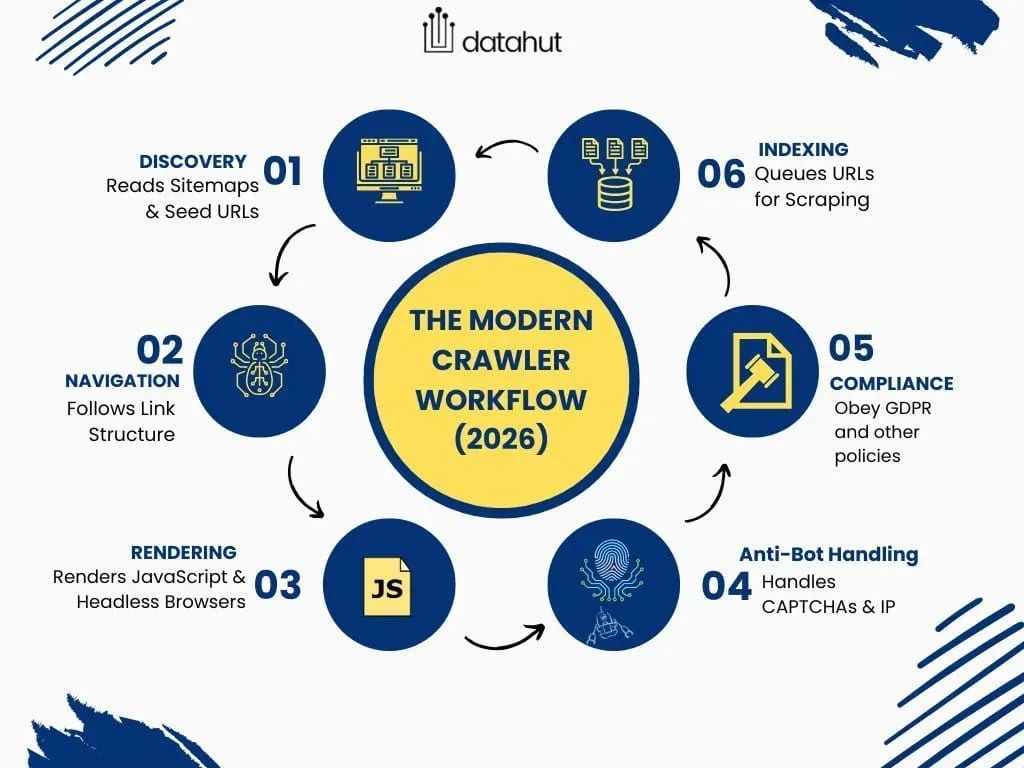
Modern crawlers are far from the simple bots of 2010. At scale they need to handle:
- JavaScript-heavy frontends and headless browser rendering.
- Geo-targeted content and distributed crawling.
- Managing user agents to appear as legitimate traffic.
- Rate limits and CAPTCHAs.
- Bot protection systems like Cloudflare Bot Management and similar tools.
Why Web Crawling Is a Bigger Deal in 2026?
Two big shifts changed the game:
1. Anti-bot & AI controls got serious
Cloudflare and similar providers protect millions of active websites and now offer one-click blocks for AI scrapers and crawlers, with default blocking for many new domains. On top of that, recent disputes made ethical, compliant crawling a board-level topic. To navigate these barriers effectively, businesses must understand how to maintain anonymity when web scraping at scale.
2. Bot traffic exploded
Reports suggest that over half of internet traffic is now bots, and a big portion of that is malicious or non-compliant. Organizations are struggling to distinguish “good” bots (like search engines or compliant crawlers) from abusive ones.
Result: Businesses that want to use web data now need serious, compliant crawling infrastructure, not hobby Python libraries or scripts. That’s exactly where a well-designed crawling strategy or a managed vendor starts saving huge money.
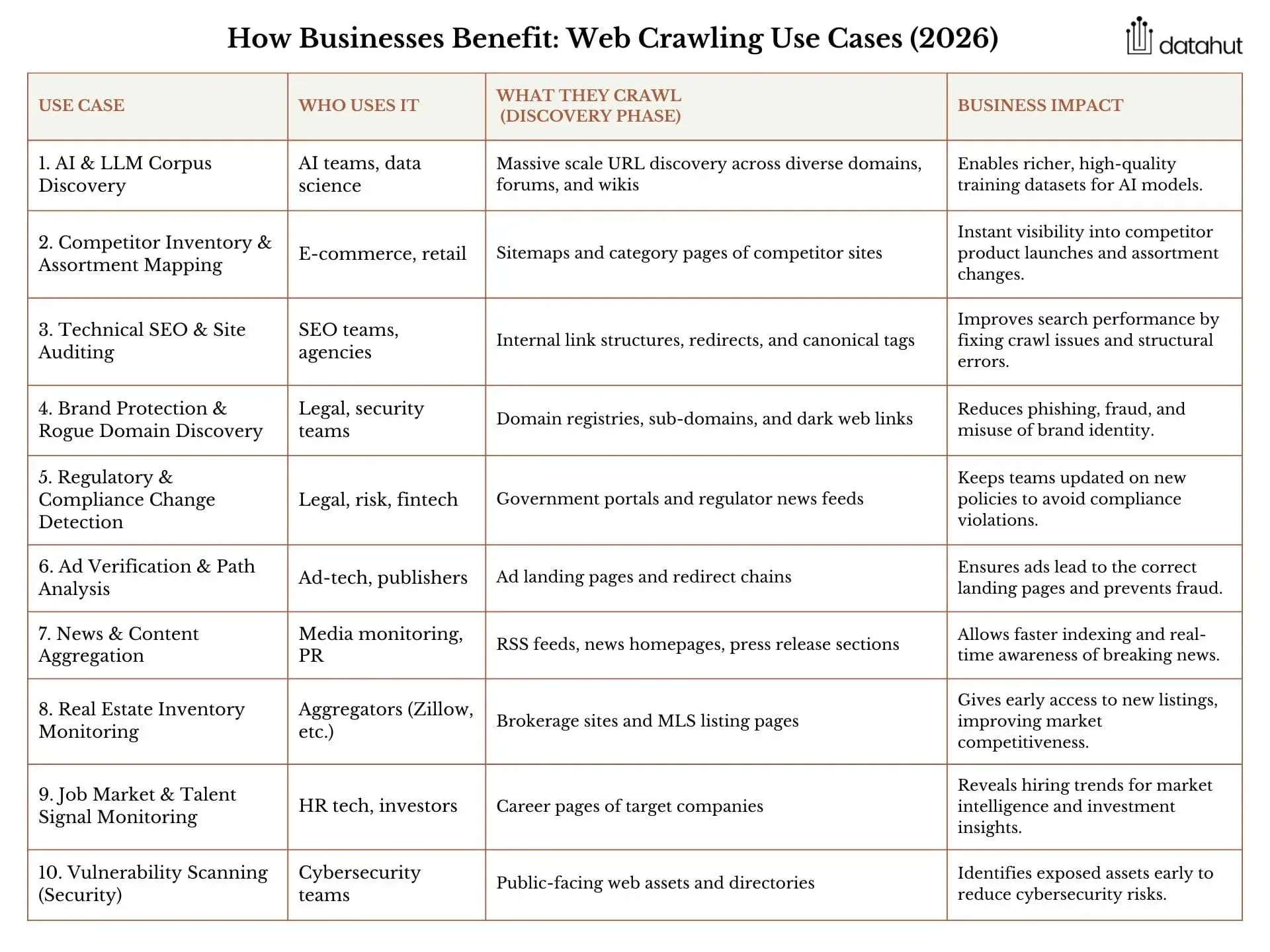
How Businesses Benefit: Web Crawling Use Cases (2026)
Web Crawling Use Cases Table
Deep Dive into Key Use Cases
1. Price Intelligence & Dynamic Pricing
Price is still one of the most powerful growth levers. Competitive price intelligence can determine profitability by allowing you to see exactly where you stand in the market.
Crawlers constantly visit competitor sites, marketplaces, and even regional country sites for price monitoring to collect:
- Current product prices
- Discounts & promotions
- Stock / availability
- Shipping fees
- Bundle offers
This feeds:
- Dynamic pricing systems that update prices in near real time. In fact, effective dynamic pricing can boost online retail profits significantly when backed by accurate real-time data.
- MAP monitoring to ensure resellers don’t undercut agreed minima.
- Margin optimization based on competitors’ moves and demand.
Multiple providers highlight price intelligence as one of the dominant web data use cases in 2026.
2. Product Data & Catalog Enrichment
If you run a marketplace, comparison site, or aggregator, you can’t manually copy product details from thousands of suppliers. Web crawling + scraping help you:
- Discover all product URLs in a category
- Extract specs, features, images, and descriptions
- Normalize attributes (size, color, material, etc.)
- Keep data fresh when suppliers change content
Analyses of data extraction applications show that product data extraction and catalog building remain core use cases across industries.
Impact:
- Faster time-to-market for new products
- Consistent, rich catalog without manual data entry
- Better search, filters, and SEO performance
3. SEO, SERP & Content Intelligence
Search teams crawl:
- Google/Bing SERPs for target keywords
- Their own sites for broken links, redirects, and metadata
- Competitor blogs / docs / landing pages
This helps them detect ranking losses early, identify content gaps, and fix technical SEO issues at scale. Instead of paying agencies for static “SEO audits” every quarter, teams run continuous crawling to keep a live picture of their search visibility.
4. Lead Generation & B2B Intelligence
For B2B companies, crawling can turn the open web into a structured lead engine. Leveraging web scraping for lead generation transforms static directories into live intent data:
- Job boards → hiring patterns (e.g., “Hiring 5 data engineers” = strong growth signal)
- Startup & company directories → basic firmographic data
- Public company websites → product lines, locations, tech stack hints
The difference in 2026 is quality and context: instead of just collecting emails, teams look at signals like rapid headcount growth, opening new locations, or heavier hiring in artificial intelligence. Those signals can feed scoring models and outbound sequences.
5. Brand Protection & Fraud Monitoring
If your brand has value, someone will try to abuse it. Crawlers patrol:
- Marketplaces for counterfeit products
- Gray/black-market sites for stolen or discounted items
- Unofficial “support” sites using your logo
- Social or classifieds listings using your brand assets
Research on web scraping use cases highlights brand protection and compliance monitoring as growing applications, especially as fraud moves online.
Benefits:
- Faster takedowns
- Reduced IP leakage and counterfeit impact
- Stronger control over channel pricing and representation
6. Real Estate & Travel Aggregation
Travel and property platforms rely heavily on crawling to stay competitive:
- Hotels, vacation rentals, and airlines → prices, availability, policies
- Real-estate portals → listings, photos, amenities, neighborhood information
This enables Metasearch engines, price-comparison widgets, and market trend dashboards. The value here is consistency and freshness—if your pricing or inventory is outdated, users bounce.
7. Financial & Alternative Data
Investors and analysts are hungry for “alternative datasets” that give an edge before official earnings. Crawling gives them a structured, time-series view of signals like job postings, product reviews, pricing changes, and public announcements. Web data is now a core part of market research, revenue forecasting, competitive intelligence, and risk analysis.
8. AI & LLM Training Data
Large language models and AI agents need clean, domain-specific training data:
- Documentation & API references
- Knowledge bases and FAQs
- Public blogs and help centers
- Regulatory and standards documents
Many platforms now position themselves as web data providers for AI, emphasizing ethical, public data collection and robust compliance. Web crawling is the discovery backbone of those AI training pipelines.
Build vs Buy: Why Many Teams Choose Managed Crawling in 2026
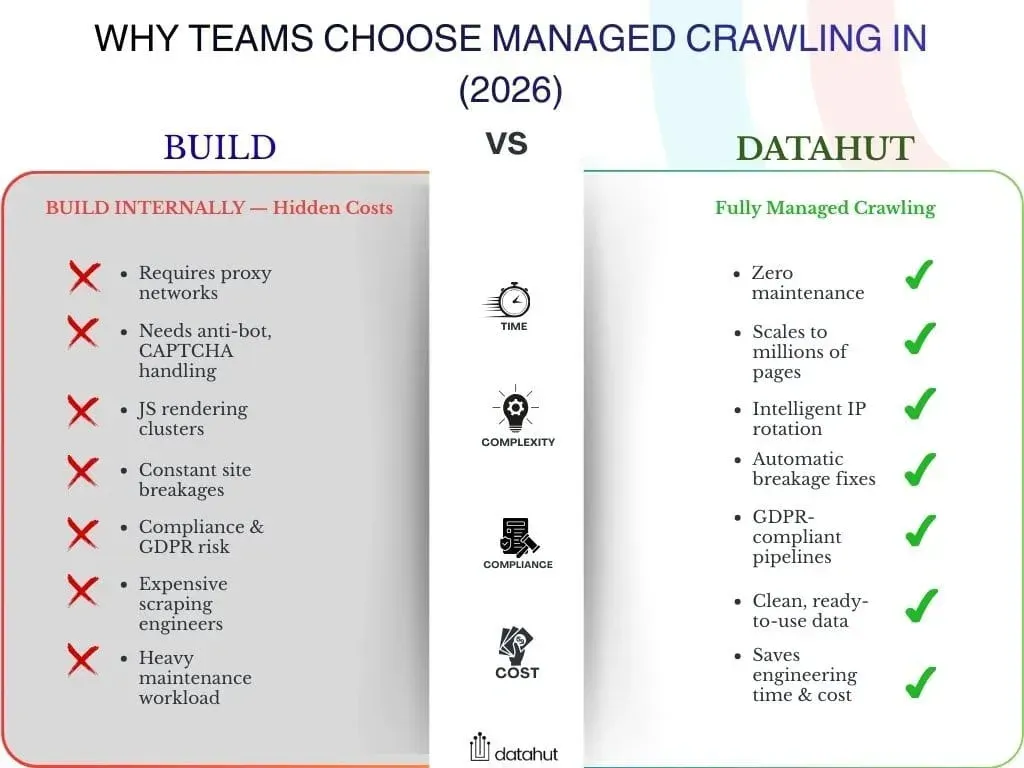
On paper, building your own crawler looks simple. In reality, the moment you operate at scale, you face a long list of moving parts. Businesses often underestimate the difficulties involved in scaling web scraping from prototype to production:
- IP rotation & global proxy networks
- JavaScript rendering using headless browsers
- CAPTCHAs and enterprise-grade anti-bot systems
- Continuous HTML and DOM structure changes
- Monitoring, retries, logging, and crawl budgets
- Data quality validation and schema enforcement
Most engineering teams don’t struggle with the first version of a crawler — they struggle with keeping it alive. That’s why leading data vendors highlight “zero-maintenance, fully managed crawling” as the primary reason enterprises outsource. Internal teams are often crushed not by building the crawler, but by the ongoing maintenance and compliance burden.
This is exactly where Datahut comes in.
Datahut provides a fully managed, compliance-first web crawling and data delivery service designed for modern, JS-heavy, anti-bot-protected websites.
Instead of maintaining fragile scripts, teams use Datahut to:
- Scale effortlessly across millions of pages without touching infrastructure
- Avoid IP blocks with intelligent rotation, fingerprinting, and region-specific access
- Handle complex rendering with production-grade headless browser pipelines
- Stay compliant with regional regulations, and ethical crawling rules
- Receive clean, analysis-ready data instead of raw HTML
- Eliminate maintenance issues ,Datahut handles breakages, retries, and updates
In short: You focus on insights. Datahut handles the crawling, compliance, and engineering complexity.
If your teams need accurate, fresh, and scalable web data without the engineering complexity, Datahut can help. Our fully managed crawling infrastructure delivers clean, analysis-ready datasets tailored to your business needs — with zero maintenance, zero downtime, and complete compliance.
Talk to us today: https://www.datahut.co/solutions
Compliance, Ethics & 2026 Reality Check
With all the hype around AI and data, it’s easy to forget the basics. To operate safely, you need a clear guide to legal and transparent data practices in web scraping:
Ensure GDPR compliance at every stage: Data Privacy Laws like GDPR require organizations to follow principles like data minimization, purpose limitation, lawful basis, and transparency. Even public-facing data can be subject to privacy rules if it contains personal identifiers.
A responsible crawling pipeline must include governance controls, validation mechanisms, and audit trails to prevent accidental collection or misuse of personal data.
Any serious web crawling strategy in 2026 must integrate this into the design from day one.
The Hidden Costs of Web Scraping
When evaluating web crawling strategies, the "free" option of building internally often carries the highest long-term price tag.
- Building Internally Diverting engineering resources to build crawlers pulls them away from your core product. Your team ends up managing a scraping infrastructure company inside your actual company, reducing focus on your primary business goals.
- Investing in Building Own Infra The cost of maintaining a robust crawling infrastructure is deceptive. Beyond server costs, you face escalating expenses for residential proxies, CAPTCHA solving services, and headless browser clusters required to bypass modern anti-bot systems.
- Talent Shortage Specialized web scraping engineers are difficult to find and expensive to hire. This is a niche skill set involving deep knowledge of reverse engineering, network protocols, and browser fingerprinting—skills that generalist full-stack developers often lack.
- Complexities at Scale A crawler that works for 1,000 pages often fails at 10 million. Handling scale requires sophisticated logic for concurrency, error handling, and data validation. As websites update their layouts and security measures, internal teams are trapped in a constant cycle of "fix and patch" maintenance.
- Legal & Compliance Liability: Navigating the minefield of global data privacy laws (GDPR, CCPA) and emerging AI regulations is a full-time job. Internal teams often lack the specialized governance frameworks to handle IP rights, cross-border data transfers, and PII protection, exposing the organization to significant regulatory risk and potential lawsuits.
- The Data Quality Trap: Scraping the web is only half the battle; making the data usable is the other. Raw web data is notoriously messy, full of duplicates, broken HTML, and inconsistent formatting. You will likely spend as much time building and maintaining normalization, deduplication, and QA pipelines as you do on the crawler itself.
Final thought
Web crawling in 2026 has become a critical capability for any organization that relies on external data to stay competitive. As industries shift toward real-time decision-making, companies increasingly recognize that depending on third-party data providers creates limitations in cost, accuracy, and flexibility. Public web data is abundant, but accessing it consistently and responsibly requires the right infrastructure.
A modern crawling strategy offers several advantages:
- Greater control over data sources and update frequency
- Improved accuracy and freshness for operational decisions
- Reduced long-term cost compared to high-priced external datasets
- Stronger visibility into markets, competitors, and customer behavior
- A scalable foundation for analytics, automation, and machine learning initiatives
- Better compliance and governance through transparent data lineage
However, building this capability internally is challenging. Teams must manage rendering, proxies, anti-bot systems, schema changes, monitoring, retries, and legal considerations. The complexity grows every month as websites evolve.
Frequently Asked Questions (FAQ)
1.What is web crawling?
Web crawling is the automated process of discovering and navigating web pages through links and sitemaps. It helps map a website so data can be collected efficiently.
2. How is web crawling different from web scraping?
Crawling finds and organizes URLs, while scraping extracts specific information such as product prices, reviews (for sentiment analysis), or product details. They usually work together in real-world data pipelines.
3. Is web crawling legal in 2026?
Yes, crawling public pages is legal when you follow site terms and Data Privacy Laws like GDPR and CCPA. The legality depends on responsible behavior and avoiding personal data collection without a lawful basis.
4. Why do companies need web crawling in 2026?
Businesses rely on crawling for competitive pricing, product intelligence, market research, and AI training data. It gives them fresher, more accurate datasets than buying static third-party reports.
5. Why do businesses outsource web crawling instead of building it?
Maintaining crawlers at scale requires handling proxies, anti-bot systems, user agents, JavaScript rendering, and constant site changes. Outsourcing removes this burden so teams can focus on using reliable data insights instead of fixing broken crawlers.


