Data Readiness: Fix Your Data Before You Invest In AI
- Tony Paul

- Feb 23
- 6 min read

Retailers are investing heavily in AI initiatives; some are hiring dedicated Chief AI officers or VP AI roles to lead them. Some are bringing in external consultants to help with it, but most of those initiatives won’t hit their original goal because they are having a data maturity problem.
What we’re seeing now is that Pilots perform well, but in production, it goes haywire. Models perform well in pilot but fail at scale. Executives who were once cheerleaders of AI are now turning into skeptics.
The main issue is not budget or talent. Most often, it is a lack of data readiness.
What data Immaturity looks like in practice
When AI programs or data initiatives underperform within a company, the postmortems often suggest model limitations or friction from the team members to adopt the solution. However, the deeper issue is the misalignment between ambition and infrastructure.
Common signs of immaturity.
Inaccurate data costs organizations an average of $12.9 million per year, according to Gartner.
Your AI models are fed obsolete data . In high-velocity retail, a price recommendation based on 24-hour-old data is often obsolete, and by the time a decision is made, the opportunity is long gone.
Pricing engines are trained on inconsistent data.
Automation initiatives are deployed without clear domain ownership.
People talk to each other across departments, but systems and data do not.
Teams does not have access to data from other departments that you’re dependent on for making decisions.
In such environments, AI initiatives will fail no matter how much investment you make. The only exception is for totally isolated deployments of a single function that doesn't have any internal data dependencies.
One of our customers said, “ The distance between our ambition and infrastructure is the distance between Hawaii and California, which is about 4000 kilometers. For this to work, both of them should be together in California.
The Illusion of a Big Leap
We’re a web scraping company, and our data powers many retail initiatives. While talking to retail leaders, one thing is clear. They want to move from their current fragmented reporting stage to a fully autonomous AI-driven stage.
I understand this goal. Margin pressure is high, tariffs are causing new problems, and AI is changing how consumers behave.
But there are no shortcuts to data maturity. Companies must move through five stages to get there.
These stages happen in order. Each one builds key abilities in data quality, speed, access and integration, timeliness, governance, ownership, and alignment with business goals.

Data Readiness Maturity Model: How to read it
Look at the data readiness maturity model below. It shows two variables. The horizontal axis tracks how mature your data capabilities are, moving from low to high as systems, governance, integration, and ownership get better.
The vertical axis represents business readiness, the degree to which data actively supports operational and strategic decisions in retail.
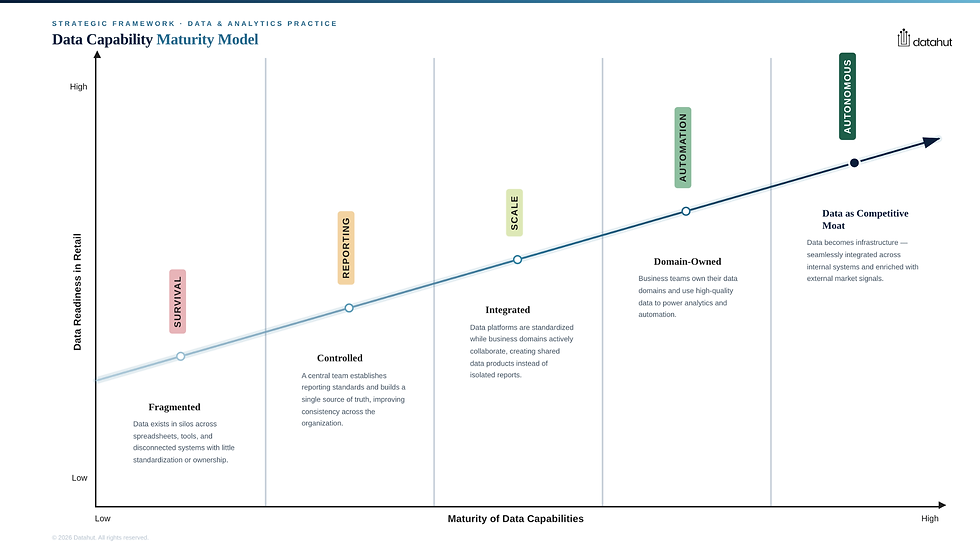
Fragmented
This is the first stage, where data readiness and capabilities are at their lowest. Data lives in disconnected systems, such as spreadsheets, Product information management software, and Shopify. It does not communicate at all, and there is no ownership, no accountability, and the decision-making is mostly reactive without knowing the full story, often on false positives or false negatives. At this stage, the organization is in survival mode. The Latency is high (weeks/months).
Controlled
In the controlled stage, maturity begins to improve . Usually, a central team establishes the standards, schemas, and data reporting structure. This definitely improves data readiness; however, the business readiness remains moderate because the reports live in isolation. Latency is moderate (days to overnight).
Integrated
This stage reflects further progress, platforms are standardised, and shared data products and dashboards replace isolated reports. Business functions operate with cross functional visibility and improved coordination. Latency is low (days/ hours)
Domain owned.
In the domain owned stage, the business teams assume accountability for their data assets, enabling automation and predictive decision-making. The data becomes embedded in production workflows. Maturity changes from merely reporting to actually using it. Near-real time or Zero-latency.
AI acts on events as they happen (e.g., a competitor price drop triggers an immediate automated response).
Data as Infrastructure
Finally, at the far right of the model sits Data as Infrastructure. Here, data maturity and business readiness are both high. Internal systems are seamlessly connected, enriched with external data, and capable of supporting autonomous, AI-driven decisions at scale. At this stage, the data is ready enough that you can move from AI pilots to production without many major bottlenecks.
The model's trajectory is deliberately sequential. Each stage builds structural strength across quality, latency, integration, timeliness, governance, and alignment.
The Cost of Skipping the Foundation
Organizations that try to use AI without improving their data infrastructure face predictable risks.
Wrong decisions
More margin pressure
And at the end, AI initiatives become an expensive experiment that yields negative results. More importantly, you don’t stand a chance against competitors who are doing it right.
Who Should Care
Data readiness is not a technology problem; it is fundamentally a P&L issue and should be seen as one. Pricing Leaders: Depend on trusted external data to protect margins, and even minor inconsistencies can compound into a material financial impact.
Strategy and executive teams: Capital allocation is based on enterprise-wide visibility, and if that visibility depends on immature data foundations, the allocation will be inappropriate.
Merchandising teams need complete, timely product attributes and demand signals to optimize assortments. Without integration, missed trends and excess inventory become problems that affects cashflow.
At advanced stages of readiness, these functions operate with synchronized, trusted data flows. At early stages, they operate with friction and blind spots.
The difference is not incremental. It is systemic.
Why now (and why us)
The rush to become data-ready is intensifying for three reasons.
Margin compression is structural. Retail volatility, from tariffs to supply shocks to shifting consumer demand, requires faster reaction cycles. Delayed insight translates directly into lost margin.
AI‑led discovery is reshaping how customers find and evaluate products. If product and pricing data are inconsistent or poorly structured, brands risk invisibility in algorithmic retail.
Information asymmetry compounds. Retailers that reach higher maturity stages accelerate decision cycles and reduce operational friction. Those that remain fragmented experience increasing drag.
In such an environment, incremental improvement is insufficient. Structural readiness determines strategic positioning.
This is precisely where Datahut operates.
Retailers do not always fail because they lack internal data. They struggle because they lack structured, timely, and decision‑ready external market signals , competitive pricing shifts, assortment gaps, stock‑out patterns, demand signals across marketplaces, and product attribute inconsistencies that weaken AI visibility.
By delivering structured, high‑quality external data feeds, we strengthen the six core dimensions of readiness: improving data quality, enhancing integration, accelerating timeliness, reinforcing governance through standardised datasets, and aligning data directly to pricing, merchandising, and strategy use cases.
We do not ask organizations to rebuild their entire infrastructure overnight. Instead, we provide the market intelligence layer that enables faster margin protection, sharper assortment decisions, and improved AI discoverability, without requiring a full internal platform overhaul.
In other words, while internal maturity must progress sequentially, external intelligence can accelerate the journey.
Retailers that combine disciplined internal data evolution with reliable external market signals move from reaction to anticipation. Those who do not risk operating with incomplete visibility in an increasingly algorithmic market.
About the author:
I’m Tony Paul, founder of Datahut, with over 15 years of experience working in the web scraping industry. We provide Data as a Service" (DaaS) to global retailers and enterprises
My core belief is that most organizations waste resources "re-inventing the wheel" when they should be focusing on the Value Layer (insights and decision-making) rather than the Commodity Layer (maintaining scrapers and infrastructure).
If you’re looking for help with web scraping, pricing, retail data, or anything in between - hit me up. You can connect with me on LinkedIn here: Tony Paul
Frequently Asked Questions
1. Can’t we improve data readiness while simultaneously investing in AI?
Yes — but only if AI initiatives are sequenced appropriately. When foundational gaps in quality, integration, and ownership are ignored, AI projects tend to stall or require costly rework; when readiness improvements and AI deployment are aligned deliberately, each reinforces the other.
2. How do we know which maturity stage we are in?
The clearest signal is operational behavior, not technology inventory. If teams debate whose numbers are correct, rely heavily on manual reconciliation, or struggle to embed insights into workflows, the organization is likely operating in Fragmented or Controlled stages rather than Integrated or Domain‑Owned. Or you can talk to us and figure out.
3. What is the first practical step toward becoming AI‑ready?
Start by identifying one high‑impact business domain — pricing, merchandising, or supply chain — and assess it across the six readiness dimensions: data quality, integration, timeliness, governance, and strategic alignment. Strengthening one domain structurally creates a repeatable blueprint for scaling readiness across the enterprise.